mod@tech

Most automotive analysts agree that the first part of the EV revolution is over. Electric vehicles have become part of everyday life instead of just expensive gimmicks. They are readily available, produced in significant numbers over different segments, and cover almost all types of vehicles. Of course, electric cars still aren’t perfect. They’re still pushed by government grants and initiatives, not just by direct sales, but the industry is getting there.

The next chapter will be highly interesting. This is when electric cars should start being better and faster with longer ranges and driving dynamics to attract car enthusiasts. Due to the enormous amounts of money invested in technology, we can expect that electric cars of the future will be more desirable and true competitors to gas-powered vehicles. So we compiled a list of new electric vehicles that should appear in the next five years. These are electric cars that will push the envelope further and expand our understanding of EVs and their real possibilities.

Photo Credit: GM

Cadillac Celestiq

The car world was puzzled when Cadillac recently announced its $300,000 super-luxury sedan. Once, the “Standard of the World,” they haven’t had much luck in recent years or even decades. But the Celestiq is hopefully here to change all that. Not only is it a stunner, but it’s also already sold out, even at its exorbitant price (via Cadillac).

Photo Credit: GM

That’s right. Although the Celestiq is a 2024 model and future vehicle, GM has already sold two years of production of these hand-built electric cars. With over 600 HP provided by a big battery pack and four electric motors, it will compete with future electric Bentley and Rolls Royce models. Drivers can expect a sublime interior, excellent performance, and a return to American luxury in a big way with this. There’s no doubt it’s one of the most anticipated cars coming soon.

The post Electric Revolution: The Most Anticipated Electric Cars of the Next Five Years appeared first on Motor Junkie.

Car collectors understandably want a great space to store, display, and work on their precious autos. But what if you could combine that space with your home? We’re not talking about a run-of-the-mill house and attached garage. We mean a home with a unique blend of building features for people just like you.

Say hello to the barndominium, a smart alternative to a conventional stick-frame house, especially for collector-car enthusiasts who want to be as close as possible to the possessions they hold so dear. Learn more about a barndominium below, including the numerous benefits it has for car collectors.

Barndominium Basics: What Is It?

Wick Buildings

Here at Wick Buildings, we think of a barndominium as a single-family residential structure built with post-frame construction. That’s also the building technique used for what some call a “pole barn.” In fact, you can think of a barndominium as a pole barn home.

Post-frame construction uses highly engineered, prefabricated laminated wooden columns as well as prefabricated trusses and other building components, which arrive on site ready to assemble.

It’s actually this construction method that makes it more structurally feasible and cost-effective to have a living space and a large open area for your cars all within a single structure. (For more information on post-frame construction vs. stick-frame construction, check out this article.)

Let’s dive into how you can benefit from a barndominium.

5 Barndominium Benefits

With advantages like the following, a barndominium could be the answer for creating a dream home that also incorporates your serious hobby.

1. Enjoy the Convenience of Having Your Cars Close By

Ferrari F430 in a Wick Building

With a barndominium, you won’t have to store your vehicles separately from your home. That means there’s no need to walk down the lane to another building.

Instead, you can have a super-spacious living area connected to the ultimate garage, or garage-mahal. And don’t forget that consolidating buildings can lower your taxable square footage.

But that convenience is really just the beginning of the benefits.

Have Plenty of Room with No Tight Squeezes

A key advantage to a barndominium is that it has less need for interior load-bearing walls. The building’s barn-like expansiveness means ample space for multiple cars and whatever else you may want to include. With no obtrusive columns, you’ll have a much easier time pulling cars in and out. You may even want to include a driving lane.

3. Enjoy a Bigger Space that’s Also More Cost-Effective

Wick Buildings

Once you go beyond a conventionally sized garage, stick-frame construction starts to get more and more impractical, and expensive. On the other hand, your barndominium’s garage space is built with post-frame construction components, a more cost-effective method, particularly when you want a super-spacious garage with more height.

That means having a platform or lift for your cars is more feasible – and so is using the space for taller toys like a boat or RV.

Add Shop Features and Man Cave Must-Haves More Easily

Wick Buildings man cave Vintage truck

A barndominium provides an open floor plan for your living space and for the special area devoted to your cars. In fact, a barndominium enables you to create a comfortable garage area where you’ll want to spend a lot of time.

For example, with all that space you can include shop features like work benches, wall racks, a vehicle lift, a wash bay, and whatever else you need to comfortably work on your cars. Also, by opting to keep this space heated, you can tend to your cars comfortably year round – no long johns or puffy coat required!

Wick Buildings

And what about when you’re not tinkering with your cars? You can still be around them when you’re just kicking back. For instance, by including space for a TV, a couple of couches, and maybe even a bar and kitchen, you’ve got a man cave everyone can enjoy.

5. The Inherent Benefits of Post-Frame Construction

Wick Buildings

●Construction can likely be done faster compared to a typical stick-frame-built house and garage.

●Barndominiums don’t require a basement, which is significant because concrete and excavating costs for a continuous foundation can often be up to 15% of overall project costs.

●Extra-large openings for windows and doors are easier – and less expensive – to construct.

●Additions like overhangs, decks, porches, and even a new wing for additional cars can also be built more easily and cost-effectively.

●Post-frame construction uses larger components in its structures, and the larger the component, the longer the lifespan.

Take the Next Step Toward Your Dream Home

If you’re thinking about building a new house for you and your family, keep your beloved autos in mind by considering a barndominium.

Just know that a barndominium project is by no means simple. The right design, high-quality materials, smart construction practices – these are essential for a functional, cost-efficient, and durable barndominium you can enjoy for years to come.

Could a barndominium be right for you? To find out, take the next step and check out our barndominium page!

Barrett-Jackson’s perennial 2023 Palm Beach auction will be a-happening in Florida before you know it. The April 13-15 event has the same quality and variety of vehicles you’ve seen in our Scottsdale coverage, but with a twist since America is an archipelago of states and subcultures that keeps things interesting. So, what will be interesting in Palm Beach? Here’s some hand-picked vehicles to whet your interest.

1948 Allard L-type Roadster
I’m not familiar with Allards other than they are quite desirable early British sports cars. They were hybrids, most often using Ford and Mercury flathead V8s. though there was a handful of Allard Palm Beach roadsters built with the Chrysler 331 Hemi.

The L-type was a four-seat roadster offered with one of the flatheads, with this one featuring the 221ci Ford. However, this example is a two-seater on the larger 112-inch wheelbase, so perhaps one of you Anglophiles can elaborate if this Allard is more custom and special than others.

1957 Dodge Custom Royal Lancer Super D-500
Among the 1957 Forward Look series, Dodge was arguably the gaudiest but, to these eyes, it also comes off as the sleekest, especially in top-line Custom Royal in Lancer two-door hardtop dress. Doesn’t it look like it’s ready to take off into the air? The Chrysler 300-C may be king, but the Dodge has its charms.

Even more charming is the engine in this one: the Super D-500, which was a dual-quad Red Ram 325 Hemi putting out 310 horsepower. Backed by Chrysler’s famed TorqueFlite, this pushbutton Dodge is the one to have.

1969 Dick Harrell Camaro
You may be familiar with 427 COPO Camaros but, before those existed, several performance-oriented shops and dealerships were transplanting 427s in place of 350s and 396s. Yenko, Nickey and several others seem to garner all the glory, but it was drag racer Dick Harrell who was hired by both dealerships to develop 427 Camaro conversions.

This 1969 Camaro SS is an original Dick Harrell Performance Center conversion. Starting out as a Rallye Green “X66” 396 Camaro, Harrell’s shop dropped in a 427, added an aftermarket Stinger hood with striping from head to toe, Kelsey-Hayes Stripper mags wrapped in offset Goodyear Polyglas tires, and whatever else the original owner specified.

1980 Jeep J10 Honcho Pickup
When I was a kid, Jeep pickups were not common. Looking online, one resource shows 6,839 built, so it stands to reason, though no mention whether that’s model year or calendar year. The Honcho trim package added fancy white wheels, striping, black and chrome grille and more.

Supposedly, only 1,264 Honchos were built from 1976-83, and here’s a nice ’80 that’s had a frame-off restoration. Power comes from AMC’s capable 360 backed by a three-speed automatic. Some liberties have been taken with the resto, but no one can deny it looks good, especially with that denim interior.

To see more of what’s on Barrett-Jackson’s Palm Beach 2023 docket, visit www.barrett-jackson.com.

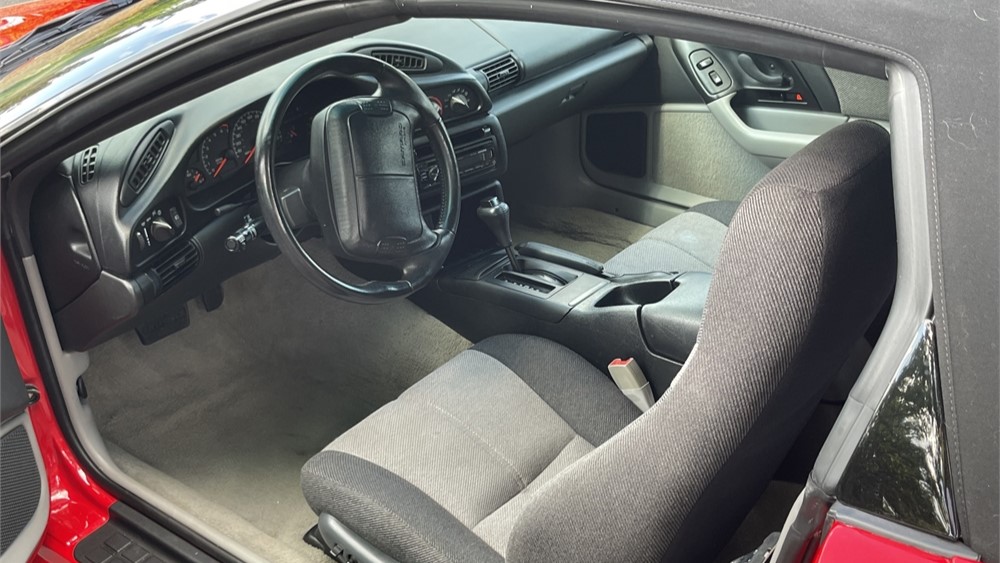
The 1980s were a transition period for the muscle car segment. Domestic automakers were having to adjust to new emissions standards. Gone were the days of the open-throttle 454 V8s and other large engines that dominated previous years. Instead, there were cars like the third-generation Camaro with all kinds of emissions control parts strapped to the engine. These ‘enhancements’ did nothing positive for performance. There were some workarounds that automakers managed to find such as Ford did with the Mustang SVO.

For the most part, the ’80s muscle cars should mostly be avoided at all costs due to their lack of performance. But there are a few worth considering nevertheless. We looked at some of the best and worst that came out during this transitional period. The 1980s were known for big hairstyles, loud music, and of course the T-Tops. The ’80s will forever be remembered for their unique place in the history books as a result of many strange aspects. However, they won’t necessarily be remembered because of their muscle cars outside of a few rare models. Check out the few best and some of the worst the unique era offered right here.

Photo Credit: Mecum

1982 Chevrolet Camaro Z/28

The 1982 Chevrolet Camaro Z/28 is a classic American muscle car that was produced by the Chevrolet division of General Motors. It was part of the third generation of Camaros produced from 1982 to 1992. The Z/28 was a high-performance version of the Camaro designed to compete with other muscle cars of the time like the Ford Mustang and the Dodge Challenger (via Motor Trend).

Photo Credit: Auto WP

The 1982 model year was the first year that the Z/28 was available with a fuel-injected engine, which was a significant improvement over the carbureted engines of previous years as a result. The Z/28 also had a sport-tuned suspension and a special body kit that made it stand out from other Camaros. Therefore, the IROC-Z had potential, but the car had limited appeal due to its style and the emissions standards of the day.

The post Back To The Future: Timeless 1980s Muscle Cars Drivers Should Actually Buy appeared first on Motor Junkie.

This 1940 Ford Deluxe coupe was refurbished in approximately 2004 and is powered by a 454ci V8 paired with a three-speed automatic transmission. The car is finished in orange with flame graphics over tan leather upholstery. Additional equipment includes a Holley carburetor, a Tuff Stuff alternator, a Walker radiator, American Racing wheels, power rack-and-pinion steering, front disc brakes, a painted grille, air conditioning, and power windows. The car was recently acquired by the seller, and the tires were reportedly replaced and fluid services were performed in preparation for the sale. This Deluxe coupe is now offered with a conditional Georgia title in the seller’s name.

The car is finished in orange with contrasting flame-style graphics and chrome trim. The bumpers have been removed, and additional details include a split windshield and rear window, a painted grille, body-color running boards, quadruple side mirrors, and dual polished exhaust outlets.

Five-spoke staggered-diameter American Racing wheels are mounted with 185/70 front and 285/70 rear General Altimax tires. The car is equipped with power-assisted rack-and-pinion steering and adjustable coilover front suspension. Stopping power is provided by front disc and rear drum brakes.

The replacement bucket seats are trimmed in tan leather upholstery and feature flame-style stitching on the headrests. Appointments include power windows, orange lap belts, air conditioning, a fire extinguisher, and aftermarket speakers. The seller states the stereo works intermittently.

The banjo-style three-spoke steering wheel is mounted on a replacement tilting column and frames VDO instrumentation including a 120-mph speedometer and supplementary gauges. A Sunpro tachometer is mounted below the dashboard. The five-digit mechanical odometer shows 28k miles, a handful of which have been added under current ownership. Total mileage is unknown.

The 454ci V8 was installed during the refurbishment and is fitted with a Tuff Stuff alternator, a Walker radiator, and a Holley carburetor with an electric choke. An oil change was performed in preparation for the sale.

Power is sent to the rear wheels via a three-speed automatic transmission. Additional underside photos are provided in the gallery.

A VIN of 18-5757378 is shown on the replacement tag above, which matches the VIN on the current conditional Georgia title.

This 1940 Ford Coupe is powered by a replacement 289ci Ford V8 mated to a C4 three-speed automatic transmission and is finished in copper over brown and tan upholstery. The car was modified under previous ownership and features painted pinstriping and flames, a Mustang II-style independent front suspension setup, a Jaguar-style independent rear suspension setup, adjustable rear coilovers, power steering, power four-wheel disc brakes, and 15″ knock-off wire wheels along with air conditioning, Stewart Warner instrumentation, a billet distributor, an Offenhauser intake manifold, and a Holley four-barrel carburetor. This Ford street rod was acquired by the seller in 2022 and is now offered with spare color-matching paint and a clean Wisconsin title in the seller’s name.

The steel body is finished in copper and is said to have been painted under previous ownership. Features include painted pinstriping and flames, a split windshield and rear window, a third brake lamp, a power antenna, electric wipers, tinted windows, running boards, polished exhaust finishers, a bright metal grille, chrome bumpers with front overriders, and aftermarket headlamps with inset LED turn signals. There are paint bubbles on the left and right drip rails.

The 15″ chrome wire wheels are secured with three-eared knock-off centers and are mounted with Goodyear Fortera tires measuring 205/70 up front and 235/70 out back. Two full-size spares are stored in the trunk. The car has been modified with a Mustang II-style independent front suspension, a Jaguar-style independent rear suspension, adjustable rear coilovers, and a power-assisted Flaming River rack-and-pinion steering system. Braking is handled by power-assisted discs at all four corners.

The front bench seat is upholstered in brown vinyl with tan cloth inserts joined by matching trunk upholstery and door panels. There is a hidden storage compartment behind the seat. Equipment includes air conditioning, lap belts, pinstriped dashboard accents, aluminum pedals, and an aftermarket cassette stereo.

The three-spoke steering wheel frames a Stewart Warner 160-mph speedometer and auxiliary instrumentation. The five-digit mechanical odometer shows 18k miles, approximately 500 of which were added under current ownership. Total mileage is unknown.

The replacement 289ci Ford V8 was installed under previous ownership and features a billet distributor, an electric fuel pump, an Offenhauser intake manifold, a Holley four-barrel carburetor, and Cobra-branded finned valve covers. Cooling is handled by an aluminum radiator with an oversized electric fan. The rear of the engine leaks oil. A 16-gallon poly fuel tank has been installed.

Power is sent to the rear wheels through a C4 three-speed automatic transmission.

A replacement VIN tag reads 185327477, which is consistent with a 1940 Ford and corresponds with the VIN listed on the Wisconsin title.

Today’s AutoHunter Cinema feature is a 2005 Chevrolet SSR. The SSR featured unique retro styling was famously inspired by Chevrolet’s late 1940s Advance Design trucks. Every SSR came equipped with a power-retractable hardtop and a color-matched tonneau cover that made it stand out even more than the retro styling. This particular SSR is finished in black over black and powered by a Whipple-supercharged 6.0-liter LS2 V8 engine paired with a four-speed automatic transmission, plus limited-slip differential. The stock LS2 SSR was rated at 390 horsepower, capable of giving the SSR 0-60 performance of 5.29 seconds, so you can imagine how quick a supercharged SSR could go.

Watch more AutoHunter Cinema videos, and get updates on the latest by subscribing to the YouTube channel.

Today’s AutoHunter Cinema feature is a 2005 Chevrolet SSR. The SSR featured unique retro styling was famously inspired by Chevrolet’s late 1940s Advance Design trucks. Every SSR came equipped with a power-retractable hardtop and a color-matched tonneau cover that made it stand out even more than the retro styling. This particular SSR is finished in black over black and powered by a Whipple-supercharged 6.0-liter LS2 V8 engine paired with a four-speed automatic transmission, plus limited-slip differential. The stock LS2 SSR was rated at 390 horsepower, capable of giving the SSR 0-60 performance of 5.29 seconds, so you can imagine how quick a supercharged SSR could go.

Watch more AutoHunter Cinema videos, and get updates on the latest by subscribing to the YouTube channel.

The NHRA Lucas Oil Drag Racing Series held its last event at the famous Houston Raceway Park last weekend. The Texas dragstrip is set to close after hosting a final HPT Shootout event on April 1st. One could only wish this was an April Fools’ joke.

On July 14, 2021, Houston Raceway Park and the NHRA announced that the facility will permanently be closing after the 2022 NHRA SpringNationals event. The property is set to be repurposed for an industrial business park expansion. However, an extended contract allowed the Houston Raceway to schedule events through the spring of 2023. Now, it’s time is up.

As posted on the Houston Raceway Park’s Facebook page, “The end of an era is on the horizon for Houston Raceway Park. Following our spring 2023 race calendar, we will turn the page in history, when we officially close the doors to drag racing in Baytown, TX. It has been an amazing 35-year run. Simply put, thank you to our fans, our sponsors, and all our stakeholders who were integral in our drag racing journey.”

The Houston Raceway Park’s quarter mile drag strip that was once called the Royal Purple Raceway opened in 1988. The expansive facility has seating capacity for over 30,000 spectators and its pit area holds around 400 race cars. The drag strip also has a three-story building that accommodates 23 VIP suites, race control facilities and a media center. Its sea-level location at the top of Trinity Bay creates an oxygen-rich environment perfect for racing, and the track has a renowned reputation for being one of the fastest tracks on the NHRA circuit.

Many special moments in racing history went down at the Houston Raceway. The NHRA saw its first four-second run at 4.99, set by Gene Snow in 1988, shortly after the track opened. That record was beaten on the same day by Eddie Hill with a 4.93-second run during the final round of Top Fuel racing. The raceway also saw first-time victories for future multi-time world champions Scott Kalitta and Jeg Coughlin Jr., Michael Phillips becoming the first African American to win in a pro category in 1997, and Larry Dixon’s first quarter-mile pass under 4.5-seconds in 1999.

Top Dragster racer Jessica Ogden took to her Facebook page with final thoughts around the racetrack’s closing: “This track has been such a big part of my life as it has been for many others! Leaving today, for the very last time, was bittersweet and I’m still in disbelief that I will never be able to go back to that track. Houston Raceway Park is where it all started for me, from watching my dad race to me starting in juniors and working my way up to big cars. So many memories made here that I’m forever grateful for. We will miss this home track dearly.”

When the NHRA Lucas Oil Drag Racing Series event came to a close, announcer Chris Monaghan gave an emotional sendoff that was shared on CompetitionPlusTV’s YouTube channel. Turn up the volume:


Announcer Chris Monaghan delivers emotional goodbye to Houston Raceway Park, one final time

www.youtube.com