
Last month, Ventura Nationals rolled into town over Labor Day weekend at the Ventura County Fairgrounds. Starting in 2003, it’s one of the biggest and best shows on the West Coast and encapsulates all aspects of automotive culture with hot rods, custom paint, restorations, live music, and vendors. Sprawled out over sixty-two acres, Ventura Nationals packed classic cars and vintage trucks in while…
This 1938 Plymouth Deluxe coupe is powered by a GM 6.0-liter Vortec V8 that was installed prior to the current owner’s acquisition in May 2017. The car wears a three-tone silver-blue-maroon paint scheme and features a 6L90 six-speed automatic transmission mated to a 8 3/4″ rear end with 3.24:1 gears. Additional modifications include chrome American Racing 15″ Torq Thrust wheels, Wilwood four-wheel disc brakes, a Mustang II-style front suspension, power steering, Vintage Air heating and air conditioning components, gray leather bucket seats, electric windows, Speedhut instrumentation, and a Kenwood AM/FM/CD stereo. This modified Plymouth Deluxe is offered on dealer consignment with a Delaware title.
The car was finished in its current metallic blue and silver under previous ownership and features a silver-accented maroon stripe at the beltline. Additional exterior details include a chrome grille and bumpers, dual side mirrors, running boards, a split rear window, and dual exhaust outlets. Additional close-up images detailing the lighting, badging, and trim are provided in the gallery below.
American Racing 15″ Torq Thrust wheels are mounted with 215/75 front and 235/75 rear Kumho Solus KR21 tires. A Mustang II-style front suspension has been retrofitted to the car as well as power steering. Braking is handled by Wilwood slotted and cross-drilled discs at all four corners.
The interior features gray leather-trimmed front bucket seats and a rear bench sourced from a later model vehicle along with a two-tone center console and door panels. The painted metal dashboard houses a control module for the Vintage Air climate control system and a Kenwood head unit. Other amenities include gray carpets, electric windows, and cupholders. Wear is visible on the driver’s seat and center console.
The three-spoke steering wheel sits ahead of centrally-mounted Speedhut instrumentation that includes a GPS-enabled 80-mph speedometer with an inset tachometer and auxiliary gauges. The digital odometer shows 11k miles, approximately 3k of which were added during current ownership. True mileage is unknown.
The engine compartment is finished in maroon and houses a GM 6.0L Vortec V8 with an aftermarket air intake and LSX-branded covers. Power is sent to the rear wheels through a 6L90 six-speed automatic transmission and a 8 3/4″ rear end with 3.24:1 gears. An oil change was carried out in preparation for the sale.
Additional images showing the condition of the underside are included in the gallery below.
The car is titled in Delaware using a state-assigned VIN, 1285099, shown above.
The Delaware title shows a “Mileage Exceeds Mechanical Limits” brand.
Haltech World Cup Finals Import vs Domestic presented by WiSECO will take place at Maryland International Raceway on November 1-5, 2023. The CarShowz crew will be in attendance to cover the event. Stay tuned here for coverage and a recap of the event, here. More About Haltech World Cup Finals Import vs Domestic The 27th […]
The post Haltech World Cup Finals Import vs Domestic appeared first on CarShowz.com.
The “Herbie” Volkswagen Beetle captured the hearts of a generation with its unforgettable adventures on the silver screen. But there’s more to Herbie than meets the eye. Beyond the distinct white racing stripes and lovable demeanor, the Herbie VW Beetle boasts a rich history that has left an indelible mark on pop culture. This spunky car made its debut in the 1968 film “The Love Bug” and quickly became a symbol of automotive joy and enthusiasm. The original Herbie, a 1963 Volkswagen Beetle, was sold at an auction for $126,500.
Herbie was known for his unique personality, displaying emotion through the positioning of his headlights and lovable horn honks. These playful quirks added a layer of endearment to the character that resonated with audiences worldwide. In this article, we’ll peel back the nostalgia and uncover the untold stories, quirks, and surprising tidbits that make this car an enduring symbol of automotive magic. So, fasten your seatbelts and join us to discover the unexpected facts about Herbie, a truly one-of-a-kind Volkswagen Beetle.
There Was a Chance Herbie Wouldn’t Be a Volkswagen
Although the Volkswagen Beetle fit the personality of Herbie quite well, there was a rumor that it almost didn’t happen. Producer Bill Walsh had a few other ideas in mind for the movie. There was a Toyota, Volvo, and even an MG lined up. But when all was said and done, the Beetle seemed to fit the part perfectly. The spunky little car, looking back, was a great choice. The Herbie franchise wouldn’t have been the same without the Beetle (via Auto Evolution).
The fact that there were a few options for Herbie just further complicates the complex history of this car. Nevertheless, the Herbie VW Beetle is by far one of the most iconic movie cars of all time. The cute little Beetle changed the way that we looked at the iconic Volkswagen. Before Herbie, there wasn’t a modern racing franchise associated with the car.
The post Surprising Facts About The Legendary “Herbie” Volkswagen Bug appeared first on Motor Junkie.
One of the biggest indicators that the car industry is constantly improving is the rapid evolution of performance. The relentless quest for speed has inspired many engineers to make cars faster and more exciting, especially when it comes to sports cars.
However, while many car fans believe that all sports cars are fast, this just isn’t the case. There are more than a few sports car models that are downright disappointing due to the fact they’re ridiculously slow. We chronicled those engineering failures, so find out which cars attempted to create speed and failed right here.
Matra Bagheera
For decades, French company Matra delivered innovative solutions, and new technologies while working with some of the biggest names in the industry. In cooperation with Simca in the early 1970s, Matra decided to produce a small sports car for the European market. Called the Bagheera, this three-seater was introduced in 1973 (via Hagerty UK).
The Bagheera had three seats up front. Even though it was very compact, three people could sit comfortably next to each other. Unfortunately, the power came from diminutive 1.2 and 1.4-liter engines that didn’t provide any exhilarating performance. However, with three seats and some French charm, the Matra Bagheera was a moderate success.
The post Failure To Launch: Sports Cars That Disappointed Performance Fans appeared first on Motor Junkie.
The automotive industry evolves faster than just about any other industry. Every year, new advancements and models hit the roads. Companies like Tesla are changing the way we drive while the old guard of Ford, GM, and Chrysler continue to try and stay relevant heading into 2024 and beyond. Some cars have been on the road for decades now. But even a good ride with solid sales numbers has to reach the end of the road at some point.
With places like California outlawing gasoline-powered vehicles in a few years, there isn’t room for a lot of these older models. The choice for cars has never been wider and these models are becoming long in the tooth. While it’s sad to see some pioneering models hit the road, it also opens the door for innovation. The next generation of cars and trucks will be even better and more efficient than ever before. Join us as we look at the cars and trucks that are calling it quits for the 2024 model year.
Audi TT & TTS
The Audi TT has been around for a long time. It was one of the original new-generation style sports cars that came out in the late 1990s. And if the styling looks familiar, it’s because Volkswagen was utilizing that type of design language in 1998 with all of their cars. Nevertheless, the TT became a surprise hit and spurred new interest in Audi. The car had a reasonable run in the racing circuit and it did quite well on sales as well. Nevertheless, the TT is long in the tooth so Audi will discontinue all variations of the car for 2024 (via Team BHP).
The TT was a notable car because of its traction control and the power plant under the hood. There wasn’t anything overly powerful about the TT but it did manage to crave a niche for itself. The convertible version was also a fun little roadster that took the twists and turns like a professional track car. All in all, the build quality of the TT is something most sports cars can’t compete with.
The post These Cars & Trucks Will Be Gone Forever In 2024 appeared first on Motor Junkie.
The post Auto Shows in Walkersville, MD on te% appeared first on CarShowz.com.
This is the 2023 Toyota Sequoia, potentially the best full-sized SUV on the market today. Our $77,784 MSRP test vehicle boasts power from the optional i-FORCE MAX twin-turbocharged 3.4-liter V6 hybrid system that produces 437 horsepower and 583 lb-ft of torque. Paired with a 10-speed automatic transmission with sequential shift, this Toyota tank hits a sweet spot between traditional Yankee utility and modern efficiency. Like previous generations, the Sequoia is based on the Toyota Tundra Pickup truck and excels as a main battle tank, but I suppose it could be used as a family vehicle or motivated people mover. The base trim sequoia SR5 starts at $59,865.
Exterior
Before I begin with the exterior features, we should talk about the Easter egg on the passenger side windshield. If you look closely at the windshield stippling, there is a line of Morse code near the Toyota Truck logo in the bottom corner. This reads “Badass Trucks” and is something you can find on the Toyota Tundra as well. Our Silver Metallic Sequoia has aggressive butch styling, with 8.6 inches of ground clearance to provide 15/20 approach departure angles in the event you want to go off road. In front, the Platinum features trim with a dark accented chrome mesh grille with chrome surrounding it. Just behind the grille are active grille shutters, a cool piece of technology to improve vehicle operating temperature characteristics and aerodynamics. You’ll also find auto leveling LED headlights with LED daytime running lights. A standard feature on the Platinum Sequioa, that comes optional on the Limited trim, are the sequential turn signals on the front and rear that are a pleasant cosmetic addition, though admittedly, not necessary. The Platinum features 20-inch dark painted alloy wheels, but if you want them even bigger, opt for the top-tier Capstone trim’s 22-inch wheels. This Sequoia features the $1,000 extra power extending running boards over the fixed boards, which is up to personal preference, but the power folding boards could also slightly improve aerodynamic efficiency. As with most manufacturers, you’ll also find an array of color keyed or piano black options which vary on trim level to provide a premium appearance.

Interior
As a full-size SUV, it comes as no surprise that the interior is spacious but done well with a variety of functionality. The Platinum features seating for seven thanks to the second-row captain’s chairs over a standard bench, and there are eight seat options available in other trims. All the seats are trimmed in leather, yes, that includes the third row. The Platinum trim features heated and ventilated front AND rear seats, which is impressive, along with three zone climate control, split for the front and universal for the back seats. For the technology, the Platinum features a massive 14-inch multimedia display with Apple CarPlay and Android Auto funneled through a 14-speaker JBL audio system. The driver gets a 12.3-inch gauge cluster display which has adjustable multi-information displays for your preference, and additional options include a $6,000 heads-up display that Toyota implements well.

Power and Performance
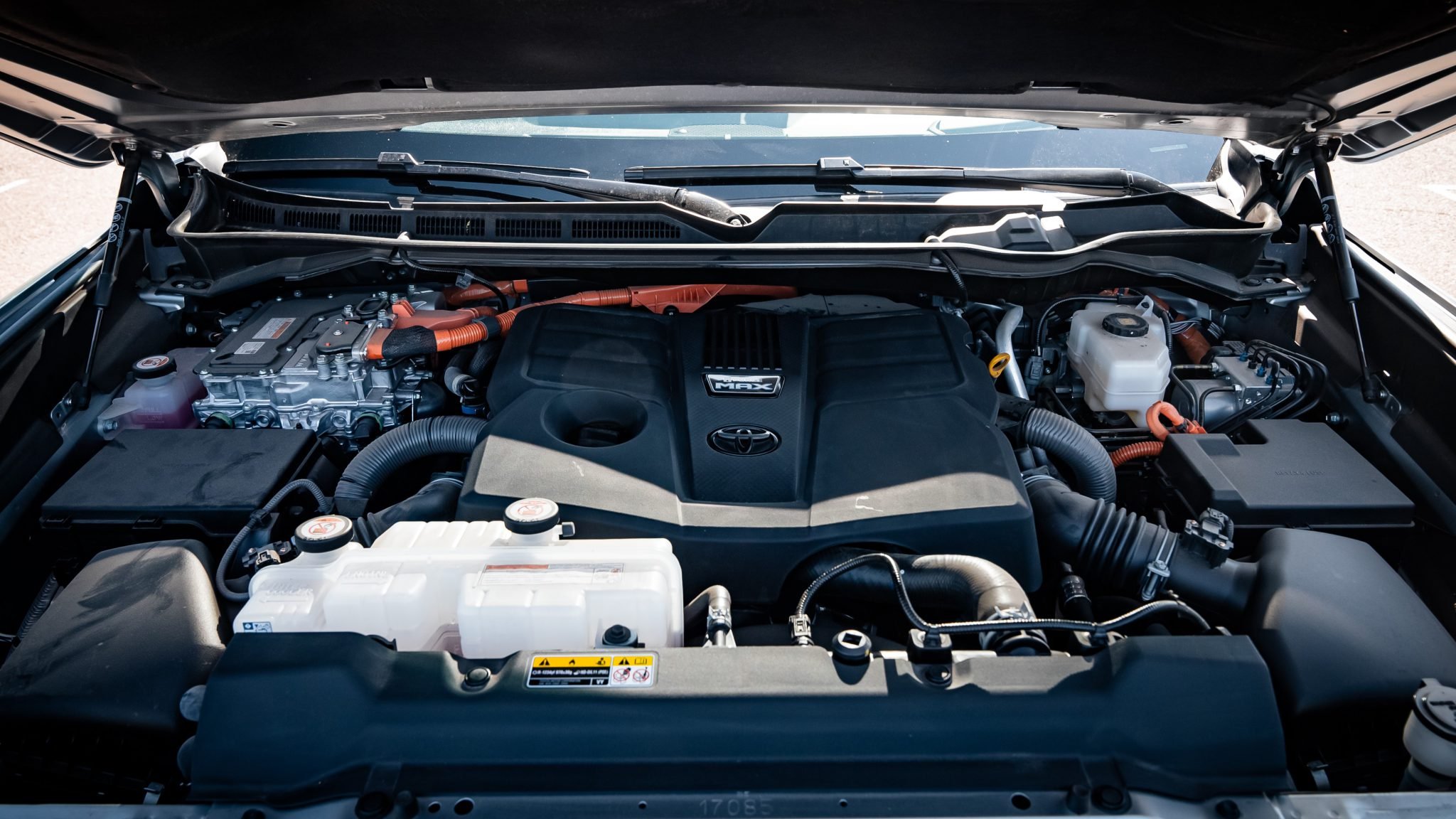
Pop the hood and you will find an engine, but more Easter eggs as well. The passenger side headlight features an outline of Michigan with the letters “R&D” for Toyota’s research and development headquarters. There’s also an outline of Texas with the word “Born” signifying the Toyota factory where it’s built alongside the Toyota Tundra. Power comes from an i-FORCE MAX twin turbocharged 3.4-liter V6 hybrid, the optional Tundra powerplant which produces 437 horsepower and 583 lb-ft of torque and is paired with a 10-speed automatic transmission with sequential shift. The hybrid powertrain is standard across all trim levels and comes as a huge improvement over the previous generation Sequoia V8. The Sequoia’s standard drive mode is two-wheel drive but can be kicked in to 4WDemand (part-time four-wheel drive) thanks to an electronic transfer case and even offers a limited slip differential. Weighing in at 5,855 pounds, the Sequoia achieves 0-60 in just 5.6 seconds, an impressive feat for such a massive vehicle. All that grunt also presents towing capabilities with a max towing capacity of 9,310 pounds for the platinum along with drive mode select and tow/haul modes. All this power comes with a cost and an EPA fuel rating of 19 mpg city / 22 mpg highway / 20 combined, with the 22.5-gallon fuel tank, this gives you an estimated 450 miles of range. If you stay out of the turbocharged boost. Not bad when you consider the size of the vehicle, but it’s not good fuel economy either.
Drive
The Sequoia drives like a tank. You have the benefit of high-up visibility through an upright windshield and massive tow mirrors, but a glimpse in the rearview mirror reminds you of the sheer size of the Sequoia. Thankfully the Platinum has a digital rearview mirror that I find helps improve visibility. Under-accelerating and braking the Sequoia exhibits a fair amount of body roll forwards and backward but seems mitigated in lateral movement relatively speaking when turning. The acceleration is smooth with no shortage of power, and the brakes are strong as expected for such a heavy vehicle. The main note for driving is the massive size of the vehicle means you must pay more attention to keeping the vehicle in lanes and when parking, which can be a challenge and may not be suitable for less confident or less skilled drivers.
Conclusion
If you get anxious driving or have trouble parking this is not for you. There is an all-conquering presence that is hard to dispute, and the crazy amount of storage and compartments gives the 2023 Toyota Sequoia a great argument as a family hauler.
Muscle car fans know that real performance cars often have their own cues that establish their levels of insane performance. These include massive hood intakes, spoilers, racing stripes, and aggressive stances. The rumble of the exhaust might just be the biggest indicator of true speed. However, some unique cars were both fast and desirable. These luxury coupes delivered a huge level of performance luxuriously.
These rides weren’t necessarily flamboyant or loud. They were models that appealed to customers who wanted luxury but craved performance. The best of luxury coupes were notorious for their ability to cocoon the driver in luxury but provide it with enough firepower to beat Mustangs at the stoplight. Find out which luxury coupes featured massive performance right here.
Mercury Marauder X100
Today, the Mercury brand is defunct. But back in the ’60s, it was a well-respected luxury division above the working-class Ford and just below Lincoln. Mercury did well in the muscle car segment with the Cougars and Cyclone. Luxury performance models were scarce until 1969 when a new generation of the Marauder left the factory. Imagined as a luxury coupe, the Marauder had a fresh design with new features like concealed headlights, a massive front end, and a sloping rear end with concave glass (via Hemmings).
It was a big, heavy car intended for cruising rather than racing. However, Mercury needed something to fight the Pontiac Grand Prix and Buick Riviera GS. They needed to upgrade the Marauder to higher spec if they wanted a piece of the action. So the Marauder X100 was made. Behind the strange name was a regular 1969 Marauder but with a 429 V8 engine with 360 hp, bucket seats, heavy-duty suspension blackout rear trim, and fender skirts.
The post Sculpted For Speed: Luxury Coupes That Tore Up The Roadways appeared first on Motor Junkie.
This 1936 Ford pickup was fitted with a 351ci V8, a four-speed AOD automatic transmission, and independent front suspension before being acquired by the seller in 2020. The truck has been repainted in burgundy with black fenders over a red interior and is equipped with 15″ black-painted steel wheels, front disc brakes, rack-and-pinion steering, a tilt-out windshield, a wood-lined cargo floor, a dual exhaust system, an aftermarket bench seat, and Dolphin gauges. This Ford pickup is now offered with an Idaho title.
The body was refinished in burgundy with black fenders and running boards under prior ownership. Exterior details include tinted windows, a tilt-out windshield, a wood-lined cargo floor, and an electric cowl air vent. The rear fenders were covered with gloss black 3M vinyl after the left fender was damaged by a bird.
The 15″ black-finished steel wheels wear bright hubcaps and 205/60 Cooper Tires CS5 Grand Tour tires. Mustang II-style independent front suspension components have been installed in addition to rack-and-pinion steering and front disc brakes.
The cabin features an aftermarket bench seat upholstered in red and fitted with lap belts for two occupants, along with red door panels and carpets. Vintage Air climate control has been added, and the air conditioning does not function.
The four-spoke steering wheel is mounted to a LimeWorks column and fronts aftermarket Dolphin gauges that consist of a 140-mph speedometer along with auxiliary readouts for coolant temperature, voltage, fuel level, and oil pressure. The six-digit odometer shows 8k miles, approximately 6k of which have been added under current ownership. Total mileage is unknown.
The 351ci Ford Windsor V8 is equipped with aluminum cylinder heads, a Holley carburetor, a Pertronix ignition system, tubular headers, and an aluminum radiator. An oil change was performed in June 2023, and the air conditioning compressor belt was installed in preparation for the sale.
Power is sent to the rear wheels through a four-speed Ford AOD automatic transmission. A dual exhaust system with Magnaflow mufflers has been added. Additional underside images are provided in the gallery.
There is currently a lien on the truck, and the seller’s lender will need to be paid off before the title can be transferred to the new owner.