Journal Classic Cars

Category Added in a WPeMatico Campaign

Rolls-Royce has revealed its latest bespoke car, the “Pearl Cullinan,” a pearl-themed take on the Cullinan SUV commissioned by a customer as a 90th birthday gift for his father.

Commissioned by the customer in 2022, the Pearl Cullinan is the first bespoke Rolls-Royce from the automaker’s Private Office Dubai, a dedicated office handling customers in the Middle East.

The exterior is finished in an exclusive Pearl Rose paint finish inspired by a pearl from the owner’s collection, and it won’t be available to other customers. It required 30 iterations, all tested on full-size body panels. These were placed under lamps to simulate how the paint would look under the Middle Eastern sun, while ultraviolet testing was done to ensure it would hold up to that strong sunlight. The paint is accented by a hand-painted rose gold pinstripe, along with a rose gold-plated Spirit of Ecstasy hood ornament and tread plates.

The interior features two different leather colors: Cashmere Gray for the front seats and Ardent Red for the rear seats. The latter references the color of the material on which pearls are traditionally presented to customers, while the burr walnut wood veneer is inspired by the wooden presentation boxes in which pearls are traditionally given to customers.

Rolls-Royce Pearl Cullinan

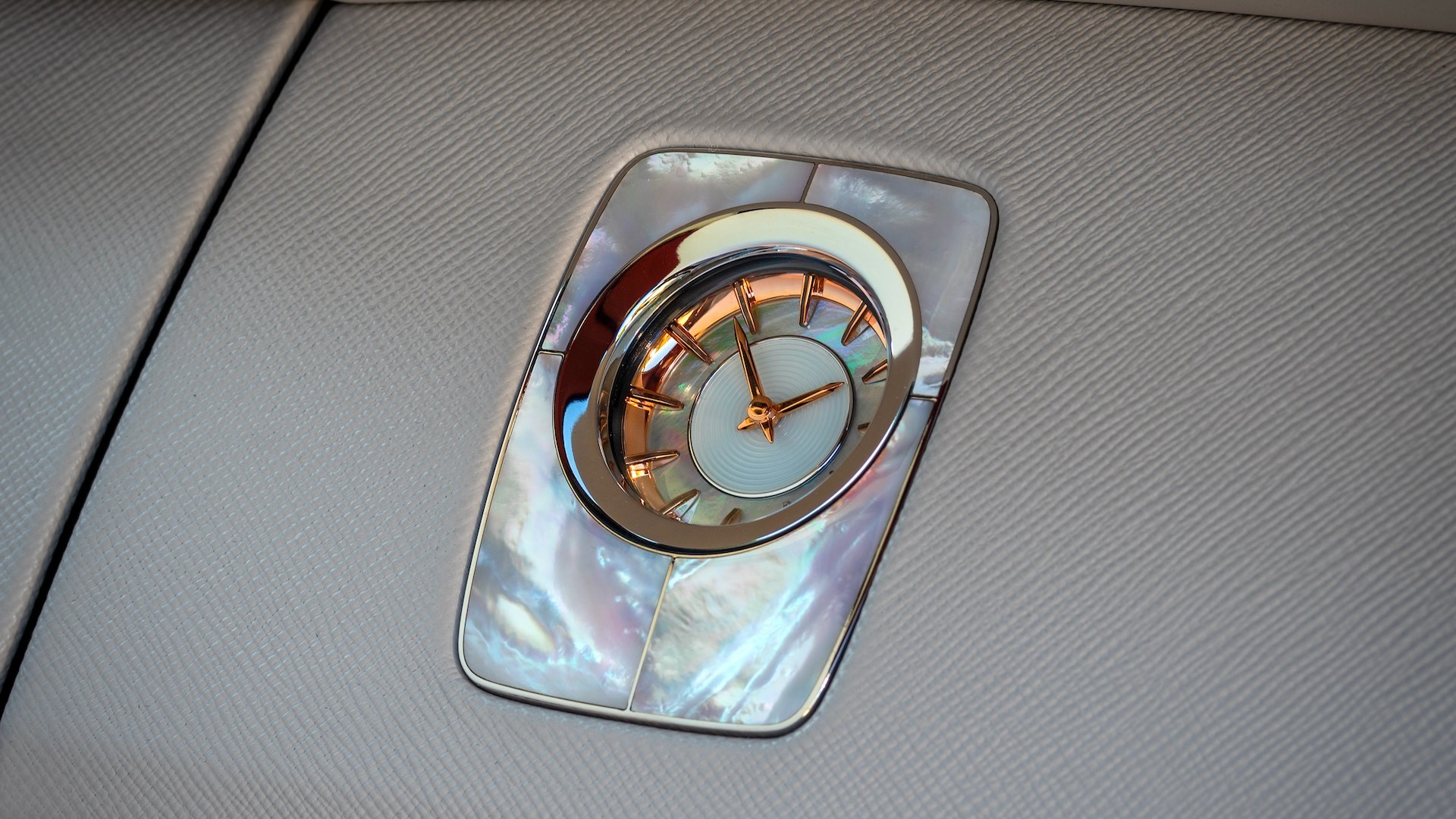
Living up to its name, the Pearl Cullinan also features the most mother-of-pearl in any Rolls-Royce production car. Each of the rear picnic tabletops is layered with 1,351 separate pieces of mother-of-pearl—all selected and placed by hand. The dashboard fascia has a mother-of-pearl inlay, as well as the Arabic word for “father” in stainless steel. The dashboard clock is set in a mother-of-pearl surround with a rose gold dial and hands. The Starlight Headliner also shows the sky as it appeared on the night the customer’s father was born.

One-off commissions are standard operating procedure at Rolls-Royce. The automaker also recently built a pink Ghost for a an Internet personality, as well as the Phantom Syntopia, a one-off so complex that it took four years to build.

For buyers with extra-deep pockets, Rolls-Royce can build a car totally unrelated to any model in its lineup. These are coachbuilt specials, the most recent of which is a car known as the Droptail.

HIGH-RES GALLERY: Rolls-Royce Pearl Cullinan

This article was originally published by Motor Authority, an editorial partner of ClassicCars.com

Featured on AutoHunter, the online auction platform driven by ClassicCars.com, is this 1994 Toyota Supra Turbo.

The first mention of the Supra name in the automotive world came about in the late 1970s in Japan, where it was launched as a variant of the compact Celica liftback. The Supra became a popular performance car – particularly in the “tuner” communities – because of its agile handling, capable drivetrains, and strong aftermarket support. These days, finding an unmodified Supra is no easy task, and finding an original with fewer than 50,000 miles on the odometer is even more challenging. That’s where today’s Super White 1994 Supra Turbo comes in: This car is being offered on AutoHunter by a private seller in Arcadia, California, and the auction ends this coming Wednesday.

Today’s Supra comes from the fourth generation which launched with the “A80” body in model year 1994. Chassis components at the time were shared with the first-generation Lexus SC coupe (sold as the Toyota Soarer in Japan). This Supra has somehow survived for the last 30 years without being modified. The CARFAX report also shows California-kept ownership all its life, with no accidents or damage on record. A new owner was reported about three years ago, and the history overall is squeaky clean.

The Supra was offered with two different inline-six powerplants: One was the 3.0-liter 2JZ-GE, and the other was a 3.0-liter 2JZ-GTE with twin turbos. The latter was capable of 320 horsepower and 315 lb-ft of torque. Toyota and Lexus shared this architecture for a number of years. In fact, my brother’s 2002 Lexus IS300 that was recently raced at No Fly Zone in Arizona has a 2JZ-GTE motor. His entire “brand” on social media centers around the “Two Jay” name for that reason.

While the Supra could easily be put to use as an all-out race car, it also catered to the grand-touring crowd – especially when outfitted with the optional four-speed automatic transmission as seen in today’s feature car. The roof has a color-matched removable panel for an open-air feeling, and the cabin is appointed with leather upholstery and automatic climate control.

You could argue that this car offers the best of multiple worlds: It has a performance-bred (yet reliable) twin-turbocharged heart, the sexy looks of a sports car, and the comfort and conveniences of a long-distance highway cruiser. You won’t find an opportunity like this very frequently. Check it out!

The auction for this 1994 Toyota Supra Turbo ends Wednesday, November 15, 2023, at 12:15 p.m. (MST)

Visit the AutoHunter listing for more information and photo gallery

Featured on AutoHunter, the online auction platform driven by ClassicCars.com, is this 1994 Toyota Supra Turbo.

The first mention of the Supra name in the automotive world came about in the late 1970s in Japan, where it was launched as a variant of the compact Celica liftback. The Supra became a popular performance car – particularly in the “tuner” communities – because of its agile handling, capable drivetrains, and strong aftermarket support. These days, finding an unmodified Supra is no easy task, and finding an original with fewer than 50,000 miles on the odometer is even more challenging. That’s where today’s Super White 1994 Supra Turbo comes in: This car is being offered on AutoHunter by a private seller in Arcadia, California, and the auction ends this coming Wednesday.

Today’s Supra comes from the fourth generation which launched with the “A80” body in model year 1994. Chassis components at the time were shared with the first-generation Lexus SC coupe (sold as the Toyota Soarer in Japan). This Supra has somehow survived for the last 30 years without being modified. The CARFAX report also shows California-kept ownership all its life, with no accidents or damage on record. A new owner was reported about three years ago, and the history overall is squeaky clean.

The Supra was offered with two different inline-six powerplants: One was the 3.0-liter 2JZ-GE, and the other was a 3.0-liter 2JZ-GTE with twin turbos. The latter was capable of 320 horsepower and 315 lb-ft of torque. Toyota and Lexus shared this architecture for a number of years. In fact, my brother’s 2002 Lexus IS300 that was recently raced at No Fly Zone in Arizona has a 2JZ-GTE motor. His entire “brand” on social media centers around the “Two Jay” name for that reason.

While the Supra could easily be put to use as an all-out race car, it also catered to the grand-touring crowd – especially when outfitted with the optional four-speed automatic transmission as seen in today’s feature car. The roof has a color-matched removable panel for an open-air feeling, and the cabin is appointed with leather upholstery and automatic climate control.

You could argue that this car offers the best of multiple worlds: It has a performance-bred (yet reliable) twin-turbocharged heart, the sexy looks of a sports car, and the comfort and conveniences of a long-distance highway cruiser. You won’t find an opportunity like this very frequently. Check it out!

The auction for this 1994 Toyota Supra Turbo ends Wednesday, November 15, 2023, at 12:15 p.m. (MST)

Visit the AutoHunter listing for more information and photo gallery
The second-generation Ford GT evolved the formula from the more “authentic” first-gen, but it wasn’t lesser because of it. Paying homage to its 1966 Le Mans win, Ford called the track car version the GT Mark II and built 45 of them, all powered by a twin-turbo 3.5-liter V6 producing 700 horsepower (40 horses more than the street version). Other tweaks include a roof-mounted intake, special outboard system, larger fixed wing and diffuser, downsized 19-inch wheels with Michelin Pilot Sport GT racing tires, fixed ride height, and stripped interior (helping reduce 200 pounds in the process). When new, the 2020 GT Mark II cost over $1.2 million, with this particular example selling for $1,088,500 at RM Sotheby’s auction during Monterey Car Week 2023.

For more Interesting Finds, car reviews, and interviews make sure to subscribe to the ClassicCars TV channel on YouTube.

The second-generation Ford GT evolved the formula from the more “authentic” first-gen, but it wasn’t lesser because of it. Paying homage to its 1966 Le Mans win, Ford called the track car version the GT Mark II and built 45 of them, all powered by a twin-turbo 3.5-liter V6 producing 700 horsepower (40 horses more than the street version). Other tweaks include a roof-mounted intake, special outboard system, larger fixed wing and diffuser, downsized 19-inch wheels with Michelin Pilot Sport GT racing tires, fixed ride height, and stripped interior (helping reduce 200 pounds in the process). When new, the 2020 GT Mark II cost over $1.2 million, with this particular example selling for $1,088,500 at RM Sotheby’s auction during Monterey Car Week 2023.

For more Interesting Finds, car reviews, and interviews make sure to subscribe to the ClassicCars TV channel on YouTube.

There is something mysterious about a black cat. This Jag’s elegant body lines, prominent hood ornament, and chrome accent trim evoke a luxurious and sophisticated feeling. Best of all, it has a 400-horsepower supercharged V8 engine under the hood, so this car is equal parts “go” and “show.”

The Pick of the Day is a low-mileage 2007 Jaguar XJR listed for sale on ClassicCars.com by a dealer in Clinton, New York. (Click the link to view the listing)

“I have personally owned this car for the last five years and have honestly loved every minute of it,” the listing says. “This car is spectacular with only 67,100 accident-free miles, of which I have put on approximately 10,000 of them.”

The XJ model has a longstanding history in the British luxury car world: Its first iteration – or “Series 1” – debuted 55 years ago in 1968 as a four-door saloon with a straight six powerplant. Evolution took it through a number of changes over the years, and the model has been gone from the Jaguar lineup since 2019. There’s no telling what kind of tricks the product planners might have up their sleeves to plan a rebirth.

Today’s car comes from the “X350” platform which spanned model years 2004 through 2010. Engineering advancements brought some important updates to this generation: The body shell was reportedly 40 percent lighter and 50 percent stiffer than the outgoing model’s, and an available adaptive air suspension kept things on the level at all times.

At the high end of the performance spectrum, the “XJR” model as seen today brought a supercharged 4.2-liter V8 to the formula – a powerplant that produced 400 horsepower and 413 lb-ft of torque. A six-speed automatic transmission put the power to the ground via the rear wheels.

 The seller has prepared a thorough presentation of dozens of photos and a 12-minute video to showcase the vehicle in its entirety. The elegant black finish looks well-kept, and those blocky five-spoke wheels give a sense of presence and power. Even the interior is primo-looking for being 16 years old.

The seller states, “Unquestionably, these XJRs have already become collectible, and the values continue to rise and for good reason. I do not let cars like this leave my stable every day. However, I have decided to let this seductive and alluring Jag free to find another garage to purr in.”

The asking price is $29,500 or best offer for this Jag.

To view this listing on ClassicCars.com, see Pick of the Day.

There is something mysterious about a black cat. This Jag’s elegant body lines, prominent hood ornament, and chrome accent trim evoke a luxurious and sophisticated feeling. Best of all, it has a 400-horsepower supercharged V8 engine under the hood, so this car is equal parts “go” and “show.”

The Pick of the Day is a low-mileage 2007 Jaguar XJR listed for sale on ClassicCars.com by a dealer in Clinton, New York. (Click the link to view the listing)

“I have personally owned this car for the last five years and have honestly loved every minute of it,” the listing says. “This car is spectacular with only 67,100 accident-free miles, of which I have put on approximately 10,000 of them.”

The XJ model has a longstanding history in the British luxury car world: Its first iteration – or “Series 1” – debuted 55 years ago in 1968 as a four-door saloon with a straight six powerplant. Evolution took it through a number of changes over the years, and the model has been gone from the Jaguar lineup since 2019. There’s no telling what kind of tricks the product planners might have up their sleeves to plan a rebirth.

Today’s car comes from the “X350” platform which spanned model years 2004 through 2010. Engineering advancements brought some important updates to this generation: The body shell was reportedly 40 percent lighter and 50 percent stiffer than the outgoing model’s, and an available adaptive air suspension kept things on the level at all times.

At the high end of the performance spectrum, the “XJR” model as seen today brought a supercharged 4.2-liter V8 to the formula – a powerplant that produced 400 horsepower and 413 lb-ft of torque. A six-speed automatic transmission put the power to the ground via the rear wheels.

 The seller has prepared a thorough presentation of dozens of photos and a 12-minute video to showcase the vehicle in its entirety. The elegant black finish looks well-kept, and those blocky five-spoke wheels give a sense of presence and power. Even the interior is primo-looking for being 16 years old.

The seller states, “Unquestionably, these XJRs have already become collectible, and the values continue to rise and for good reason. I do not let cars like this leave my stable every day. However, I have decided to let this seductive and alluring Jag free to find another garage to purr in.”

The asking price is $29,500 or best offer for this Jag.

To view this listing on ClassicCars.com, see Pick of the Day.

Remember the second-generation Chevrolet Camaro that was introduced at the end of February 1970? It was supposed to be an advancement on the Bow Tie pony car. The press certainly felt so, but the collector’s market disagrees, as 1967-69 Camaros are near the top in popularity. It’s not often one finds a nicely preserved non-Z/28 of this era like our Pick of the Day, a 1970 Camaro SS/RS listed on ClassicCars.com by a dealership in Elyria, Ohio. (Click the link to view the listing)

Chevrolet shuffled the Camaro’s feature list a bit for the 1970 redesign. For one thing, the convertible was discontinued, which was a portent of things to come for other American ragtops in the market, if not the sporty car market. The model structure continued, with base Camaros being available with the Rally Sport (RS) trim package as well as the Super Sport (SS) and Z/28 performance packages. As before, the RS could be combined with the SS or Z/28, but the RS completely changed from 1967-69 — gone were the hidden headlamps, with the front end now featuring delicate bumpers, parking lights that looked like fog lights, and a huge grille surrounded by Endura plastic (the same material used on the 1968 GTO’s nose).

The SS’s engines were mainly carry-overs: the 350/300 was the same, but the 396/325 was discontinued, leaving only the 396 with 350 or 375 horsepower. The big news was the Z/28, which eschewed the little 302 for the LT1 350, a 360-horsepower powerhouse that was akin to the old 302 but with more cubes. Though it didn’t properly satisfy the Trans-Am fans who were only too happy to point out the LT1 did not measure to race specification, the LT1 had a much broader powerband for the street and was available with an automatic, yet it lost little in the form of rev-happy performance.

This 1970 Chevrolet Camaro has a ton going for it: it has the performance of the hi-po 350 from the SS package, the good looks from the RS package, and is painted in Daytona Yellow. Would the four-speed help pull you big-block folks into this? “The condition of this car speaks volumes to the love it received in its life. If you can’t handle the few paint flaws in the original paint that are well illustrated in the photos that’s ok, there are plenty of restored, shiny paint cars out there. If you truly understand what it means to find a car in this original condition you may have just found your next gem,” states the seller. That’s because this Camaro has only 13,000 miles on the odometer. He calls this Camaro a “survivor,” but that’s practically a political position in the hobby so let’s just say the Camaro is original and the due diligence is on you to determine whether it’s a survivor.

“Paperwork, you say? Yep, got that too . . . Protect-O-Plate, original owner’s manual, original purchase agreements. My, oh my!” adds the seller. Inside, the Camaro’s originality is less spoiled by the elements and can be more fully appreciated — a time warp, per the seller.  Other options include special instrumentation, Positraction, power steering, sport mirrors, spoiler, and undercoating, though the seller says, “We are sending the car for ice blasting to clean the underside and engine compartment up a bit.”

It will take $68,500 to bring this 1970 Camaro SS/RS to your home. Its originality, combined with a mix of options that would make many other Camaros jealous, make it a prime find for the Bow Tie guy or gal who’s a true believer in the superiority of the 1970 Camaro.

To view this listing on ClassicCars.com, see Pick of the Day.

Featured on AutoHunter, the online auction platform driven by ClassicCars.com, is this 27k-Mile 1994 Chevrolet Camaro Z28 convertible.

The pony car races have been going on for decades: Ever since the Mustang debuted in the mid-1960s, it has competed head-to-head with the Camaro (and with other vehicles in the segment) for market share. By the 1990s, both the Camaro and the Mustang were in their fourth generations, and the battle raged on. Today’s Camaro convertible is a standout survivor from that neo-classic era with only 27,509 miles on the odometer. It is being offered by a private seller in Peachtree City, Georgia, and the auction ends on Tuesday.

Finished in Bright Red, this Camaro clearly comes from an enthusiast’s garage. The seller posted the following comment on the auction: “I have driven it several long distances and it drives like new. Paint is near flawless and top works as it should. The car has been stored inside its entire life.”

One thing you may not know about this car is that all 1993 through 2002 Camaros were built in Canada. General Motors had closed up shop at the Van Nuys assembly plant in California and moved production to Sainte-Therese, Quebec, beginning in late 1992. In addition to the new facility, there were also new techniques and tools implemented at the time including construction using sheet molding compound (SMC) which was a form of fiberglass. The Camaro’s F-body platform was again shared with its badge-engineered sibling, the Pontiac Firebird.

Aside from the audio system (which has been upgraded to an Alpine radio with Bluetooth compatibility) this car is all stock. Momentum comes from an LT1 5.7-liter OHV V8 mated to a 4L60E four-speed automatic transmission and a limited-slip differential. The powertrain was rated at 275 horsepower and 325 lb-ft of torque when new.

This Camaro was previously listed on AutoHunter in September and is now being offered at a lower reserve price. Here is your (second) chance to buy a well-kept Z28. Best of all (at least according to the photos in the listing) it comes with a bowtie-branded cassette tape. I wonder what kind of tunes that has on it?

Finally, you may have heard: Chevrolet has discontinued the Camaro for the 2024 model year, but company representatives said, “This is not the end of the Camaro’s story.” It will be interesting to see what the future holds for the important model. Meanwhile, pick up a classic that is bound to appreciate!

The auction for this 27k-Mile 1994 Chevrolet Camaro Z28 ends Tuesday, November 14, 2023, at 1:15 p.m. (MST)

Visit the AutoHunter listing for more information and photo gallery
Ferrari and the NHTSA have issued a recall on the SF90 Stradale and SF90 Spider and urged owners not to drive their supercars.

The reason is due to turbocharger oil delivery pipes used on the SF90’s twin-turbocharged 4.0-liter V-8 that may have been manufactured with a notch or incorrect thickness. The defect could result in an oil leak that in turn could cause a fire.
The recall affects SF90s from the 2022-2024 model years, which equates to 614 vehicles in the U.S., according to the recall notice published on the NHTSA’s website on Oct. 17.

The remedy requires dealers to replace any defective turbocharger oil delivery pipes, a service that will be provided free of charge.
Ferrari SF90 Stradale

Owner notification letters are expected to be mailed out on Dec. 16, but anyone looking for further information can contact Ferrari at 1-201-816-2668 or the NHTSA at 1-888-327-4236 (reference recall campaign number 23V698000).

The SF90 has been around since 2019, but the issue was only detected by Ferrari in July following the pre-production review of a new model, likely to be the hardcore SF90 XX that was unveiled one month prior. The SF90 XX shares its twin-turbo 4.0-liter V-8 with other SF90 variants, although the XX version of the engine has been substantially upgraded.
This is actually the second recall for the SF90 this year. In March, a recall (NHTSA recall campaign number 23V136000) was issued for 13 examples built from the 2021-2023 model years due to airbags that could impact a child seat. So few cars were included because the recall only affected SF90s ordered with a specific seat.

This article was originally published by Motor Authority, an editorial partner of ClassicCars.com