Journal Classic Cars

Category Added in a WPeMatico Campaign

Our Pick of the Day on ClassicCars.com is an early example of the E23 BMW 7 series, a 1979 BMW 733i located at a dealer in Sioux Falls, South Dakota. I can still remember the first time I saw a BMW 733i. I was in the 8th grade and saw one parked in front of the BMW dealer in Tucson, Arizona. The only car I could compare it to at the time was the new 6 Series. To me, it was the most sporty-looking high-end luxury sedan ever. Compared to the Mercedes S Class of the time, it looked like something new and futuristic – more like a luxury sports sedan than any German luxury car I had ever seen. The shark-nose front end is a great style feature and looks as good or better today than it did when new. The BMW E23 7 Series is quite possibly my single favorite Paul Bracq design, combining elegance and sporting in what was a brand-new way at the time.

Over the years I have had the opportunity to drive a few of these first-generation E23 7 Series cars, and even bought one about 10 years ago to use during Monterey Car Week. What surprised me the most is that these first 7 Series BMWs still hold up as a luxury car today. Sure, there’s no Bluetooth or navigation, but the materials used and the build quality of these first 7 Series cars were probably the very best that BMW had built at the time. The one I bought was a 1984 model, and after 30 years and over 150,000 miles later, it still felt like an amazingly well-constructed car.

The other thing about these first 7 Series cars is that they are truly sports sedans in luxury-car clothes; they are fun to drive and handle better than any other sedan of the era. Period magazine tests showed very believable skid-pad numbers of .85g – and yet somehow the car also rides very nicely.

This car is painted in what I am assuming is its original Alpine White over its original red full leather interior. I say “original” as this car has only covered a total of 49,000 miles from new and looks to be a completely original example based on the photos provided.
The seller states, “This 733i exudes sophistication and style. Equipped with an automatic transmission, this first-generation BMW 7 Series delivers a smooth and refined driving experience, true to the BMW legacy of precision engineering and comfort. Perfect for collectors or enthusiasts looking to own a piece of BMW history.”

I would agree with that statement, but I wanted to know more about this specific car’s history. Finding a first-generation 7 Series with low miles and this clean is very unusual, and I was sure there was a story to go along with it. To find out more, I called the selling dealer and asked them about this 733i. I found out that the owner of the dealership actually acquired the car from the family that purchased the car new. It includes service history, all manuals, tools and everything else it came with when it rolled off the showroom floor.

The exterior looks outstanding, with no visible issues anywhere. The paint appears to be in excellent condition, and the brightwork and rubber trim all appear to be in time-capsule-like form.

The same goes for the interior. The red leather is in excellent shape, the headliner looks great and is not sagging anywhere, and the wood trim also appears as good as it did when new. Amazingly, even the dash is uncracked, and the car still features its original Blaupunkt AM/FM cassette stereo.

The same goes for the engine compartment, which in photos looks very clean and all-original under the hood. The engine still has traces of the original cosmoline, something BMW collectors love to see.
It is interesting that many older European car collectors do not seem to gravitate toward the luxury cars of the 1970s and ’80s and instead focus more on the sports and GT options. That is changing, though, as it seems many younger collectors – yes, that’s you, Wes and Forrest – have embraced classic 1980s and 1990s European luxury cars. I totally get it. These cars always represented the best a manufacturer could build in the era, and the original E23 BMW 7 Series cars definitely used this model to showcase the height of the automaker’s capabilities. It was the model BMW went all out to build, looking to produce the best European luxury car in the world. The legendary automotive journalist David E. David when writing his first review of the BMW 733i: “Damn, what a car … this is Bim­mer Infinity.” I agree with him wholeheartedly.

This all-original, low-mile 1979 BMW 733i is being offered for $19,411. I have to say it is one of the finest examples I have seen in years and represents what I would call a good buy, especially for BMW Infinity.

Click here to view this Pick of the Day on ClassicCars.com

The coolest cars have hidden headlights. That was my credo when I was a kid, so when Mrs. Vinokur stopped by in her Country Squire to pick up her kids, she would turn on the headlights for my benefit so I could see the doors flip up to expose a pair of duals. I was on cloud nine.

Though a feature not as common as on coupes and sedans, there were other family haulers that had this feature in the 1960-70s—here’s a list.

American Motors
Seriously, AMC never offered any cars (wagons or otherwise) that featured concealed headlamps? Let’s have a moment of silence and shed a tear, then let’s be thankful for the AMX/III.

Buick
Another company that never built a wagon with hidden headlights, though it came close with the Skyhawk later in the 1980s—some body styles and/or trim levels offered concealed headlights, but it was never applied to the wagon.

Cadillac
The Standard of the World never officially offered a station wagon, so not much to say here.

1968 Chevrolet Caprice wagon

Chevrolet
There were only two instances of Chevrolet wagons having hidden headlights, and they were available as an option on the 1968 Caprice Estate Wagon and its successor, the 1969 Kingswood Estate.

Brochure showing the concealed headlights option for 1969 Kingswood Estate wagon.

Chrysler
Though several models used concealed headlights starting in 1968 with the 300, no wagons ever had their halogens hidden.

DeSoto
DeSoto was an early adopter with its “Airfoil” lights for 1942 (never to offer them again), though a station wagon was not in the company’s portfolio at the time.

Dodge
The first full-size Dodge to feature hidden headlights was the 1972 Monaco and, yes, it was available as a wagon. This continued into 1973, and then the restyled (and renamed) Royal Monaco showed up for 1975. The treatment was given to the regular Monaco for 1976, then reverted to the Royal Monaco for 1977 because—guess what?—Dodge pulled a fast one and renamed the mid-size Coronet “Monaco.” Confused? Maybe we’ll write another story to sort that one out!

Ford
Ford first introduced hidden headlights on the 1967 Thunderbird, but the feature didn’t appear on wagons until the 1968 Country Squire. Ford continued this through 1970, then returned for 1975 with the LTD Country Squire, which was produced in this form through 1978.

1970 Torino Squire

But we cannot forget the Torino. The 1970 Torino Squire came with concealed headlights standard, and it was available as an option for the Torino wagon (though not available on the Fairlane 500 and 1970½ Falcon wagons). For 1971, the hidden lids were now optional for both the Squire and the Torino 500 wagon.

1970 Mercury Marquis Colony Park and Marquis Wagon

Mercury
Hidden headlights for the brand started with the 1967 Cougar but, when it came to wagons, the feature wasn’t introduced until the 1969 Marquis Colony Park wagon. For 1970, it was joined by a regular Marquis wagon. While the Country Squire ditched hidden headlights for 1971, both Marquis wagons continued to utilize hidden headlights. It would remain this way through 1978.

1970 Mercury Montego MX Villager

The first and only Montego wagon to feature a full-width grille shrouding headlights was the 1970 Montego MX Villager.

Oldsmobile
The company from Lansing never offered a wagon with hidden headlights, but wouldn’t a Toronado wagon be neat?

1972 Plymouth Sport Suburban

Plymouth
The 1970 Sport Fury was the first Plymouth to feature concealed headlights, as did its wagon companion, which was called the Sport Suburban (seen in the lead image of this article). This continued through 1972.

Pontiac
If you thought Pontiac never offered a wagon with hidden headlights, you’d be partially correct—you’d have to wait for the middle of the 1968 model year when Pontiac introduced hidden headlights for the Bonneville. Was there a surplus of Grand Prix grilles and Pontiac felt introducing the feature for the Bonneville would help? [Shruggy] Since there was a Bonneville wagon, it certainly was within the realm of possibilities to have a 1968 Pontiac wagon with hidden headlights.

1968 Pontiac Grande Parisienne Safari

However, a year earlier, Canadians were able to buy a Grande Parisienne Safari with the front clip from the Grand Prix. This was repeated again for 1968.

Normally, we bring you reviews of new cars that manufacturers send us to drive for a week. This is also a new vehicle review, but it’s a little different. Four of my Collector Car Network colleagues and I recently traveled to South Florida for the Barrett-Jackson 2025 Palm Beach Auction, which meant we needed a rental car that could carry all of us and our luggage and camera gear. We ended up driving away from the Alamo lot in a Black 2025 Chevrolet Tahoe LT with a Jet Black leather interior. Since we all spent several days and nights in it traveling to the South Florida Fairgrounds, our hotel, and various dinner spots, I thought I would incorporate everyone’s perspective into this review.

Chevrolet rolled out the fifth-generation Tahoe as a 2021 model, which incorporated some major updates, such as a futuristic exterior design, an all-new chassis with an independent rear suspension, an optional Duramax 3.0-liter turbodiesel inline-six, and the upscale High Country trim level. Consider the 2025 model a mid-cycle refresh. Exterior tweaks include new front and rear lighting, a redesigned front fascia, two additional paint colors, and available 24-inch wheels.

Inside, Chevrolet lowered the instrument panel, redesigned the steering wheel, and dropped the outgoing model’s push-button transmission shifter in favor of a column-mounted stalk. All trim levels come standard with an 11-inch driver information display and a 17.7-inch infotainment screen.

According to Chevy, “The multilink independent rear suspension design introduced on the current Tahoe and Suburban has been updated to provide more refined ride-and-handling dynamics. Additional steering calibration improvements offer a confident drive experience across conditions.”

The more refined 3.0-liter Duramax turbodiesel I6 received new pistons, a retuned turbo compressor, and higher-flow fuel injectors, as well as cooling improvements. Thanks to the new hardware, output is up to 305 horsepower and 495 lb-ft of torque, which is channeled through a 10-speed automatic.

Our rental LT had the base EcoTec3 5.3-liter V8, which generates 355 horsepower at 5,600 rpm and 383 lb-ft of torque at 4,100 rpm, paired with a 10-speed automatic. Every time the Tahoe started up, its nasty snarl made me glad that V8s are still alive in this age of hybrids and EVs. From my shotgun seat, the Tahoe certainly seemed to have enough grunt to get me and the rest of the Palm Beach crew up to speed quickly enough. There was also plenty of space behind me, so I never had to move my seat up to give the person behind me enough legroom. When we had to load all of our backpacks, suitcases, and equipment into the rear, it was a different story: The space behind the third row wasn’t quite enough, so we had to lower part of it and use the cubic feet it freed up to fit the rest of our stuff.

I served as the navigator for most of our five days and nights in Palm Beach, which was much easier to do with the wireless Apple CarPlay. The massive center screen made it almost impossible to miss the next turn in the navigation system’s directions. The touchscreen also allowed me to set the temperature for my climate zone, but if I didn’t feel like tapping my way to comfort, I could use the dial on the center stack. Touch controls are modern and slick, but there’s a reason why dials, switches, and buttons have been around so long: they work.

So what did my colleagues think of the revamped Tahoe? I’ll let them tell you.

The engine has a satisfying growl—especially at cold-start or under throttle. It sounds powerful but not too loud. The throttle responds quickly for a full-size SUV. Power delivery is smooth and confident, with strong acceleration that doesn’t feel strained. Despite its size, the Tahoe doesn’t drive like a boat. Steering is responsive, and body roll is well controlled.

The second row feels like first class: Generous legroom and headroom, reclining seats, and individual climate controls make it a very comfortable place to ride. Taller passengers will find the second row roomy and supportive, with great visibility and plenty of space to relax. Even with the third row up, the Tahoe has impressive cargo space—plenty of room for gear, suitcases, or work equipment.

Jordan Muscarella, Business Manager

The middle and third-row seating was extremely comfortable, with great airflow from the rear vents and plenty of legroom. Being able to recline the middle row is great for adding a little more comfort on long drives. I also appreciate how easy it was to get in and out of the third row.

The car sounded great with plenty of power but still had a smooth and luxurious feel. Its the exact SUV I would want to be chauffeured in.

Jared Costello, Senior Business Analyst

I did not expect that kind of power from the back seat! One second I was just riding along, and the next—boom—the engine let out a deep groan and pushed me into the seats like the new TRON ride at Disney World. This thing moves. And it’s not just quick—it feels premium, too. From the back, it gave off this armored-luxury vibe, like I was some kind of executive being chauffeured in a bulletproof tank. There was tons of legroom back there, and the USB-C ports kept my devices charged before and after long workdays. It’s rare that the second row leaves such a strong impression, but this ride nailed it.

The real star of the show? The suspension. It was buttery smooth. Every pothole, crack, or bump just disappeared under us. It was so well dialed in that I couldn’t help but think, Man, I wish my Lexus rode like this.

Luke Lamendola, Social Media Content Creator

Right off the bat, I noticed how comfortable the third row is. I’m on the shorter side (about 5’6″), so legroom usually isn’t a huge issue for me, but even so, I didn’t feel cramped or stuck in a “kids only” section. The extra space made longer rides much more tolerable than I expected. I was also able to recline the seat slightly, which made a big difference in comfort. I wouldn’t want to spend hours back there every day, but for short trips and even decent-length drives, it’s genuinely comfortable.

The ride itself is smooth. Even from the rear, I could tell the suspension was soaking up bumps pretty well, and I didn’t feel tossed around like I usually do in the back of three-row vehicles. The cabin stays surprisingly quiet too, even at highway speeds.

I also got a short turn driving the Tahoe, and even though it was just for a few miles, I came away impressed. Despite its size, it doesn’t feel bulky or hard to handle. Acceleration felt strong. That big V8 just screams and it becomes addicting.

Dustin W. Johnson, Media Supervisor

I can still remember the moment when I completely understood the allure of muscle cars. I was a sophomore in high school and my daily driver was a 1968 Porsche 912 Targa I had purchased from a neighbor for $2,000. I was a big European car fan and even had a job after school at an independent Porsche shop. I thought muscle cars were uncivilized and basically the kind of car bought by people who preferred torque over quality.

Then one day during lunch, my friend Frank from photography class drove us to lunch in his uncle’s 1970 SS 396 Chevelle. We got in the car, he started it and let it warm up a bit and then looked at me and told me to hang on. We burned rubber in first and second gear, and the incredible power and torque from that big-block Chevelle slammed me back in my seat. I had never been in a car that felt that powerful. Combined with the awesome sound of the cowl induction sucking in air to feed the four-barrel carb, this was a serious car. From that moment on I understood just how awesome muscle cars were.

Today’s AutoHunter Spotlight is a slightly earlier model than the one that led to my epiphany: a 1968 Chevrolet Chevelle SS 396.

The seller describes this SS Chevelle as being powered by a 396ci V8 backed by a three-speed Turbo Hydra-matic 400 automatic transmission. The car is painted in Light Blue Metallic paint over a black vinyl interior, and this true SS 396 is offered by the selling dealer with a clear title.

The word “true” used above is important to note, as there are a ton of “made-up” SS Chevelles out there on the market. According to the seller, this car is the real deal, and that statement is backed up by the second and third digits of the VIN (38), meaning this is indeed a real-deal SS 396.

The exterior of this Chevelle features paint that looks to be in excellent condition with a black side stripe. The car has its correct twin-domed hood, twin chrome side view mirrors and chrome bumpers, all of which look to be in excellent condition. The car is riding on staggered-width black U.S. Mags wheels – 18 inches front and 20 inches rears – clad in 225/45 front and 275/35 rear tires.

The interior of the car looks to be correct and appears to have typical modifications, such as a modern aftermarket stereo. The seats look to be in the correct vinyl, and the dash, carpets, headliner and door cards all look correct and in excellent condition. The only add-on, which I would call a period add-on, are the auxiliary gauges for water temp and oil pressure.

Under the hood is the magic Chevy 396 big-block with a four-barrel carb on a Edelbrock aluminum intake manifold. I like the very clean overall condition of the engine compartment. It looks like the brake booster is brand-new, and all hoses and such also look very new. This car also has a 12-bolt rear – and I actually like that it has an automatic, as it has plenty of torque to go fast. I also love the look of the shifter in this era of Chevy muscle cars.

To me, the SS 396 Chevelle is the premier GM muscle car, and one this nice I would happily park in my own garage. It looks good enough to show and would be a blast to drive. I am not a huge fan of the wheels, but I am sure they provide a lot of traction for the 396. I would ask the seller if the engine is numbers-matching to this car. If it isn’t, I wouldn’t make that a sticking point but just factor that into what my high bid would be.

With that being said, if you like this car half as much as I do, then you might want to get ready to bid soon, as the auction for this 1968 Chevy Chevelle SS 396 ends on Tuesday, May 6, 2025, at 11:30 a.m. (PDT).

Visit the AutoHunter listing for more information and a photo gallery

What looks like a Chevelle, features Pontiac styling, was sold by Pontiac dealerships, but wasn’t a Pontiac? Our Pick of the Day, of course! And this hybrid of sorts could have only come from Canada, the land of Tim Hortons and Chiliwack! Currently listed for sale on ClassicCars.com, this 1968 Beaumont SD 396 hardtop can be bought from a dealership in Clarkston, Michigan.

The story has been told many times, but it bears repeating: Canada is its own country with its own autonomy, though it’s a member of the Commonwealth of Nations. While the 1960s were rocking and rolling in America, Canada was still a bit of a developing nation. The difference with total population and median income at the time was much larger than it is now, which was reflected by its automobile industry and the cars that were available.

Additionally, Canada had somewhat strict tariffs to protect its automobile industry. Several American manufacturers had assembly plants in the Great White North, so they were able to bypass any tariffs. But the market was limited due to the country’s population size, and since the population’s buying power skewed towards the cheaper side of the market, manufacturers combined brands into single dealerships. Hence, Pontiacs could often be found sold alongside Buicks and GMCs. To give Pontiac more appeal to the Canadian population, Canadian Pontiacs were based on Chevrolets for entry-level appeal and economies of scale.

This would become even more apparent with the introduction of the Chevy II in 1962, which was called the Acadian—not a model, but its own brand that looked like a Chevy II but featured Pontiac design elements like the split grille. The top trim level was called “Beaumont.” When the Chevelle was introduced for 1964, Canada called its version the “Acadian Beaumont.” The top trim level was called “Sport Deluxe,” which was akin to the Malibu Super Sport.

Beaumont was spun off from Acadian for 1966, itself becoming its own marque. Midyear 1967, the Sport Deluxe package required the 396, thereby becoming analogous to the Chevelle SS 396. So, when the A-body was redesigned for 1968, the performance Beaumont became the Sport Deluxe 396 (aka “SD 396”). Standard was a 325-horsepower Econo-Jet 396 V8, with a 350-horse version available (the 375-horse L78 396 was never available on Canadian-built cars). Again, hallmarks from Pontiac styling were used, like the split grille (with a Canadian variation of the Pontiac arrowhead), while the dashboard would have been more familiar to Pontiac folks in the U.S.

Thanks to the Auto Pact that was instituted in 1970, the raison d’être for the Beaumont no longer existed, so 1969 was the final year for the Beaumont and the SD 396 package. A history like that makes this 1968 Beaumont SD 396 hardtop quite a novelty—even in Canada. Painted in Tripoli Turquoise, this SD 396 features the standard 396 backed by the optional TH400 automatic. Other features include Parchment vinyl interior with optional front bucket seats and console, white racing stripes, 3.31 gears, plus updates like an HEI distributor, headers, Vintage Air, updated stereo, and more. Staggered-width Ridler wheels complete the picture.

Vintage Vehicle Services (which has invoices of Canadian-sold GM vehicles going back 80 years) has determined that 702 Beaumont SD 396 hardtops were built in 1968. In some ways, the Beaumont was ahead of its time because a decade later, it would not be unusual to find Chevy engines in Pontiacs stateside, but remember: Don’t call this $65,900 car a Pontiac if you wish to reside in the good graces of Canadians—we really need it at this moment!

Click here to view this Pick of the Day on ClassicCars.com

Last week, we told you about the six cars that would be auctioned off for charity at the Barrett-Jackson 2025 Palm Beach Auction. Altogether, they raised $992,000 for a variety of organizations; $425,000 of that went to the Tunnel to Towers Foundation thanks to two well known car enthusiasts who put their money down on the 2024 Ford Mustang Dark Horse with VIN 001.

You read that correctly: two gentlemen opened their wallets to help others. Hendrick Motorsports owner and Hendrick Automotive Group chairman Rick Hendrick bid $325,000 on the 500-horsepower high-performance Mustang with Brembo brakes and unique chassis tuning. Arizona businessman and car collector Ron Pratte got in on the action by donating another $100,000 to the total, 100 percent of which will help the Tunnel to Towers Foundation in its mission to “honor the sacrifice of firefighter Stephen Siller who laid down his life to save others on September 11, 2001.”

Fittingly, members of the FDNY (New York City Fire Department) were present when the Dark Horse crossed the auction block, then posed for photos with T2T CEO and chairman Frank Siller and Barrett-Jackson CEO and chairman Craig Jackson (as well as actor and comedian Adam Ferrara).

The Tunnel to Towers Foundation also participates in or hosts several international and national events, such as New York City Marathon, to raise funds that support members of the military and first responders. In addition, the 501(c)(3) non-profit organization runs several programs that provide housing for the families of those who paid the ultimate price while protecting others and serving our country. Those include the Fallen First Responder Home Program, which “aims to pay off the mortgages of fallen law enforcement officers and firefighters who lose their lives in the line of duty, or to 9/11 related illness, and leave behind young children,” and the Gold Star Family Home Program, through which the foundation “will provide a mortgage-free home to surviving spouses with young children.”

To learn more about the Tunnel to Towers Foundation, check out its website here. To see more cool cars Barrett-Jackson has auctioned off for charity in the past, click this link.

What happens when one British icon merges with another? Some very pricey garments!

Over in Warwickshire, Aston Martin has teamed up with The Greatest Rock and Roll Band in the World to produce the Aston Martin F1 x Rolling Stones Collection. This limited-edition collaboration features Andy Warhol’s best work—the Rolling Stones tongue logo—blended with the iconic Aston Martin wings. Logical, innit?

“Ultra exclusive, limited run, co-branded merchandise collection fusing the speed and precision of Formula One with the rebellious spirit of rock and roll,” says the RS No. 9 Carnaby website. What’s that? The website for Rolling Stones’ “flagship retail experience” that brings together music and fashion in the uber-fashionable Carnaby Street in London. (In case you need a reminder, that’s the home city of the Rolling Stones, not that wimpy Liverpudlian foursome.)

Currently, the RS No. 9 Carnaby website features three items of collaboration: T-shirt, hoodie, and baseball cap, all worn by two sullen young adults who were not alive when Tattoo You was the Stones’ latest and greatest. If you fancy yourself as both an automotive and music enthusiast, you can inspect the “wears” at rsno9.com and see if they meet your fashionable standards.

“They should’ve put a V8 in it!” If you spend enough time online, you’ll come across that comment in regards to certain cars. Take the Plymouth Prowler or the second-generation Ford F-150 Raptor as examples of this kind of thinking. The Mazda MX-5 Miata has never been offered by the factory with anything other than a four-cylinder engine, making it the perfect target for the lamentations of power-hungry enthusiasts. Well, the people behind our Pick of the Day, an LS7-powered 2006 Mazda MX-5 Miata track car posted on ClassicCars.com by a dealer in Wisconsin, did put a V8 in it – and a big one, too.

For the 2006 model year, Mazda released an all-new, third generation of the MX-5 Miata. The “NC,” as it’s otherwise known, was a front-mid-engine car based on a new platform covered with new exterior styling. Weight went down and rigidity increased. Mazda paired the new 170-horsepower, 140-lb-ft 2.0-liter I4 with a standard five-speed manual gearbox, an available six-speed stick, or an all-new six-speed automatic (which shaved output slightly to 166 horsepower). Trim levels included the base Club Spec, MX-5, Touring, Sport, and flagship Grand Touring.

Despite its modest power, the Miata is a perennial favorite for people who like to go to the track. But whoever got their wrenches on this one, which is reportedly based on an MX-5 Cup car campaigned by Playboy Enterprises Inc., decided that more is more. He or she yanked out the original engine and replaced it with a new LS7 7.0-liter V8 crate engine running a dry-sump oiling system. In the C6 Corvette Z06, the LS7 pumped out 505 horsepower; here, it produces 520 – at the wheels.

Of course, everything around that had to be beefed up, so the builder(s) installed a Tranzilla six-speed manual from Rockland Standard Gear Inc., custom axles, and the rear differential from a fifth-generation Camaro. A V8 Roadsters tubular suspension with Ohlins adjustable coilovers and a set of big Wilwood brakes keep this race car on the track. Whoever modified this car also made sure to fit it with a vented hood, a dramatic red and silver color scheme, a black hardtop, and Konig wheels.

The cockpit was completely overhauled as well. Instead of carpeting, it now has exposed Thermo-Tec heat and sound insulation. When the detachable Sparco steering wheel is in place, it sits in front of an AiM dash logger. The driver and a lucky passenger (who doesn’t get motion sickness) are held in place during high-G turns by a pair of black racing buckets and surrounded by a roll cage.

If you want to see how wild a V8-powered Miata can be at your local track (and find out who you can beat with one), add this this LS7-powered 2006 Mazda MX-5 Miata to your paddock. All you need to do to qualify for the race is pay the asking price of $79,900.

Click here to view this Pick of the Day on ClassicCars.com

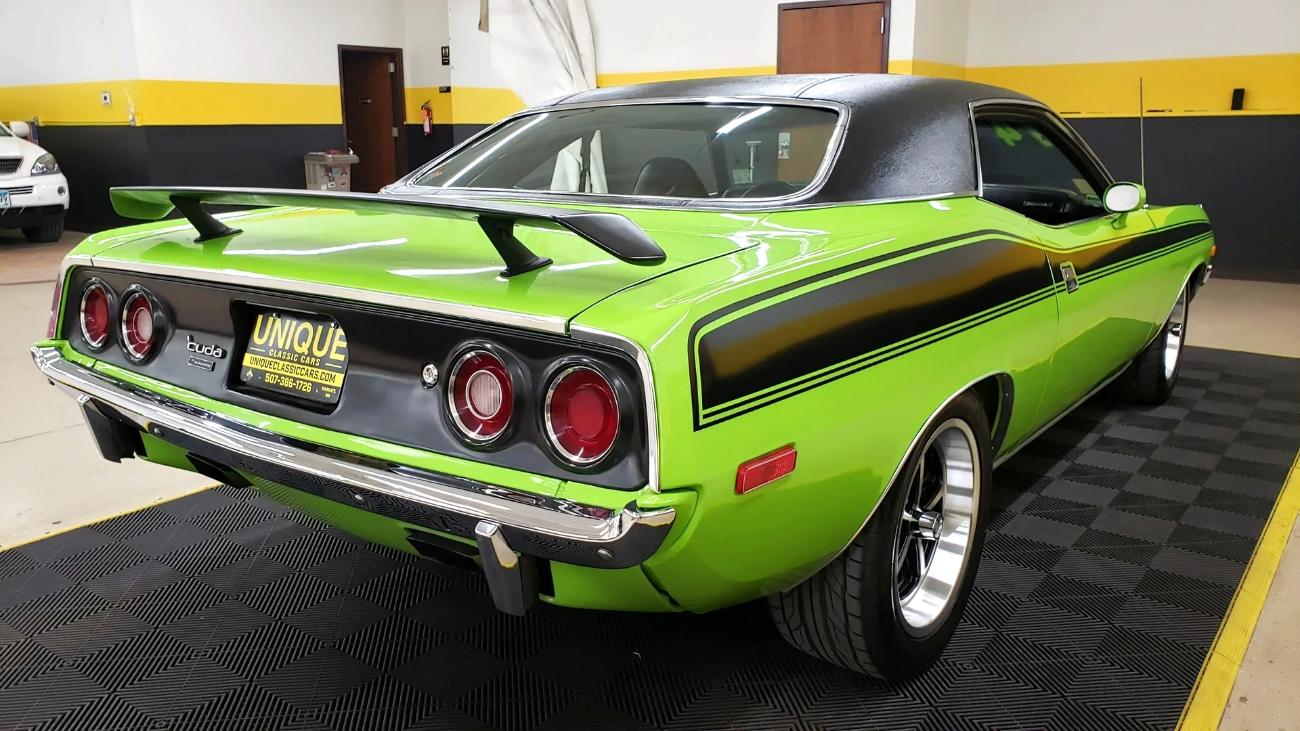
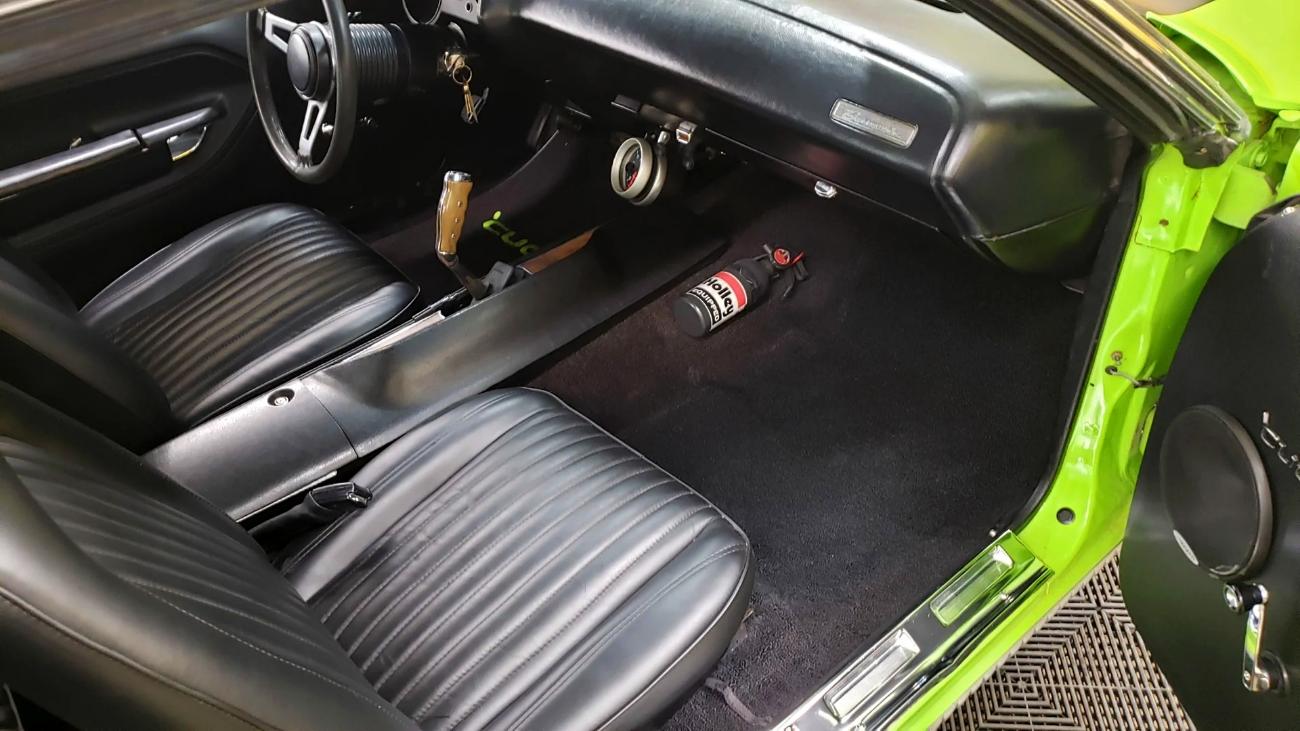
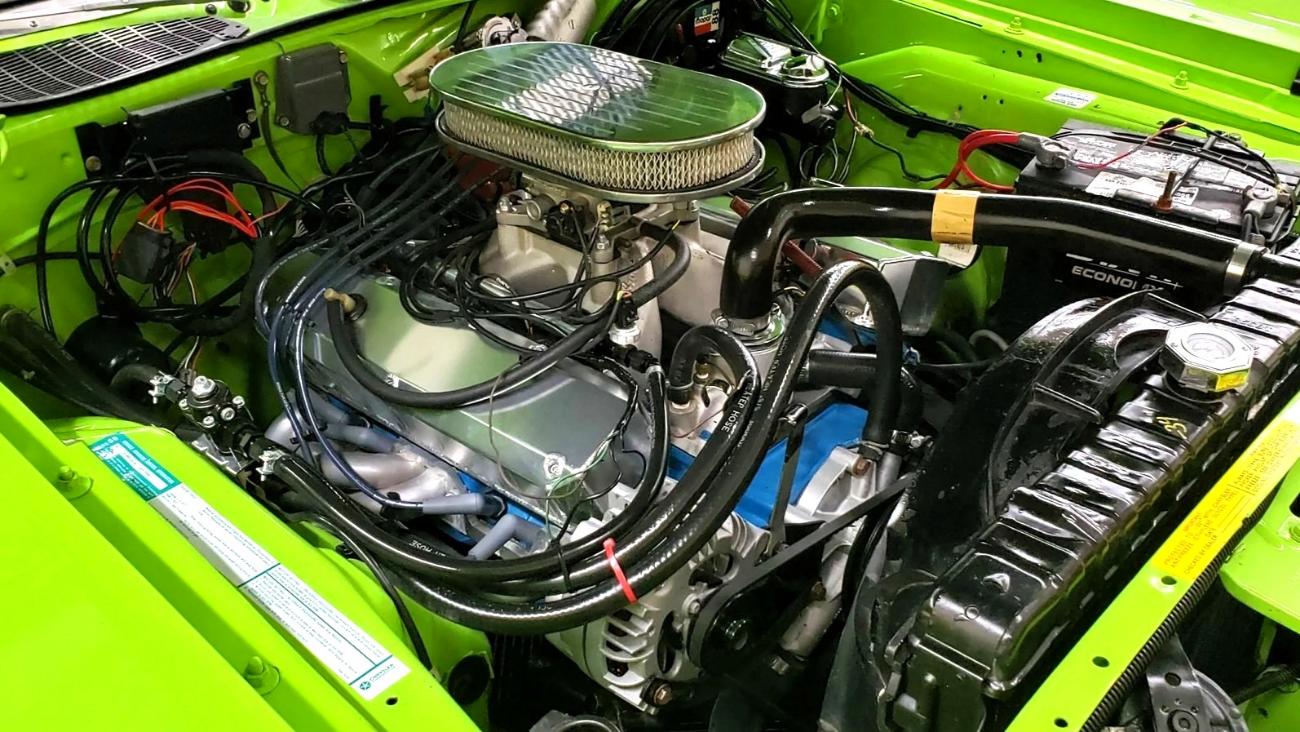
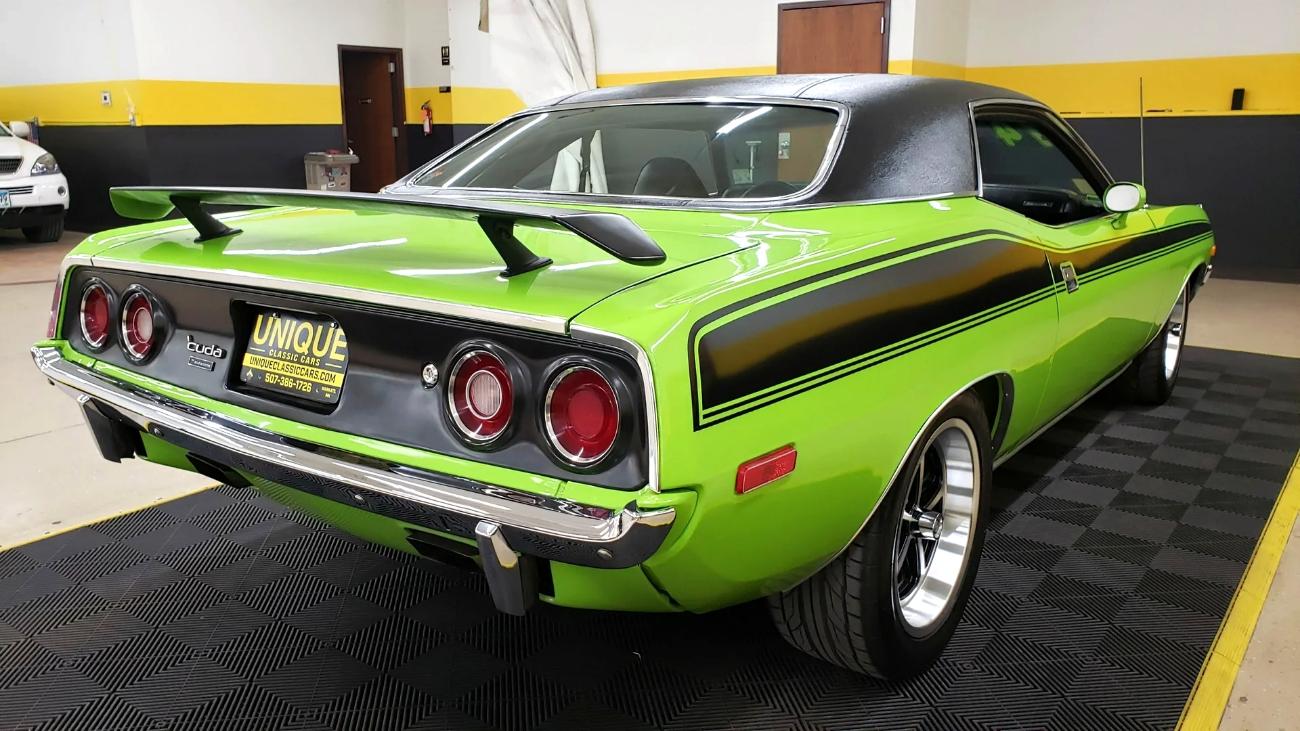
Currently listed on AutoHunter is this 1970 Plymouth ‘Cuda hardtop. Wearing new duds, the redesigned Barracuda was expected to be a smash hit but the sporty car market was down, and Barracuda sales even lagged its more expensive cousin, the Dodge Challenger, by a long shot. Nonetheless, the all-new Barracuda (and the performance-oriented ‘Cuda model we have here) exploited everything that was desirable about pony cars, like deft proportions, an engine suitable for every type of consumer, and enough options to make a Mustang envious. The car in this AutoHunter Spotlight features a 335-horsepower 383, which was the standard engine for the ‘Cuda, backed by a TorqueFlite automatic. Painted “FJ5” Limelight” with white vinyl top over a black vinyl interior, this muscle Mopar comes from the selling dealer with a clear title.

The Limelight hue is seemingly made brighter by the white vinyl top. Other exterior features include front Elastomeric bumper, non-functional scooped hood with pins and lanyards, dual racing mirrors, rear panel blackout, driving lights, “gilled” rocker panels, and rear spoiler. A set of 14-inch Rallye wheels are wrapped in F70 Goodyear Polyglas white-letter radials.

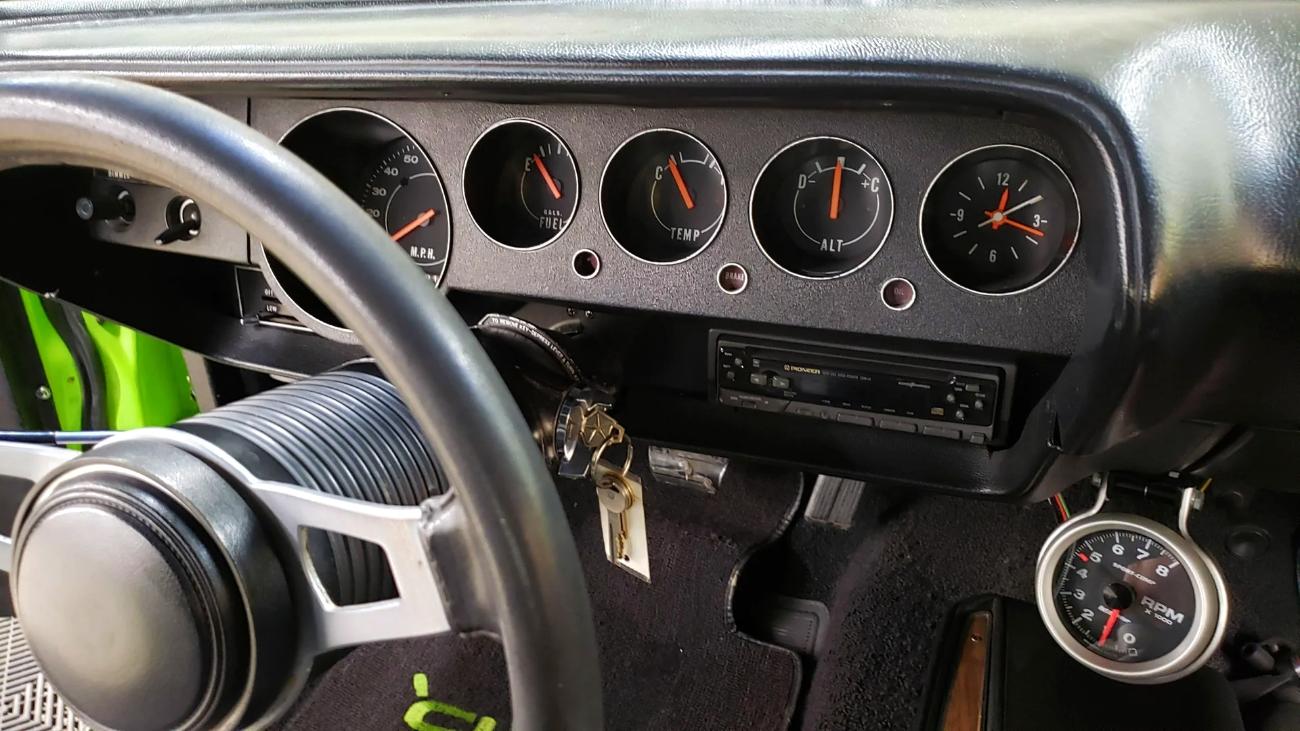
The black interior features front bucket seats divided by a console housing a Slap-Stik shifter. Other features include woodgrain trim, pushbutton AM radio, two-spoke steering wheel, and driver-side remote mirror.

Instrumentation includes a 150-mph speedometer, 8,000-rpm tachometer, and gauges for the oil pressure, coolant temperature, alternator, clock, and fuel. The odometer currently shows 1,403 miles, though the title reads mileage-exempt.

The “’Cuda 383” V8 was originally rated at 335 horsepower with a four-barrel carburetor. It’s connected to a three-speed TorqueFlite automatic.

Underneath, you’ll find drum brakes on all four corners. A dual exhaust system is routed through the rear valence panel.

Limelight is among the brightest of Mopar High Impact colors during the era. Combined with a white vinyl top and Elastomeric front bumper, this 1970 ‘Cuda 383 hardtop really pops—dare I say it’s pretty? If you want to go on a date with her, be sure to place a bid because the auction ends on Monday, May 5, 2025, at 12:00 p.m. (PDT).

Visit the AutoHunter listing for more information and a photo gallery

Currently listed on AutoHunter is this 1976 Volkswagen Beetle Convertible, which is powered by a 1600cc horizontally opposed four-cylinder engine mated to a four-speed manual transmission. Finished in Competition Orange and equipped with a black convertible top over a black vinyl interior, this VW Bug is now offered by the seller in Oregon with service records, an emissions report, a car cover, spare parts (including an engine), and a clear title.

After being stored for more than 10 years, this Beetle was recently refreshed. Its Competition Orange exterior features chrome bumpers with black trim, chrome trim, front fender-mounted turn signals, chrome side mirror housings, running boards, and dual exhaust outlets. A black manual soft top covers the passenger compartment.

The 15-inch chrome wheels have VW-branded hubcaps and come wrapped in 165/80 Federal Super Steel 657 radial tires.

Inside the cabin is black vinyl front bucket and rear bench seating. Features include manual windows, a floor-mounted shifter, and a locking glove box.

A VDO 100-mph speedometer with an integrated fuel gauge displays important information. The analog odometer shows 87,522 miles, but the title for this vehicle indicates it’s mileage-exempt.

The original engine was swapped out for a 1600cc horizontally opposed four-cylinder engine that has less than 200 miles on it. The powerplant is connected to a four-speed manual gearbox. New parts include a two-barrel carburetor, clutch, throwout bearing, pressure plate, and battery.

Underpinnings consist of a four-wheel independent suspension and drum brakes, which have been updated with new drums and shoes.

The parts that come with the purchase of this VW Beetle consist of a rebuildable engine, three spare carburetors, two distributors and flywheels, a workbench-mountable engine stand, and more.

The auction for this 1976 Volkswagen Beetle Convertible ends on Friday, May 2, 2025, at 12:00 p.m. (PDT).

Visit the AutoHunter listing for more information and a photo gallery