mod@tech

Featured on AutoHunter, the online auction platform driven by ClassicCars.com, is a 1966 Ford Mustang convertible.

It features a resprayed Tahoe Turquoise exterior with a power-retractable white top. The Tahoe Turquoise exterior is complemented by 289 emblems, chrome brightwork, and rocker moldings.

1966 Ford Mustang convertible

This Ford Mustang convertible rides on steel 14-inch wheels with hubcap and Hankook Optimo whitewall tires.

1966 Ford Mustang convertible

“The interior is fitted with two-tone Aqua vinyl low-back bucket seats up front and a matching rear bench and door panels,” the listing states. “Amenities include vent windows, lap belts, and a push-button radio. The trunk contains a whitewall spare tire.”

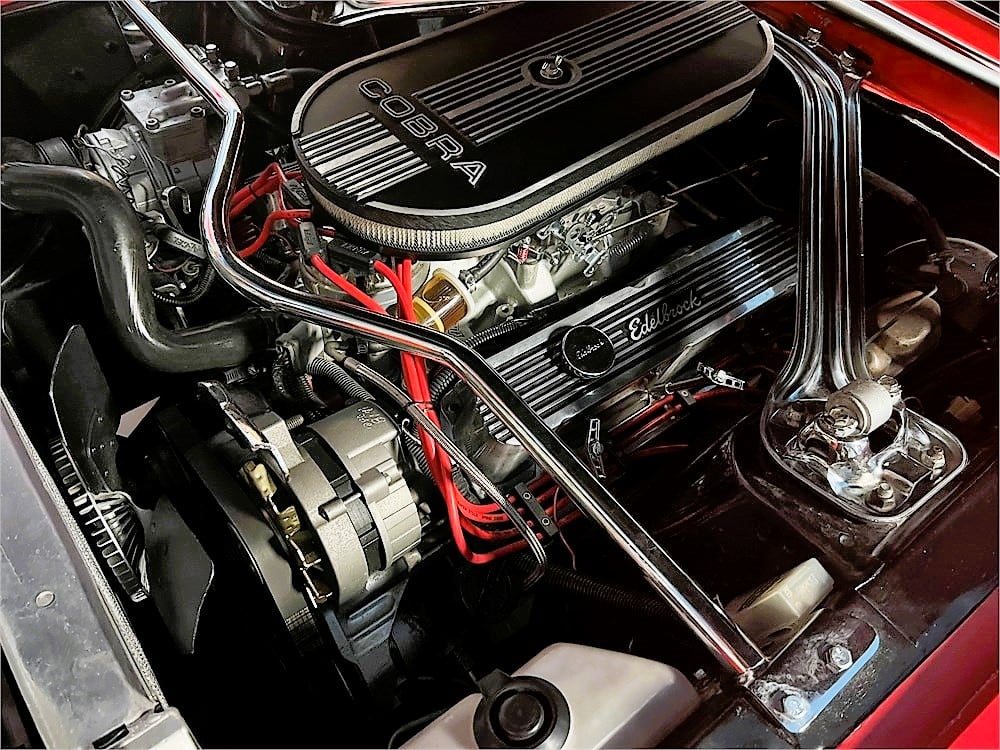
Under the hood is the reportedly original 289ci V8 engine that’s paired with a floor-mounted three-speed automatic transmission.

289ci V8 engine
289ci V8 engine

The sale includes a clear title, and a vinyl convertible top boot. This Ford Mustang’s five-digit mechanical odometer reads 30,868 miles, but the true mileage on the chassis is unknown.

Date plate
Date plate

This 1966 Ford Mustang convertible’s auction ends on Thursday, February 9, 2023, at 3:20 p.m. (MST)

Visit the AutoHunter listing for more information and photo gallery
Hot Rodding doesn’t stop at the road’s end. In fact, the mechanized cultural phenomenon has permeated far beyond asphalt and into the hearts of freshwater boating enthusiasts across generations. For 2023, the Grand National Roadster show, held in Pomona, California welcomed hot road boats to join the festivities. Nearly an entire show hall was full of wild, vintage, and immaculately restored offerings to the maritime gods of speed. Feast your eyes on this gallery of hemi-powered, roots-blown, stack injected, and otherwise wickedly fast hot rod boats.

Hot Rod Boats of the Grand National Roadster Show 2023

During Arizona Auction Week 2023, the ClassicCars.com Journal had the pleasure to attend The Scottsdale Auction hosted by Bonhams. Held at the Westin Kierland Resort & Spa in the northern reaches of Scottsdale, the auction was another well-heeled event to satiate enthusiasts.

Of course, Bonhams is one of the world’s oldest companies, having been founded in 1793. It’s also one of the world’s largest auction houses when it comes to antiquities, fine art, jewelry and, of course, motor cars (as the Brits like to call it).

Pedal cars lead the auction

The understated affair featured a small buffet breakfast for attendees, with plenty of staff on hand to attend to the hungry crowd. But what the crowd was truly hungry for were classic cars, some of which commanded millions of dollars. The cars highlighted to garner the most attention were the 2006 Maserati MC12 Corse track car ($3,811,000), 1912 Simplex 50HP five-passenger Torpedo Tourer ($4,845,000), 1958 BMW 507 Series II ($2,067,500), 1965 Ferrari 275 GTS roadster ($1,586,250), 1953 Siata 208S Spider ($1,572,500) and 2005 Porsche Carrera GT ($1,033,500). However, the cars that truly excited us were the 1957 Chrysler Ghia Super Dart 400 ($819,000) and 1954 Chrysler Ghia GS-1 ($802,500).

2006 Maserati MC12 Corse

Those cars, plus many others, can be seen below, and follow this link for more coverage of Arizona Auction Week.

1912 Simplex
1958 BMW 507
2005 Porsche Carrera GT

While Dodge’s Little Red Express may lay claim to the original sport truck monicker, Ford’s Lighting may have rolled out of the showroom at a quicker pace, and GMC’s turbo AWD storm warnings might have packed more era-leading tech, it was Chevrolet’s Silverado SS 454 pickup that had our hearts. The limited run, single-cab, big-block pickup revived a sound and presence that hadn’t been seen outside the muscle car realm in quite some time and was a bedroom wall poster aspiration for many a high-schooler. Today, surviving specimens are few and far between and even fewer are in as solid condition as this prime example that’s currently up for auction.

The truck is said to have been owned by the founder of Royal Purple oil, which seems like an obvious quell for any concerns about oil change intervals. The engine has been rebuilt and the paint resprayed in the original Onyx Black hue. Careful observers will note the cowl hood which is a tasteful, yet aftermarket add-on.

The inarguable star of the show was the 454ci big-block Chevy under the hood. While it only produced 230hp in factory trim, enthusiasts were quick to tap the performance potential of all those cubic inches.

The Garnet Red cloth interior is original and in excellent shape. According to the seller all of the original guages and HVAC controls function.

If you like what you see, make sure to check the auction page for more photos, info, or to make a bid on this 1990 Chevrolet Silverado 454 SS

Kit cars are the automotive embodiment of grand plans. They’re the means by which anybody with ambition and a set of hand tools can build an exotic or sporty car on par with something that would normally cost a few decades’ worth of salary. They’re also supposed to be rather quick to assemble, with the most basic and straightforward versions taking about a weekend to plop onto a running and rolling chassis. Then there’s the Devin-Crosley kit car that Jim Liberty has taken on, a project that will soon come to fruition after 75 years.

“How does a 75-year-old car just sit as it came from Devin?” Jim asked. “The owner’s only concern was whether he had enough juice to finish it.”

Jim, who is based in Costa Mesa, California, and is best known for his Porsche 356 restorations, isn’t above taking on something a little more unique. His shop truck is a lightly modified Crosley CC pickup, and he’s restored a 1960 Austin-Healey Sprite to recapture the feeling of his first sports car. It was the former, however, that led him to the long-dormant Devin project—the longest, in fact, that we’ve come across.

“I was buying parts for the pickup from the owner and he told me he just had too much work over the years to ever get started on it,” Jim says.

1948 Devin-Crosley project

Photo courtesy Jim Liberty

According to the story that the owner related, the project began sometime around 1948, even before Devin started building fiberglass bodies. The prior owner of the project had a 1946 Crosley station wagon that caught fire and, rather than scrap it, he socked it away in his Ohio basement. Then, sometime after Devin established Devin Enterprises in 1954, the station wagon owner bought a Devin fiberglass roadster body.

Bill Devin, once called “the Enzo Ferrari of the Okie Flats,” only grew up in Oklahoma; other than a few years in Iowa, he spent most of his adult life in California. Cars, however, were a constant throughout his life, from the Chevrolet dealership that his father ran to the Chrysler-Plymouth dealerships that he operated and on to the Crosley Hotshot in which he started his sports car racing career and the Ferraris and other European cars he bought, sold, and raced. While other California-based hot-rodders and racers had already discovered the benefits of fiberglass bodies, Devin taught himself how to work in the medium and quickly became one of, if not the most, prolific manufacturers of fiberglass bodies for existing car chassis. He started by splashing a mold off a Deutsch-Bonnet for his Devin-Panhard, according to Kevin Callahan at Devin Sports Cars, then progressed to developing his own molds, patterned after an unnamed small Italian spider (reportedly a Scaglietti-bodied Ermini 357 Sport, one of three built). Rather than produce a single mold for a single chassis, Devin instead produced as many as 50 sections of molds from which he could mix and match to lay up bodies in dozens of sizes for multiple chassis.

Bill Devin with some of his production fiberglass cars

Bill Devin with some of his production fiberglass carsPhoto via Devin Sports Cars

While Devin later went on to offer his own body and chassis combination under the name Devin SS as well as versions for rear-engine applications after the Volkswagen phenomenon took hold, the owner of the now-stripped Crosley chassis bought a front-engine body along with a couple of fiberglass racing seats direct from Devin. As Jim told the story, the builder got as far as extending the chassis by 24 inches and placing the body on the chassis before other priorities obviously took over. After Roughly 60 years, that owner then took the project to the Crosley Automobile Club‘s Nationals in Wauseon, Ohio, where he offered it for sale in the swap meet and where the Sioux Falls-based owner spotted it.

“It was 100 percent virgin when he bought it,” Jim says.

1948 Devin-Crosley project

Photo courtesy Jim Liberty

Other than adding some Dayton wire wheels to the car, though, he never did anything with it either, so he sold the project to Jim. While the Devin came with a Crosley 750cc four-cylinder, presumably the station wagon’s original engine, and a Sprite four-speed transmission, a common upgrade over the Crosley’s unsynchronized three-speed manual transmission, Jim said trying to mate the two “turned into a nightmare” so he substituted a supercharged 1275-cc four-cylinder out of an MG for the Crosley engine and kept the Sprite transmission. He also widened the rear axle to accommodate the wider wire wheels, but left the rest of the chassis alone and focused on the bodywork necessary for preparing a 60-something-year-old fiberglass body for the first paint ever to coat its surfaces. Plans call for it to be black with red racing stripes and a red vinyl interior using those original Devin seats, Jim says.

1948 Devin-Crosley project

Photo courtesy Jim Liberty

And while it’s not a 356, Jim says it’s still getting the same treatment as any of his projects, which benefit from a number of specialists within walking distance of his shop. “The best of the best,” he says.

According to Jim, the Devin will be titled in California as a 1948 Crosley and will be going up for sale sometime this fall.

Cars and trucks are some of the deadliest things humans use on a daily basis, and most drivers don’t even realize that. But automotive design and safety have come a long way in the past few decades. However, there have been extremely unsafe cars, even with modern safety enhancements. During the 1990s, SUVs were a hot-button issue and the Isuzu Trooper was at the forefront of the discussion as the worst.

The Ford Explorer was also the subject of intense controversy in the early 2000s due to explosions and rollover incidents. Looking back a few decades, the Chevrolet Corvair was so bad that a congressman named Ralph Nader penned a book about it titled “Unsafe At Any Speed”. We looked back through the decades and found some of the most unsafe cars on the road. You’ll want to avoid these rides, so find out just which model they are right here.

Chevrolet Vega GT
Photo Credit: GM

Chevrolet Vega

The Vega was known for “literally” being a rust bucket as it started rusting as soon as the driver left the dealership. But the Vega was also a very unsafe car with a poor crash test rating and build quality. The engine design was the poorest ever made out of GM, with everything from piston scuffing to head gasket failure (via Motor Trend).

Chevrolet Vega GT
Photo Credit: Cars and Bids

There’s no denying the Vega was rushed onto the market. The real question was how did GM get away with it for so long? There was an onslaught of new compact cars that hit the market during this period, and the Vega was one of them. But between poor build quality and limited reliability, the Vega was an awful car.

The post Driving Dangers: The Most Unsafe Cars On The Road At Any Speed appeared first on Motor Junkie.

The 2023 Barrett-Jackson Scottsdale auction just wrapped up and among the 1,907 vehicles sold (totaling more than $184.2 million in sales) were numerous offerings by Porsche. A 2005 Carrera GT was the top selling Porsche at the auction with a $1,595,000 hammer price. The Carrera GT was the second most expensive car at the 2023 Barrett-Jackson Scottsdale auction, trailing only a 1989 Ferrari F40 that sold for $2,750,000, and is proper example to lead the Top 10 Porsche sales from the recent auction.

Top 10 Porsche sales at the 2023 Barrett-Jackson Scottsdale auction

It’s amazing how two simple letters can pack so much meaning for car enthusiasts. Chevrolet and its “Super Sport” models, or SS for short, have been a truly dominating force in the auto world since the early 1960s. The SS series was one of the first “royal family” models in GM’s stable. Technically, the SS designation was introduced in the late 1950s for a special track-only Corvette.

But it became truly well-known when those two S were bolted on the fenders of the 1961 Impala. That was the exact moment when the SS moniker became legendary and set the path forth for many cars that followed. Muscle car fans remember these fire-breathing GM beasts as some of the finest muscle cars of Detroit’s Golden Age, and for good reason. Check out the greatest car that bore the coveted SS designation right here.

Photo Credit: Mecum

1961 Chevrolet Impala SS 409

The legendary 196q Impala SS (Super Sport) package has its place in muscle car history as a very important model that promoted performance to the general public. This was one of the first high-performance automobiles that were relatively affordable and fast. Everything started when Chevrolet decided to transform its 409 truck engine for use in passenger cars and found out it could outrun all other cars on the road. Just with mild modifications to the engine, it could produce up to 409 HP, enough to propel the Impala from 0 to 60 mph in just six seconds flat (via Motor Trend).

Photo Credit: Mecum

At the time that was Corvette territory. So as a mid-year introduction, Chevrolet presented the SS package. It featured bucket seats, sports trim, and other details. It came with a 348 V8 engine with 350 HP. However, the most interesting option was the 409 V8 with up to 409 HP if you opted for the dual quad intake system. Even though Chevrolet sold over a million of its full-size models, it only made 456 Impalas SS models that year. Out of those, only 142 Impalas came with the 409 engine. Interestingly, the 409 option was available for all Chevrolet full-size models in 1961. Hence, Chevrolet could make sedans and wagons with 409, but those cars have yet to surface. Today, the 1961 Impala SS 409 is one of the most valuable cars in Chevrolet’s storied muscle car history.

The post Muscle To Masterpiece: The Greatest Chevrolet SS Models Ever Made appeared first on Motor Junkie.

This 1931 Chevrolet Independence sport coupe is said to have been modified in hot-rod style during the 1980s in Ohio and is powered by a 307ci V8 and a three-speed automatic transmission sourced from a 1970 Chevrolet Nova. The steel body is paired with fiberglass rear fenders and has been refinished in blue, and the interior has been redone in gray cloth. Features include 16″ wire wheels, Wilwood front disc brakes, a Flaming River steering rack, fender-mounted spares, a removable tow ball, a crank-up windshield, a roll-down rear window, a Kenwood CD stereo, and R134a air conditioning. The seller acquired the car in 2011, and recent service is said to have included rebuilding the carburetor, changing the oil, recharging the air-conditioning system, and replacing the steering rack, steering column, and steering pump. This modified Series AE coupe is now offered with an Ohio title in the seller’s name.

The body is said to have been modified in late 1980s, at which time it was repainted in blue with red pinstripes along the body lines. The rumble seat was converted into a trunk, and the car features fiberglass rear fenders, side-mounted spares, a front wiper, a crank-up windshield, a roll-down rear window, bright bumpers, and a removable tow ball. Signs of age and other imperfections are noted in the paint.

Chrome-finished 16″ wire wheels wear spinner center caps and are mounted with 215/55 front  and 255/70 rear Performance Radial GT tires. The chassis has been modified, and Wilwood disc brakes are utilized up front. The seller states that a Flaming River replacement steering rack, steering column, and power-steering pump have been recently installed.

The interior features a bench seat with gray cloth upholstery, and the kick panels and rear trim have been covered to match. Appointments include a center console, a Kenwood CD stereo, and a Vintage Air climate-control system, which the seller states was recently repaired and recharged with R134a refrigerant.

An aftermarket steering wheel sits ahead of a VDO 120-mph speedometer and four auxiliary gauges. The five-digit mechanical odometer shows 14k miles, approximately 200 of which have been added by the seller. True chassis mileage is unknown.

The 307ci V8 and TH350 three-speed automatic transmission are said to have been sourced from a 1970 Nova. The engine is topped with a Rochester two-barrel carburetor and makes use of a mechanical fuel pump, tubular exhaust headers, and a dual exhaust system. The seller states that the carburetor was rebuilt and the oil changed in preparation for the sale.

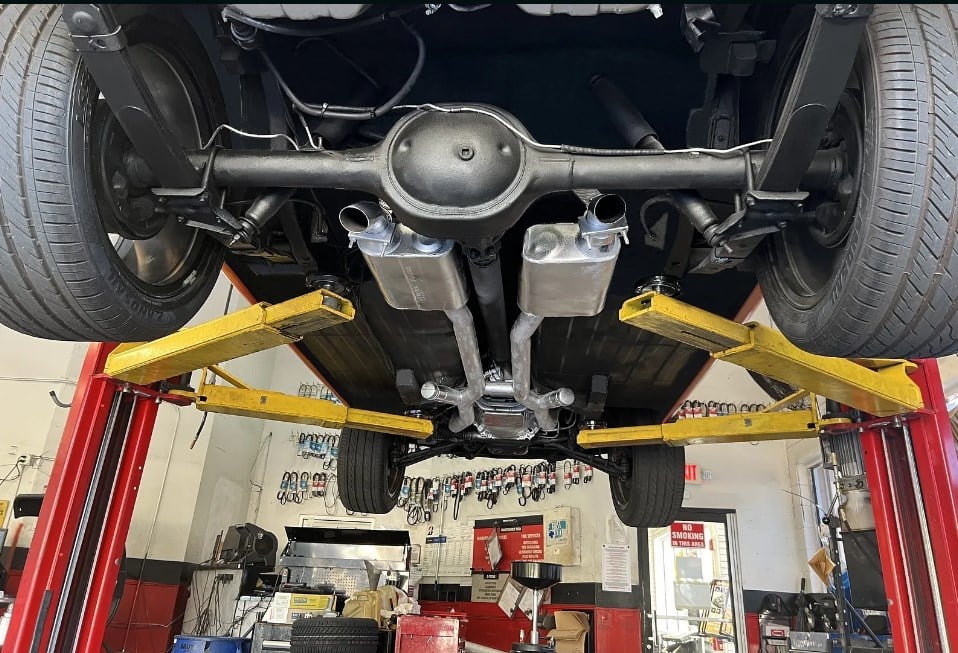
Power is delivered to the wheels through a solid rear axle with 3.08:1 gears inside a 10-bolt GM 8.2″ differential. Additional photos of the underside are presented in the gallery below.

A reproduction VIN tag has been affixed to the car and matches the Identification Number listed on the Ohio title. The title lists “Mlg Brand Non-Actual: Warning Odometer Discrepancy” under the Brands section, and the document also notes the vehicle model as “12AE,” although the rumble-seat “sport coupe” for 1931 was known as 6AE. A redacted image of the title is provided in the gallery.