mod@tech

This 1934 Ford Tudor Sedan street rod was built approximately 17 years ago utilizing a chopped steel body that is finished in black with red flame-style pinstripes. The frame has been fitted with a Heidt’s Mustang II-style front suspension, rack-and-pinion steering, 17″ and 18″ REV wheels, front disc brakes, and a three-speed automatic transmission. Power comes from a 350ci Chevy V8 that is fed by a Carter carburetor and fitted with “ram horn” headers and a billet air cleaner cover and valve covers. The interior is trimmed in red cloth upholstery and incorporates VDO instrumentation, billet bezels, a tilt column, a Lecarra steering wheel, a Lokar shifter, and a retro-style radio. Acquired by the seller in 2021, this Ford street rod is offered with a clean New Jersey title in the seller’s name.

The steel Tudor Sedan body was chopped approximately 2.5″ and fitted with fiberglass fenders before being finished in black with red flame pinstripes under prior ownership. Exterior details include chrome headlight housings and bumpers, a recessed license plate box, reverse-hinged doors, teardrop taillights, and tinted windows. There are no windshield wipers installed, the driver’s door is misaligned, and paint blemishes are visible on the cowl, grille, and above the left running board.

Chrome 17” and 18” REV 100 Classic Series wheels are mounted with Nankang Noble Sport NS-20 tires measuring 205/45 up front and 245/45 out back. A Mustang II-style Heidt’s front end has been installed along with rack-and-pinion steering, tubular control arms, and front disc brakes.

The interior is trimmed in red cloth upholstery and features a Lecarra steering wheel mounted to a tilt column in addition to a Lokar shifter, hand-crank windows, and dual cupholders. A Ford-branded retro-style radio is mounted in the center of the dashboard and is linked with tweeters above the windshield and speakers in the front kick and rear side panels.

VDO instrumentation is housed in three billet bezels across the dashboard and includes a 120-mph speedometer, a tachometer, an analog clock, and readouts for coolant temperature, oil pressure, voltage, and fuel level. The five-digit mechanical odometer shows 24k miles, approximately 2k of which have been added under current ownership.

The 350ci Chevy V8 was installed in 2007 during the build, and it is equipped with a Carter carburetor, “ram horn” headers, a billet air cleaner cover and valve covers, and a chrome alternator and electric fan. The seller states fluid and filter changes were performed in 2022.

Power is delivered to the rear wheels through a three-speed automatic transmission. A dual exhaust system with chrome tips is fitted.

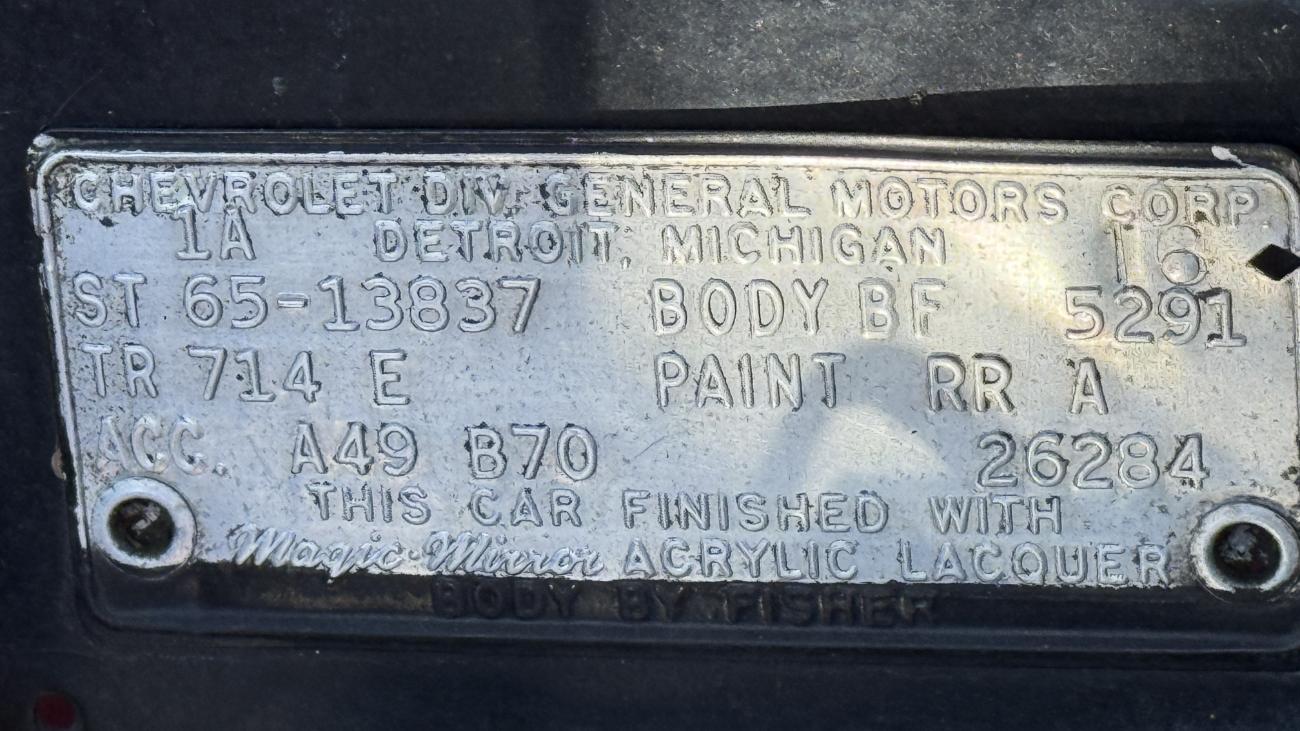
The vehicle is titled in New Jersey by VIN DMV30183 as displayed on the Tennessee assigned identification plate above.

This Factory Five Racing ’33 Hot Rod utilizes a composite body over a steel chassis and is powered by a 4.6-liter Ford V8 with a BBK intake manifold, Trick Flow valve covers, an MSD ignition, and a stainless-steel dual exhaust system. It rides on adjustable coilovers with a four-link rear suspension setup, inboard front coilovers with rocker arms, four-wheel disc brakes, and 17” REV Wheels. Finished in midnight blue with ghosted flames and gray leather upholstery, the car also has a Vintage Air HVAC system, chrome roll hoop, Pioneer touchscreen head unit, and a removal hardtop that stows on an included stand when not in use. This FFR ’33 Hot Rod was acquired by the current owner on BaT in October 2023 and is now offered on dealer consignment with factory assembly manuals, spare parts, a cover, and a clean Texas title in the seller’s name listing the car as a 2017 Assembled Vehicle.

The composite body is styled to resemble a 1933 Ford Roadster, and it is finished in midnight with ghosted flames on the hood, side panels, and front fenders. Exterior details also include rear-hinged doors, LED taillights, a chrome roll bar, and dual exhaust outlets.

A body-color removable hardtop with an integrated windshield and stand will accompany the vehicle.

REV 17” Wheels are mounted with Nitto NT555 Extreme ZR tires sized 245/45 up front and 285/40 out back. The car rides on adjustable coilovers and features a four-link rear suspension setup, inboard front coilovers with rocker arms, and four-wheel disc brakes.

The cabin houses bucket seats trimmed in gray leather upholstery. A US Shift Quick 1 digital shift controller is mounted in the center console, and additional amenities include a Vintage Air HVAC system and a dash-mounted Pioneer touchscreen head unit wired to dual Crunch Powerzone amplifiers in the trunk and Skar speakers between the seats and in the door panels.

A Factory Five Racing steering wheel features bright accents and sits ahead of a central instrument panel housing AutoMeter gauges that include a 120-mph speedometer, a 7k-rpm tachometer, and auxiliary displays. The digital odometer shows approximately 1,450 miles, which represents the distance driven since completion.

The 4.6-liter V8 was reportedly sourced from a 2002 Ford Mustang and features a BBK intake manifold, Trick Flow valve covers, an MSD ignition, and a stainless-steel dual exhaust system. The Odyssey battery was replaced in October 2023, and the selling dealer reports that the injection system was repaired following the last auction.

Power is sent to the rear wheels via an FR70W four-speed automatic transmission.

The car is titled using the State of Ohio-assigned VIN shown above. The title lists the car as a 2017 assembled vehicle and carries a Not Actual Mileage remark.

When it comes to human beings, it is easy to fall in line and be part of the pack. The ones that stand out do so because they approach life in a different manner. That also holds true with the hot rods and customs that we build – a lot feels the same. Those who show a dose of creativity may be more likely to capture our attention like our Pick of the Day, an LS2-powered 1971 Chevrolet Malibu convertible. It is listed on ClassicCars.com by a seller in Jacksonville, Florida. (Click the link to view the listing)

1968 Caprice with optional hidden headlights

Starting with the 1962 Lotus Elan, hidden headlights would soon become a “thing,” with the Chevrolet Corvette following the next model year. This styling feature would last into the early years of the Millennium. Mainstream vehicle adoption of hidden headlights appears to have begun with the 1965 Buick Riviera, while the most mainstream of brands, Chevrolet, never joined the bandwagon the way other manufacturers did. We all know that the 1967-69 Camaro with the Rally Sport package featured hidden headlights; much less common was the 1968-69 Caprice and 1969 Kingswood Estate wagon with the option.

Notice that the Chevelle never acquired hidden headlights. That seems to have eschewed other trends as well during that era, such as spoilers. Even air induction – something that was available for the GTO starting in 1965 – never became a thing until 1970. The Cowl Induction system that was available through 1972 became one of the more efficient systems on the market.

For 1971, Chevrolet facelifted the Chevelle, reflecting the influence of the 1970-½ Camaro, including its dual headlights and round taillights. Under the hood was another big change because General Motors decided to introduce low-compression engines a year earlier than the federal mandate. The Super Sport also became a watered-down package, now available with 350 two-barrel and four-barrel engines in addition to the big-blocks. The LS3 400 (really, 402ci) was rated at 300 horsepower, while two 454s were available: the LS5 454, which increased by five horses to 365 horsepower (though that was advertised and not on paper), while the LS6 fell to 425, which still was quite substantial. However, for some reason, the LS6 was only installed in the Corvette.

Coming full circle, here we have a very nice LS2-powered 1971 Chevrolet Malibu convertible with what looks to be hidden headlights. Clearly this was not available from the factory, but the builder created a graceful look that gives 1969 Camaro RS vibes. “Nut-and-bolt rotisserie restoration completed in 2015 by Mike Staveski of RMR Dream Cars/Time Machines in Hudson, Florida,” says the seller. “This 1971 Chevrolet Chevelle was a standout at the 2015 SEMA Ignited after-party held on Friday, November 6 with a crowd of hundreds in attendance. The car was also the star of the Atech Motorsports stand at SEMA, wowing onlookers with its blend of classic Chevelle styling and 21st century craftsmanship.”

Power comes from an all-aluminum LS2 with a Rootes-type Magnuson supercharger backed by a 4L60E four-speed automatic. Out back, you’ll find a 12-bolt rear with 3.73 gears and Positraction. Other features include four-wheel disc brakes and QA1 adjustable coilovers.

In black lacquer with ghosted SS stripes and red accents, this Chevelle looks great with its full-width grille and the best that modernity has to offer . . . plus it has SEMA cred! Creativity and quality do not come cheap, however, which is why you will need $114,999 to own this special Chevelle.

Click here for this ClassicCars.com Pick of the Day.

The Lamborghini Countach is a car Jay Leno knows intimately. He’s owned a 1987 example since new, and over the almost four decades the car has been in his possession, he’s managed to rack up more than 70,000 miles. That’s impressive for a man with a car collection as vast as the one owned by Leno.

Leno has now featured a Countach 25th Anniversary Edition on the latest episode of his online series “Jay Leno’s Garage.” The car is a 1989 example finished in a similar shade of red to Leno’s Countach, and with a black interior.

The Countach 25th Anniversary Edition was launched in 1988 to mark Lamborghini’s 25th birthday, and had a production run that numbered 658 examples in total.

It’s distinguished from the earlier Countach Quattrovalvole (QV), which Leno owns, by unique front and side spoilers and modified air vents, some of which was designed by Pagani CEO and founder Horacio Pagani, who was working for Lamborghini at the time.

Lamborghini Countach 25th Anniversary Edition

Drive comes from a 5.2-liter V-12 delivering 455 hp, and capable of carrying the car to a top speed of 183 mph. The tires fitted were the widest fitted to any production car of its time, measuring 225/50 at the front and 345/35 at the rear.

The Countach 25th Anniversary Edition came at the tail end of the Countach’s run. The car’s successor, the Diablo, entered production in 1990. Incredibly, the Countach had a production run that lasted almost two decades. The first prototype, designed by Marcello Gandini, was shown as early as the 1971 Geneva auto show. It was a hit, and the start of production followed in 1974.

Lamborghini in recent years used the iconic design of the Countach for a modern iteration based on the platform of the Aventador. The car debuted in 2021 to mark the 50th anniversary of the Countach prototype’s debut, and just 112 were built, the number referencing the LP 112 model designation used during development of the original Countach.

This article was originally published by Motor Authority, an editorial partner of ClassicCars.com

Featured on AutoHunter.com, the online auction platform driven by ClassicCars.com, is this 1960 Chevrolet Corvette. It was given a frame-up restoration in 2012 that consisted of the body being repainted, a new soft top being installed, and the engine being rebuilt. Power is supplied by a 283ci V8, which is connected to a four-speed manual gearbox. Finished in red and white over a black vinyl interior, this C1 Corvette comes with a clear title in the seller’s name.

The body was previously yellow but was repainted red with white coves and fitted with a new white soft top as part of the 2012 restoration. Features include chrome trim, a driver-side mirror, a plastic rear window, and a rear antenna. 

A set of 15-inch wheels wrapped in 205/75 Coker Classic whitewall radial tires connect this first-generation Corvette to the road. 

Black vinyl covers the pair of bucket seats inside. The cockpit is equipped with manual windows, a Corvette-branded three-spoke steering wheel, and a clock. The trunk has room for a spare tire. According to the seller, the Wonder Bar radio is nonoperational. 

Vehicle information is displayed on a 160-mph speedometer, a 7,000-rpm tachometer, and gauges for the fuel level, temperature, battery, and oil pressure. The five-digit odometer shows 39,446 miles, but the true mileage on this vehicle is unknown. 

In 2012, the 283ci V8 was rebuilt during the restoration process. It comes equipped with an aftermarket carburetor and sends its power to the rear wheels through a four-speed manual transmission.  

Suspension hardware includes an independent front setup and a parallelogram rear design with semi-elliptic outrigger-mounted leaf springs. Manual brakes bring this Corvette to a stop. The engine breathes through a pair of rear bumper-mounted exhaust outlets. 

The seller notes the presence of various interior blemishes, a small tear in the driver’s door weatherstripping, and surface rust on the rear sway bar. 

The following items will come with the purchase of the vehicle:

  • White hardtop with storage stand and dust cover
  • Original dual carburetors and intake manifold
  • Restoration and operating manuals
  • Parts reference guide

The auction for this 1960 Chevrolet Corvette ends on Tuesday, August 6, 2024 at 12:15 p.m. (PDT).        

Visit the AutoHunter listing for more information and a photo gallery 
The Scene The builds with Mike Boone – Our first CarShowz Talk Podcast kicked off a couple of weeks ago with Mike Boone and published last week via YouTube, Apple Podcast, Spotify, iHeart and Amazon Music. We are excited for this next journey, and we are honored for the opportunity to serve the automotive community. […]

The post The Scene The builds with Mike Boone – Podcast appeared first on CarShowz.com.

Featured on AutoHunter, the online auction platform driven by ClassicCars.com, is this 1981 Chevrolet Camaro Z28 Tribute.

Around the time Journey dropped the hit song “Don’t Stop Believin” in October 1981, the Chevrolet Camaro was on the verge of a completely new generation. A commercial for the 1981 Camaro Z28 called it the “ultimate Camaro” and proclaimed it an exceptional driver’s car. The aerodynamic treatment on the front and rear fenders was both functional and attractive, and marketing materials called it one of the “best-dressed cars” on the road.

What happens when you combine those good looks with a modernized V8 powertrain? Today, we get to find out. This customized Camaro is being listed by a dealer in Gladstone, Oregon, and the auction will end on Tuesday.

Interestingly enough, the CARFAX history for the car doesn’t start until 17 years after production. However, based on what we know, it spent life in California, Nevada, and Oregon – all of which are known to be relatively good regions to own and preserve a collector car.

The second-generation Camaro was in its last phase of production in the early 1980s; the body style had originally launched in 1970 and went through subsequent facelifts in both 1974 and 1978. When compared to previous Camaros, this version was lower, longer, and wider than before. By 1980, development was already underway for the new generation, so the final model years received just a few updates. (One such change for 1980 was an adjustment to the speedometer that modified it from 130 mph to 85 mph).

For 1981, the Camaro Z28 was available with two V8 engines: a 305 and a 350. There were restrictions on availability of the latter – particularly in California where emissions regulations were at an all-time high. Luckily for us, today’s featured car has a few tricks up its sleeve that amplify its performance and bring it into the modern era.

Starting with the exterior, the body has been recoated in pearl white and dressed in tan tri-tone accent striping around the perimeter. A set of later-model Camaro IROC-Z wheels give a subtle “OEM-plus” look to the car.

Most notably, upgrades have taken place under the hood where we find a fuel-injected Vortec 5.3-liter V8 that is connected to a newer 4L60E four-speed automatic transmission. It’s a combination that suits the car’s performance aspirations while keeping it daily-friendly.  

Chevrolet touted: “The Z28 is not only handsome and sporty on the outside, it is just as good-looking on the inside. It’s an open invitation to take the sporty steering wheel and head on out. The Z28 is a special machine, for a driver who demands more than the ordinary.”

Looking for something extraordinary? Look no further. The auction for this 1981 Chevrolet Camaro Z28 Tribute ends Tuesday, August 6, 2024 at 11:30 a.m. (PDT)

Visit the AutoHunter listing for more information and photo gallery

General Motors is developing an adaptive air intake duct that could expand and contract based on airflow, which the automaker claims will allow for increased parts commonality across vehicles.

The adaptive intake was the subject of a patent application filed by GM in 2022, but which only surfaced when it was published by the United States Patent and Trademark Office (USPTO) June 27, 2024.

General Motors adaptive air intake patent image

In the application, GM discusses an air intake setup consisting of fixed inlet and outlet portions, with a movable element in the middle. That middle part would be “made of a flexible material having a cross-sectional area that expands and contracts responsive to the incoming air flow volume,” GM said in the application.

Potential materials that could achieve the required level of flexibility include various polyethylene blends, as well as “waterproof felt, silicone fabric, and platinum-catalyzed silicon,” according to GM.

General Motors adaptive air intake patent image

If the interior of an air intake can expand or contract for different rates of air flow, the packaging doesn’t need to change for different applications, GM notes. That reduces the need for different air intake designs for different vehicles, along with associated manufacturing costs related to specific tooling for those design variations. An adaptive air intake would be more space efficient as well, GM claims, making it easier to package in a vehicle as well as easier to ship to factories.

The cost-cutting powers of parts commonality are hard to underestimate. It’s why automakers seek to use big-ticket items like engines and infotainment systems across as many models as possible. And that will likely be the motivation should this adaptive air intake make it to production.

HIGH-RES GALLERY: General Motors adaptive air intake patent image

This article was originally published by Motor Authority, an editorial partner of ClassicCars.com

The Pick of the Day is a 2000 Volkswagen Jetta pickup conversion listed for sale by a Tennessee dealership on ClassicCars.com

Truck-like cars (aka coupe utility vehicles) haven’t been big in a while. The Ford Ranchero rode off into the sunset at the end of the 1970s and the Chevrolet El Camino was on its way into the history books in the late 1980s. Even the Holden Ute from Australia was ute-enized last decade. But that decline in the coupe utility vehicle’s popularity didn’t stop someone from converting a 2000 Volkwagen Jetta into a pickup.

Although the selling dealer says it was handcrafted by a company in Florida, it looks like it came from Smyth of Tiverton, Rhode Island. Either way, it’s distinctive, which you can’t say about regular Jettas of the 2000s. No doubt, they were popular, but that resulted in there being so many of them that they blurred into the background. They were victims of their own success.

This custom-made Jetta truck doesn’t have that problem. In fact, it may have the opposite issue – people may see it’s a car with a bed and not even notice that it was once a Jetta. Can you blame them? You don’t exactly see these every day, even if you live in a neighborhood full of El Camino and Ranchero owners.
It started life 151,211 miles ago as a front-wheel-drive German sedan with a turbocharged 1.8-liter four-cylinder engine and five-speed manual gearbox.

Now it’s an unforgettable sport truck that rides on flashy wheels, low-profile tires, and an air suspension and is capable of hauling bicycles and BBQ grilles.
For $19,850, this unique Jetta can be yours. If you end up getting it, let us know in the comments section below…and how it awkward things got when you pulled up in the Home Depot parking lot next to a Ford F-350 Super Duty owner.

Click here to view the listing for this Pick of the Day on ClassicCars.com

Mini GT has grown to be one of the newly favored manufacturers in the diecast scene with a balance between price, quality, engineering, and artistry. In today’s episode of Collectible Corner we will be taking a look at one of the more recent releases from their collaboration with Kaido House.

Make sure to subscribe to the ClassicCars TV YouTube channel for all episodes of Collectible Corner, as well as see interesting finds and car reviews!