This 1941 Ford Pickup was built into a hot rod between the seller’s acquisition in 2017 and its completion in 2019. Highlighting the build is a 283ci Chevrolet V8 fitted with a stroker crankshaft and a Holley double-pumper 650 as well as an Edelbrock Torker manifold and finned valve covers, and it is linked to a three-speed GM automatic and a Ford 9″ rear end. Front disc brakes, lowering blocks, and Corvette wheel covers have been fitted along with a floor shifter, and portions of the full-fendered body were repainted. This Ford pickup is now offered in 95409 (Santa Rosa, California) with and a clean California title in the seller’s name.
The bodywork is finished in black with custom flourishes. The bumpers have been removed, and the seller notes that the metal above the running boards was repaired and the right-rear fender was repainted with single-stage gloss black paint. Blue-dot traillights and tri-bar headlights have been fitted. There are rust bubbles on the drop-down tailgate, and the wipers do not work.
The seller installed front disc brakes, lowering blocks, rear air shocks, and ’59 Corvette wheel covers, and the whitewall tires are from Coker.
The seller tells us insulation was added to the cab before it was reupholstered with diamond-stitched vinyl.
A floor shifter, banjo-style steering wheel, and Stewart-Warner gauges are provided for the driver. The 17k miles indicated is not accurate to the chassis, and the seller notes the Brodie knob pictured is not included and the turn signal lights on the dashboard do not work.
The seller replaced the sheet metal in the engine bay and installed the 283ci V8, which has been fitted with a stroker crankshaft and is topped by an Edelbrock intake manifold and valve covers along with a Holley 650 double-pumper carburetor.
The three-speed automatic transmission is linked to a Ford 9″ rear end. The seller notes that frame repairs were performed above the axles and at the motor mounts.
The VIN stamped on the frame indicates the sequence “8665797”, with the first digit and last digit obscured. Sequence 186657976 aligns with a 1941 Ford, and the truck is titled in California using VIN 6657976.
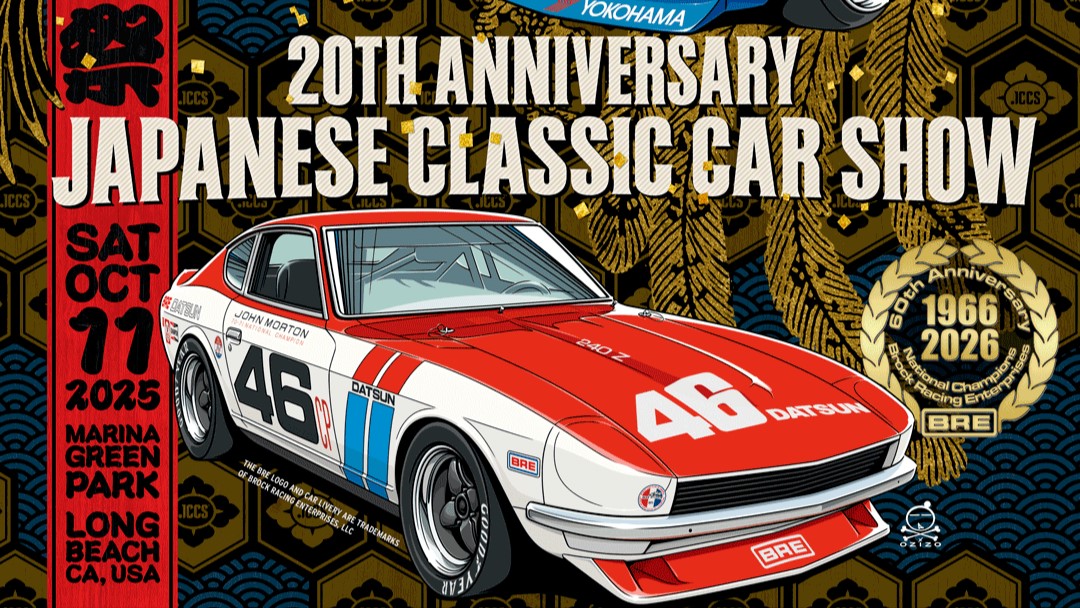
It’s stunning how quickly time seems to pass. If you’re of a certain age, you might think the 1990s weren’t that long ago, but they were. The Z32 Nissan 300ZX, Mk IV Toyota Supra, and FD Mazda RX-7 are now in their 30s. And the Japanese Classic Car Show (JCCS) on October 11 will mark the 20th anniversary honoring machines from the “Land of the Rising Sun.”
Photo courtesy of the Japanese Classic Car Show
According to the JCCS website, “Back in 2005, Japanese cars weren’t even widely seen as ‘classics.’ Now, thanks to a passionate community of fans, builders, and collectors, we’re proudly celebrating the craftsmanship, culture, and legacy that continue to thrive in the U.S. and beyond.” So expect to see USDM and JDM versions of Japanese performance cars, racing vehicles, sedans, and even SUVs from yesteryear at the Marina Green Park in Long Beach, California this coming Saturday. You can also expect to see coverage of the show on The ClassicCars.com Journal from Honda and Acura enthusiast Tyson Hugie.
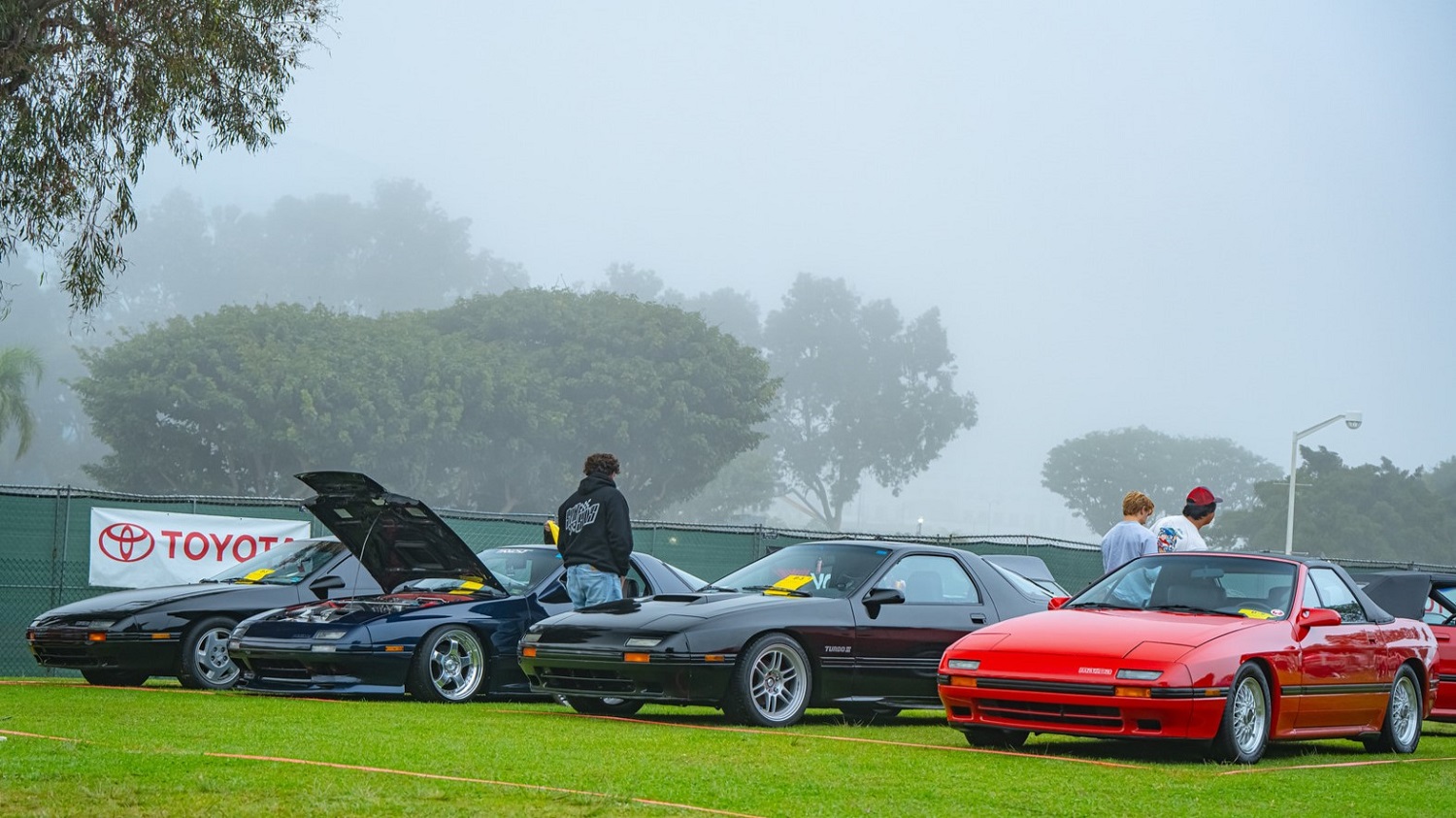
FC Mazda RX-7s (Photo courtesy of the Japanese Classic Car Show)
It’s been 60years since automotive designer Peter Brock left Shelby (where he penned the lines of the Daytona Coupe) and started his own company, Brock Racing Enterprises (BRE). The BRE race team’s Datsun 240Z went on win two C Production National Championships; its 510s and driver John Morton took 1st place in the 1971 and 1972 Trans Am 2.5 Championships. Brock, Morton, and other members of the original BRE race team will be at the JCCS to mark the big anniversary—next to the Nissan booth, of course.
Photo courtesy of the Japanese Classic Car Show
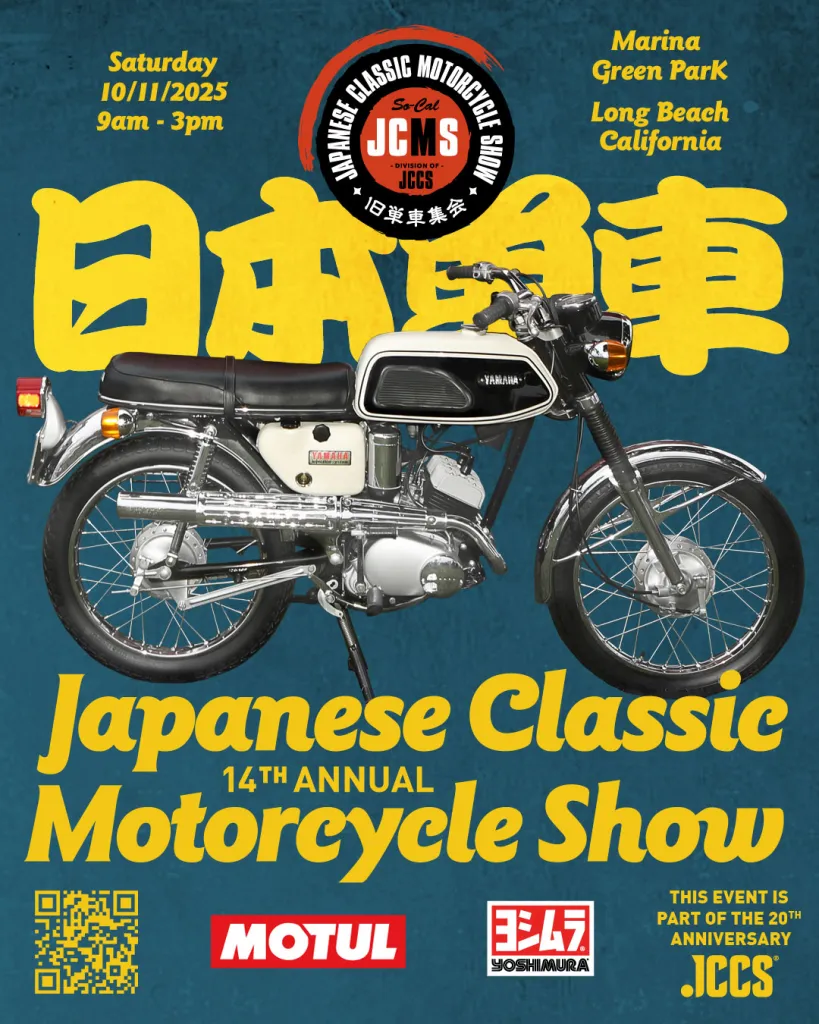
There will also be plenty of cool bikes to check out because the 14th Annual Japanese Classic Motorcycle Show will be happening at the same time.
Vehicle registration for the 20th Anniversary Japanese Classic Car Show is closed, but you can still purchase tickets and attend—currently, they’re $20 but, at the door, the price goes up to $25. How many yen is that? We’ll leave that to you to figure out.
The joy of driving didn’t become a thing in America until GIs returned from post-World War II Europe with strange vehicles from England and Italy. Detroit took note of this and developed the 1953 Corvette, a half-baked attempt that finally began to fulfill its objective two years later.
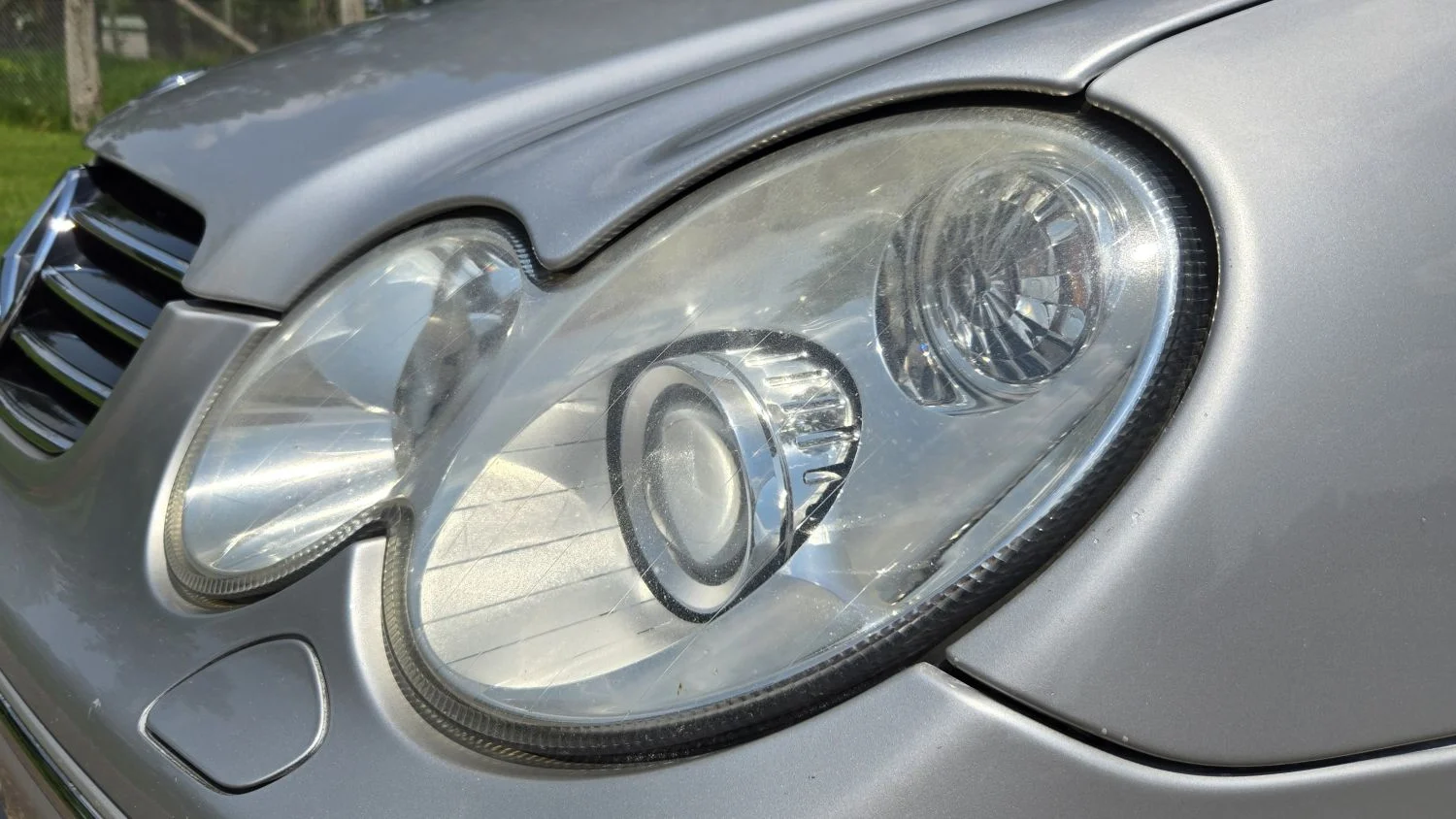
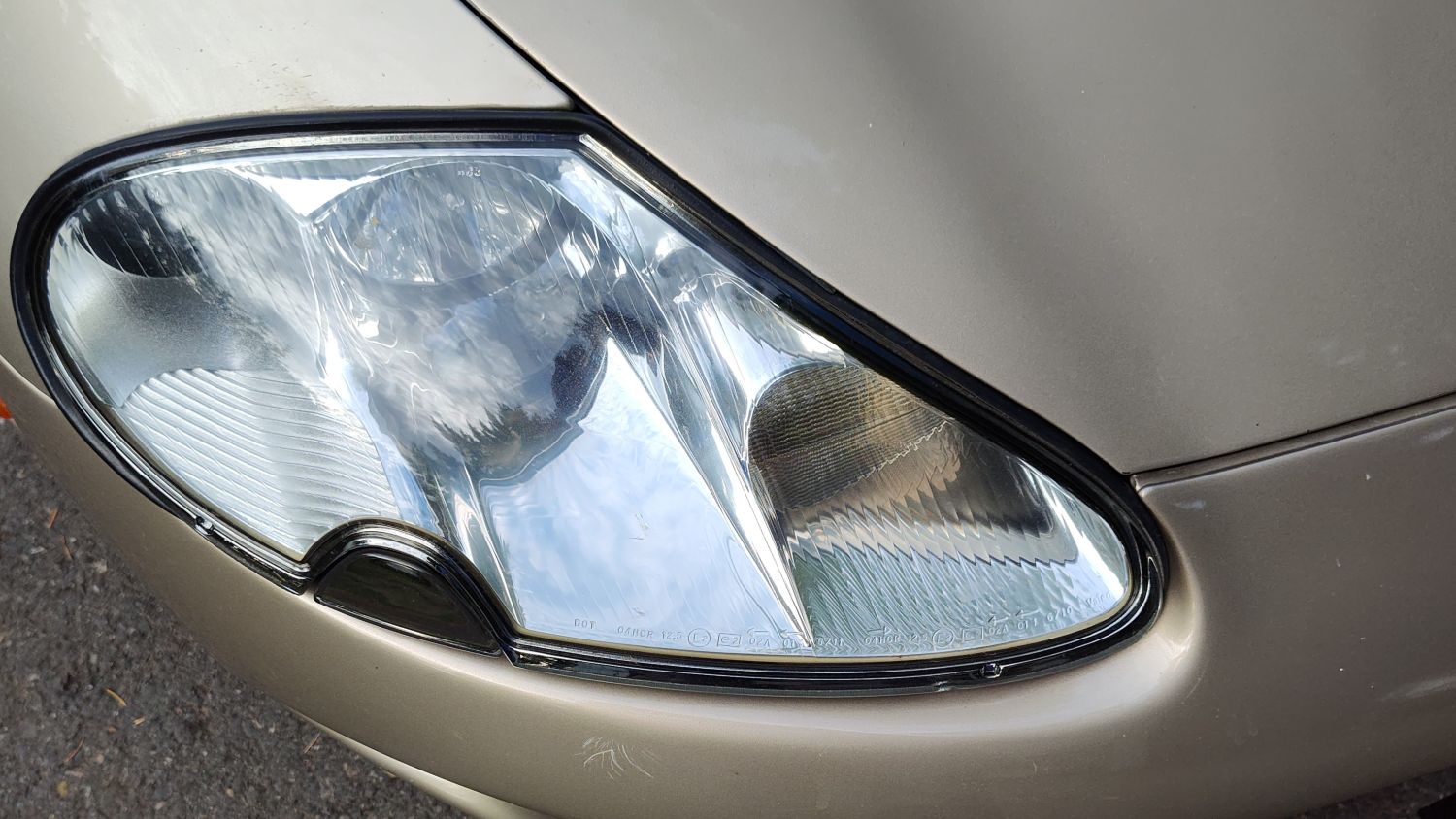
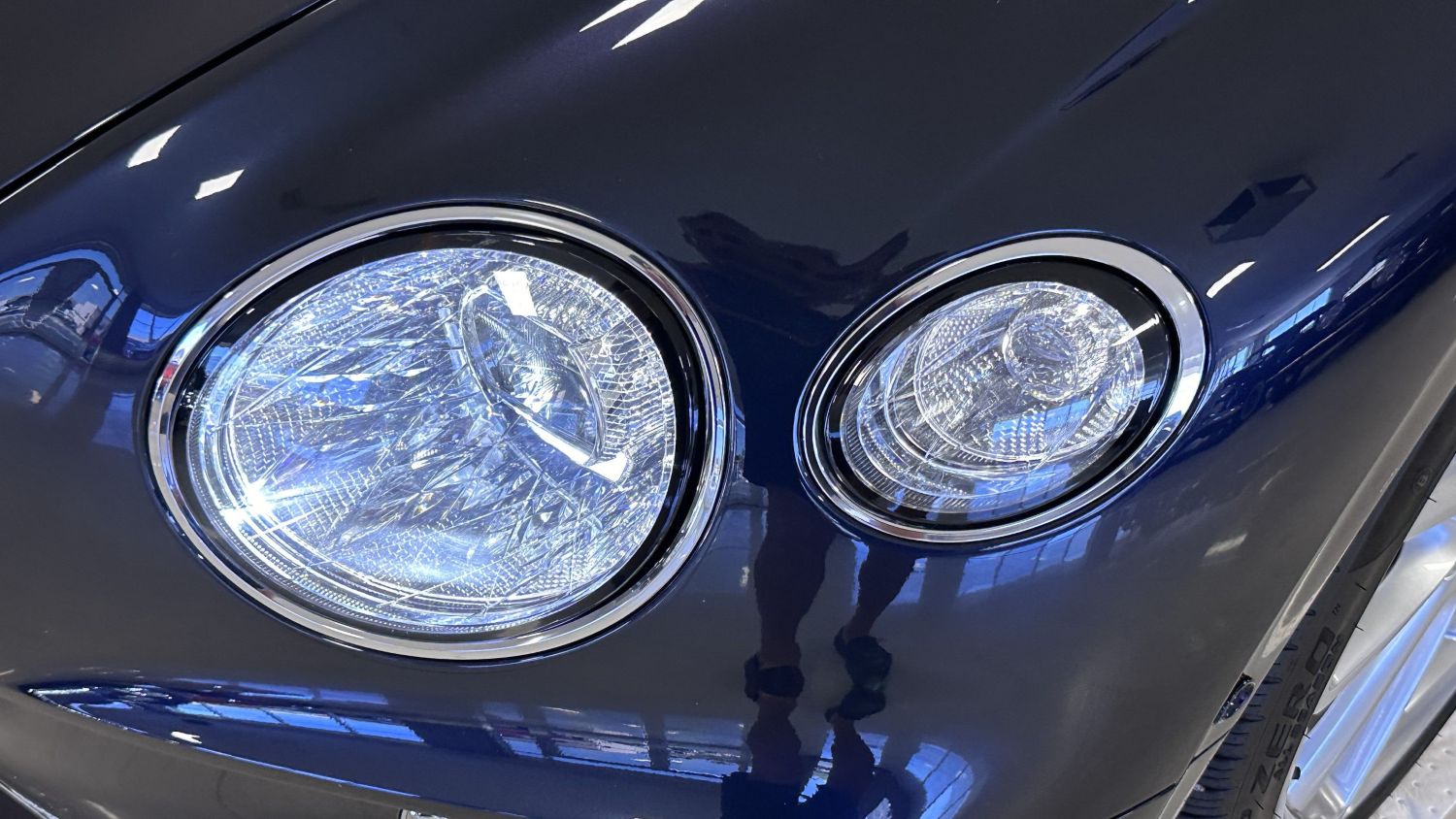
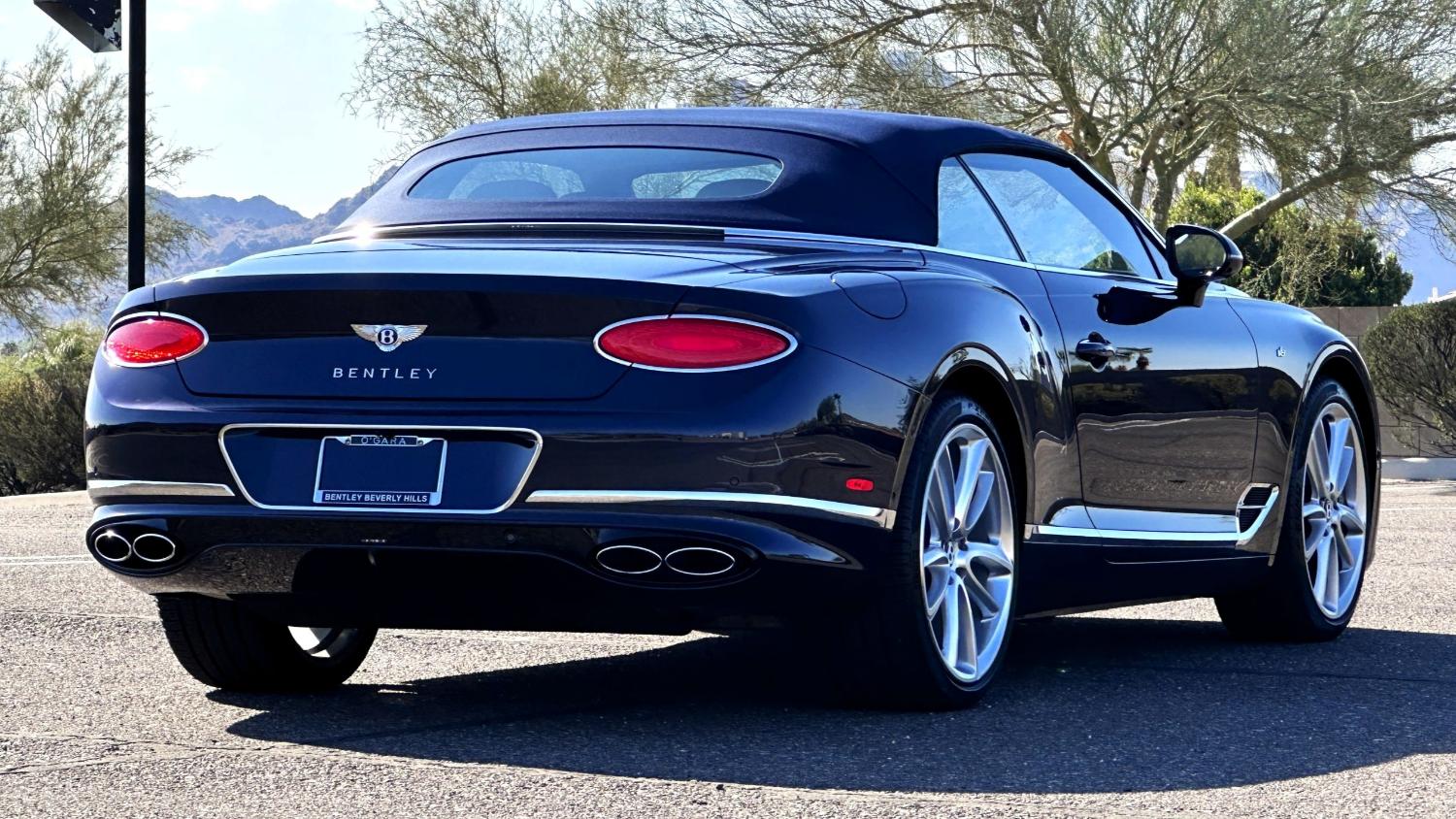
Below you’ll find four vehicles currently for sale on AutoHunter that are modern takes on gran turismos, luxurious grand tourers designed for high-speed, long-distance driving. Can you identify them? Post your answers in the Comments section below, including model year, make, and model. Having trouble identifying a car? You can click on an image for a quick cheat.
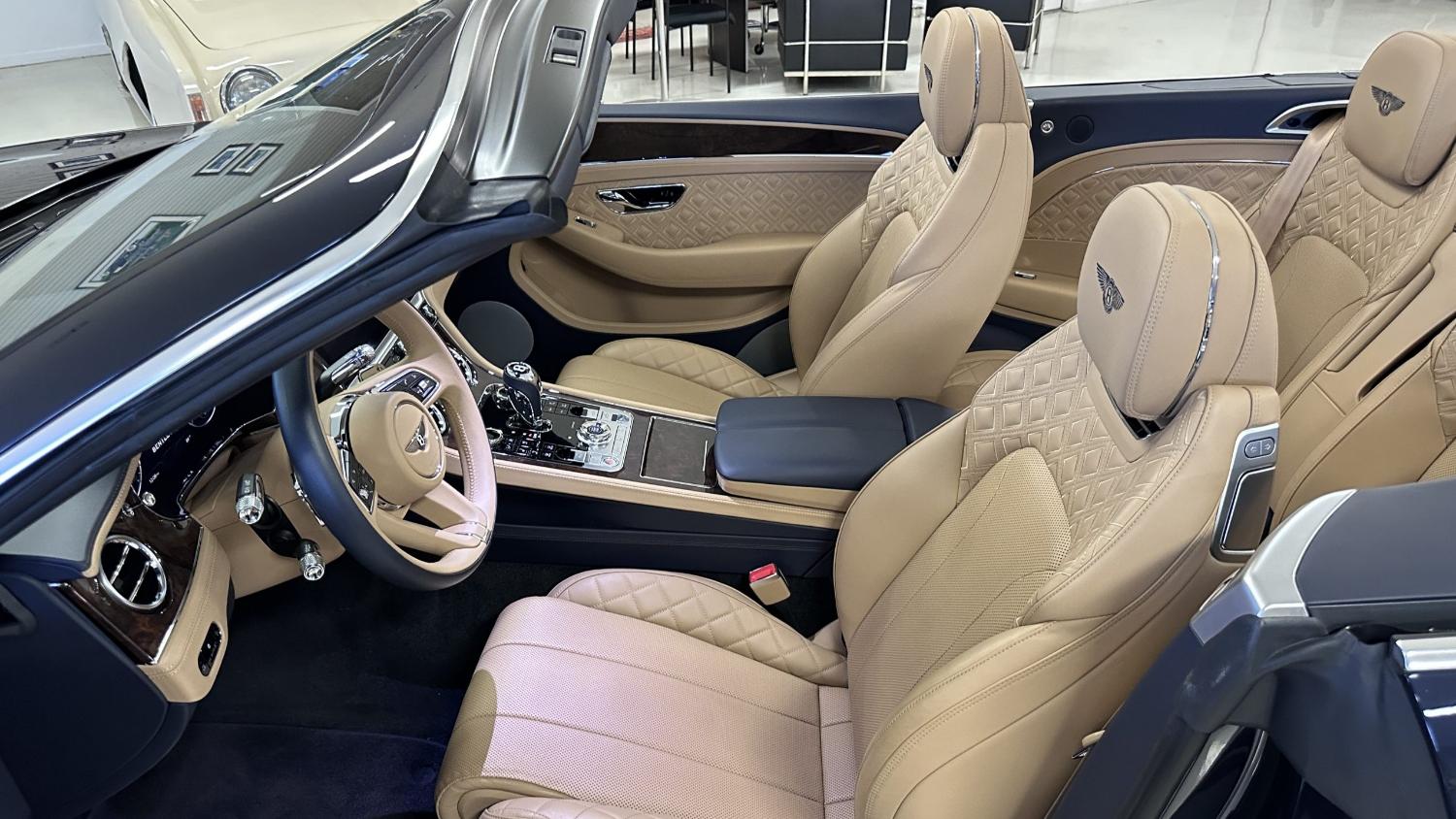
Currently listed on AutoHunter is this 5,142-mile 2021 Bentley Continental GTC, one of 1,972 built. Power comes from a twin-turbo 4.0-liter V8 paired with an eight-speed dual-clutch automatic transmission. Features include active all-wheel drive, special Mulliner Driving Specification, adjustable suspension, a suite of driver assistance features, and much more. Painted in Dark Sapphire Metallic with a blue top over a Camel leather interior, this gran turismo convertible comes from the selling dealer with a Bentley jump box, wind deflector, an umbrella, a clean CARFAX, and a clear title.
The Dark Sapphire Metallic paint is nicely complemented by lower-body chrome trim. Of course, the blue soft top is power-operated and includes a tonneau cover. Also note the jewel-like headlights with 55 individual LED lights each. Other features include a pair of twin exhaust pipes and dual power-adjustable side mirrors. A set of 22-inch Open Spoke Alloy wheels is wrapped in staggered-width Pirelli P Zero radials—275/35 front, 315/30 rear.
The Camel leather upholstery includes power-adjustable bucket seats with the Front Seat Comfort package. Other interior features include Burr Walnut trim, adaptive cruise control, a heated steering wheel, wireless charging, a 12.3-inch high-resolution touchscreen with a 360-degree camera view, and much more.
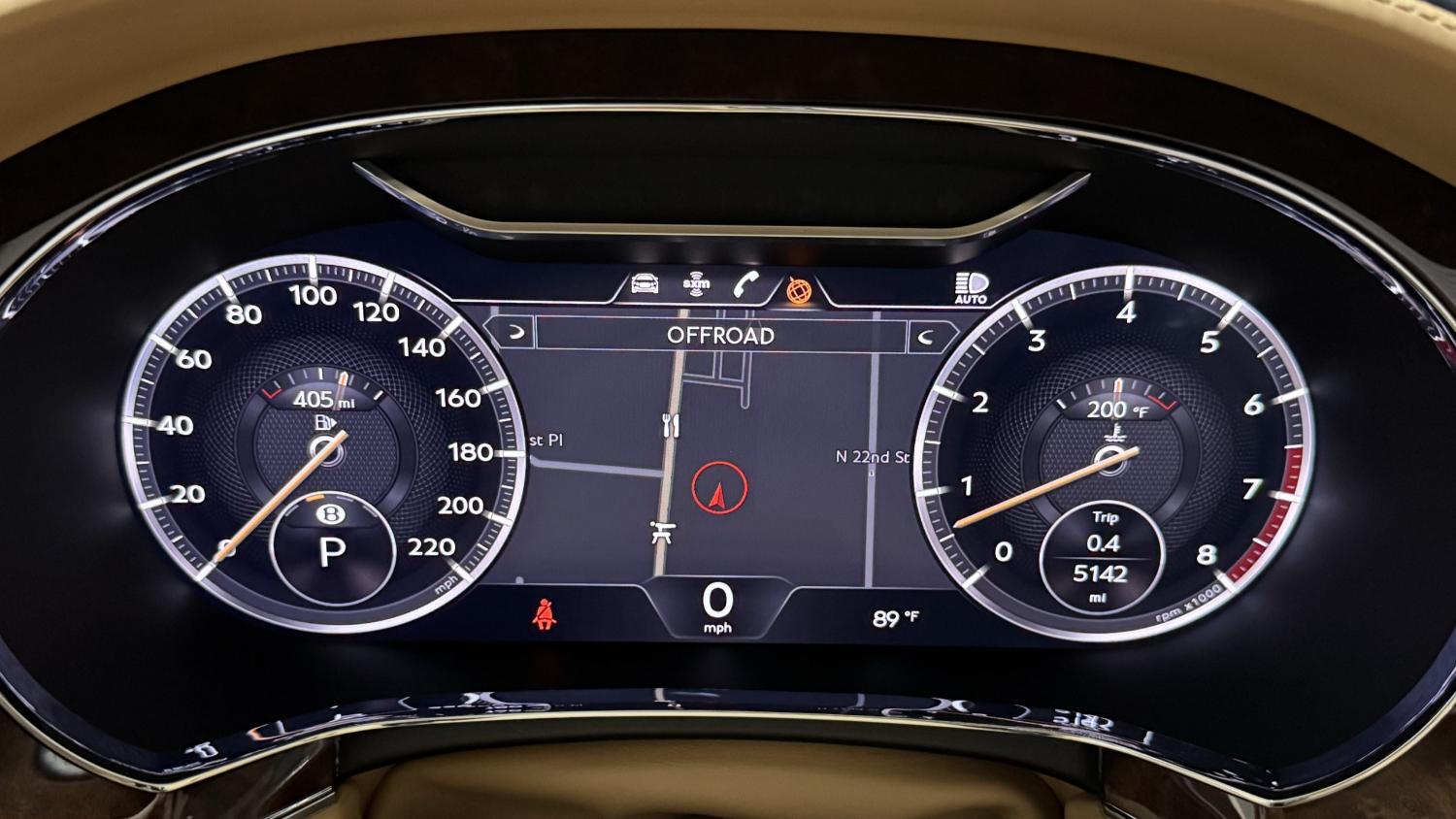
The instrument panel consists of a 220-mph speedometer, an 8,000-rpm tachometer, gauges for the fuel and water temperature, and a GPS display. A rotating display on the center portion of the dashboard includes a thermometer, compass, and stopwatch. The odometer shows 5,142 miles, which is in line with the CARFAX reading from January of this year.
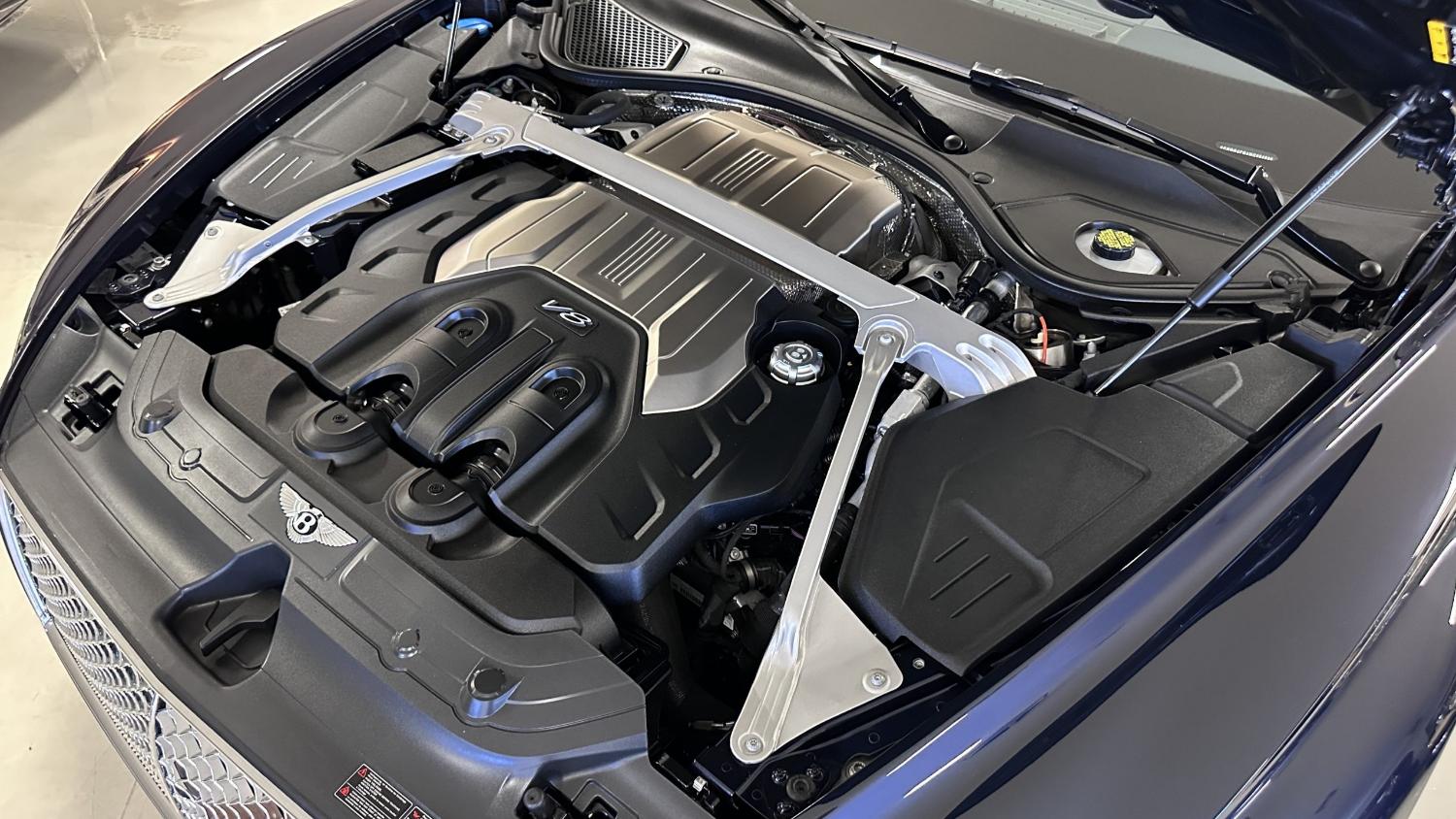
Under the hood, you’ll find a twin-turbo 4.0-liter V8 putting out 542 horsepower and 568 lb-ft of torque. All that is deployed by an eight-speed dual-clutch automatic.
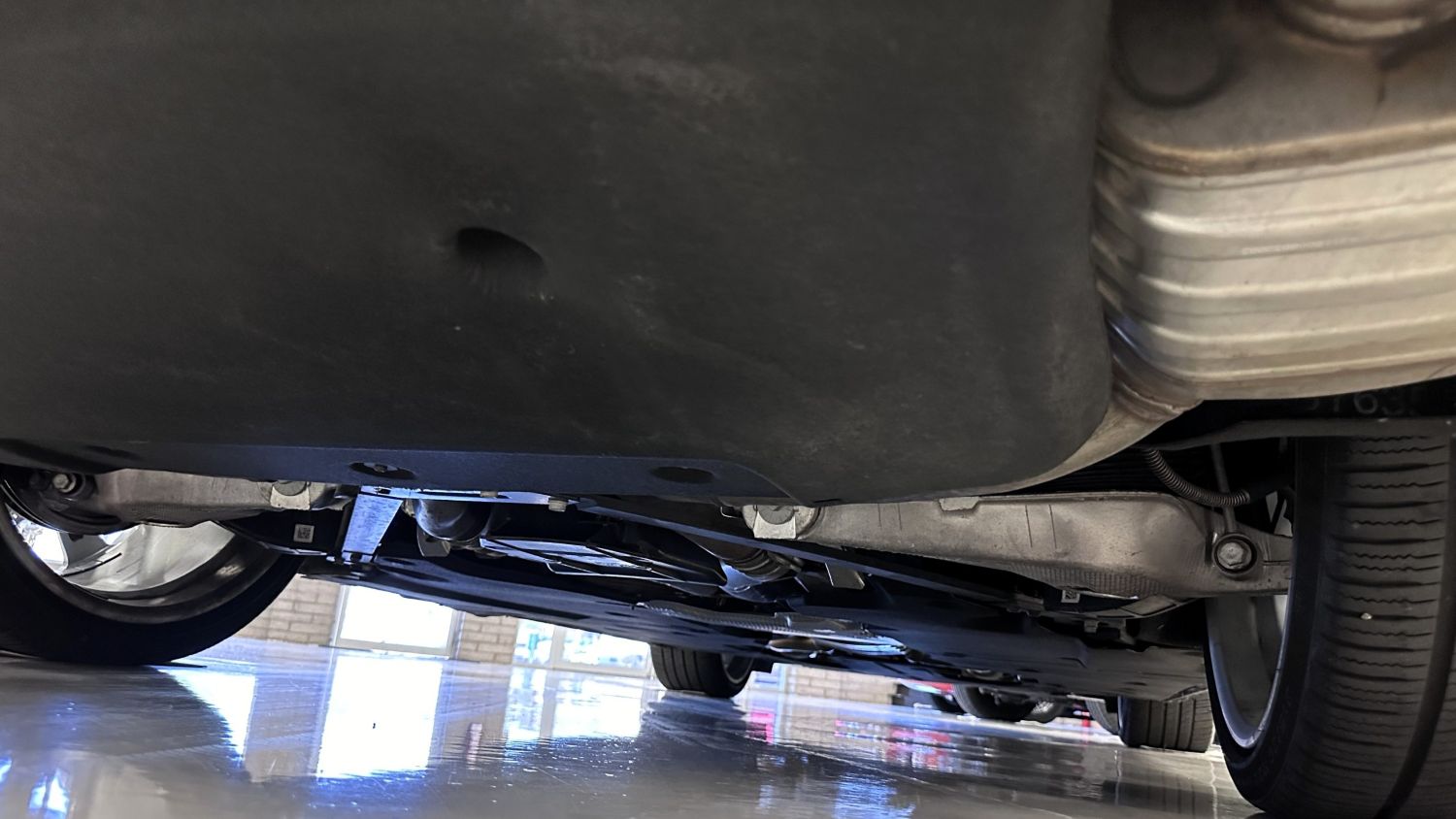
The undercarriage features an Active All-Wheel Drive system, adjustable suspension, and power four-wheel disc brakes.
It has been said that it is good to be the king. This 2021 Bentley Continental GTC is a convertible that treats you like one with its copious power and lushly trimmed interior, the latter part of the deluxe Mulliner Driving Specification. Coronation is approaching, so place your bid on this drop-top chariot because the auction ends on Thursday, October 9, 2025, at 1:00 p.m. (PDT).
Though there is some argument about it, for most people the Pontiac GTO introduced the world to the idea of muscle cars. At this point, it is a legend, and every generation of the GTO is desirable in its own right.
What Pontiac did extremely well, and probably better than any other manufacturer, was to modify and change the GTO to respond to the changing needs and expectations of buyers. What started out as basically an option package for a GM intermediate-class car, the Pontiac LeMans, evolved into a vehicle that was not just an option package, but its own model.
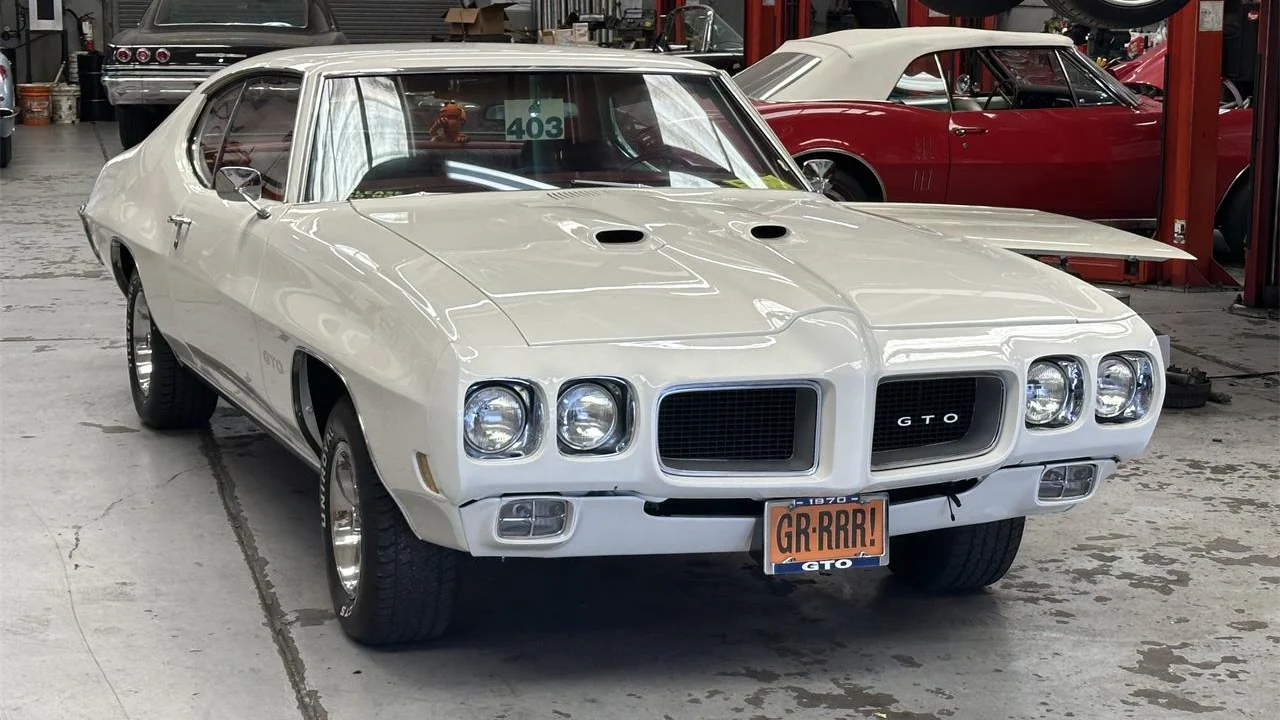
In 1968 the GTO received a complete redesign with much more streamlined styling, incorporating a sort of fastback-style rear window. Pontiac also redesigned the front bumper in the body color, which was made out of a plastic called Endura. You could still get a GTO with a chrome front bumper if you wished, but the body-colored bumper, along with the dual hood scoops, are to me what makes this generation of GTO super cool-looking and very 1970s aggressive.
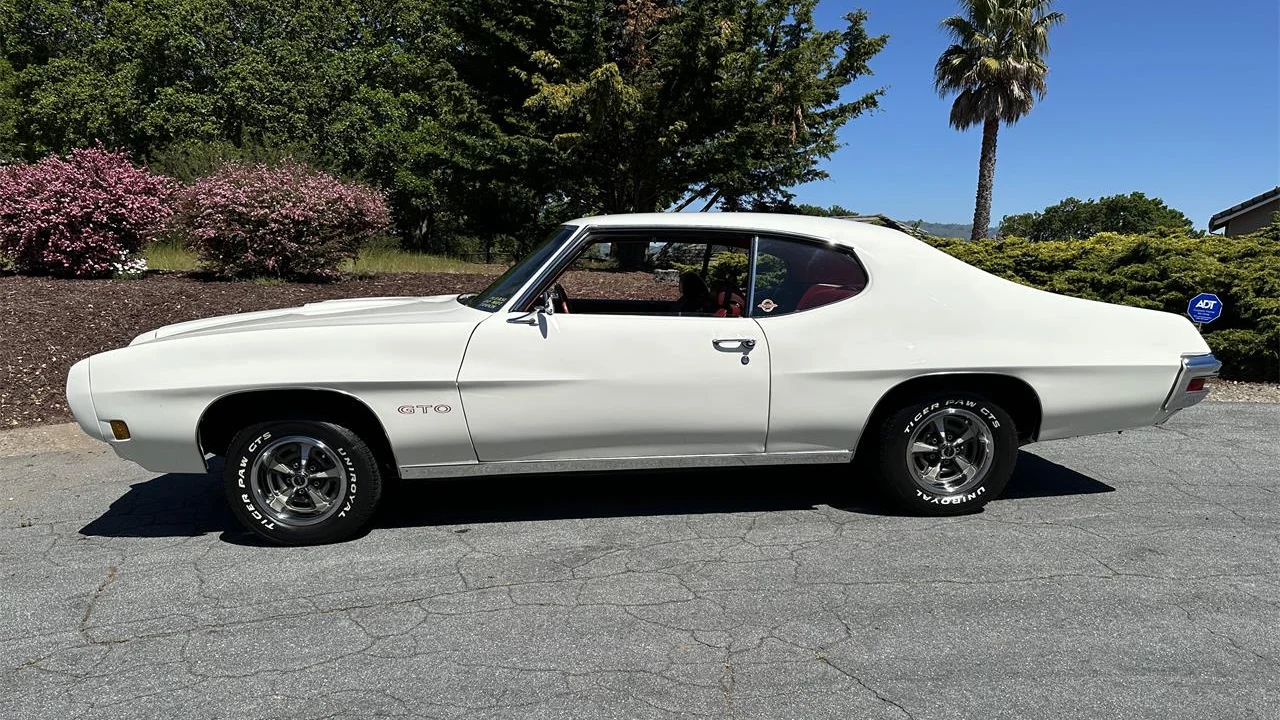
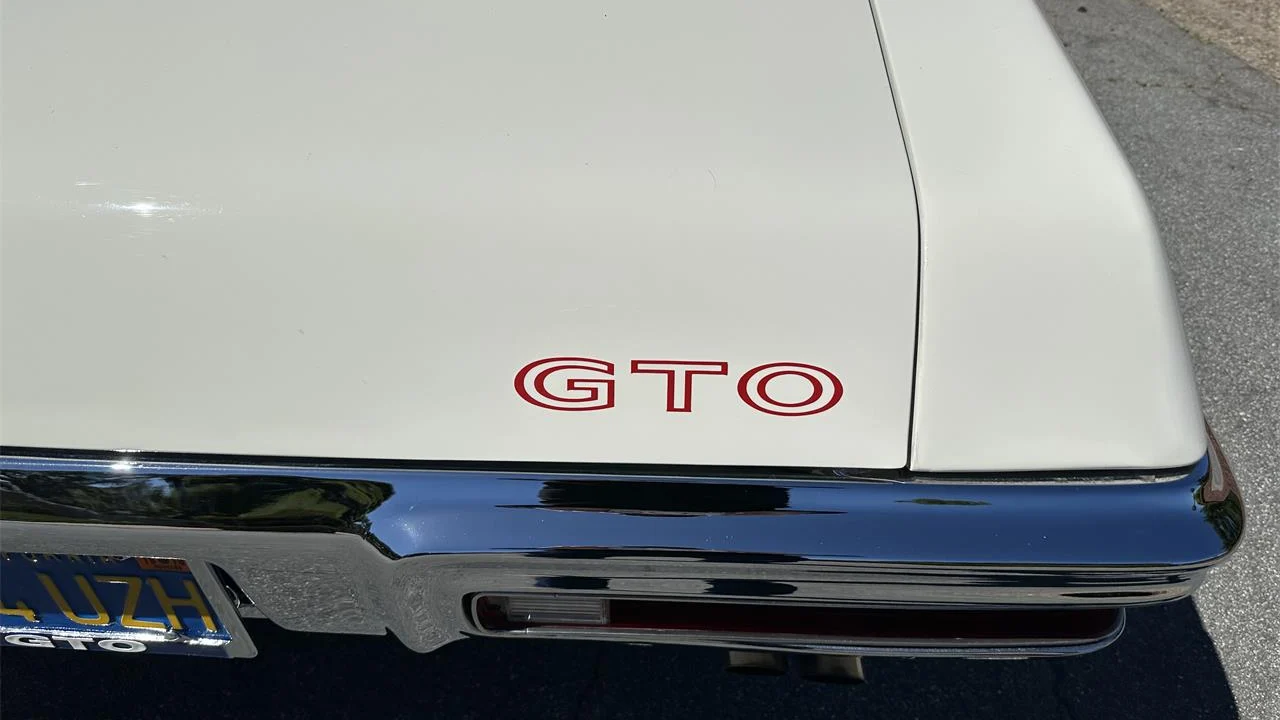
The seller describes this 1970 GTO as a “gorgeous restored” example painted in its factory color of Polar White with a basecoat/clearcoat process. The seller goes on to say that the second owner had it for 25 years and that they are the third owner.
The car was restored five years ago and has been garaged ever since. In the comprehensive description, the seller reports that at the time it was restored, new weatherstripping and window felts were installed. The car is said to still have all its original Soft Ray tinted glass, with the side and back glass in excellent condition. The seller also states the stainless steel around the original front and rear windows is in great shape, and the photos appear to support that. In addition, the car received new side-view mirrors, while the door handles are original and look great. Importantly, the original front Endura nose and grilles are also in excellent condition, as these can often suffer over the years. The car retains its original headlight bezels and parking lights, as well as its original wheel well and rocker moldings, all of which look outstanding. The seller also states that the car’s original rear bumper has been rechromed.
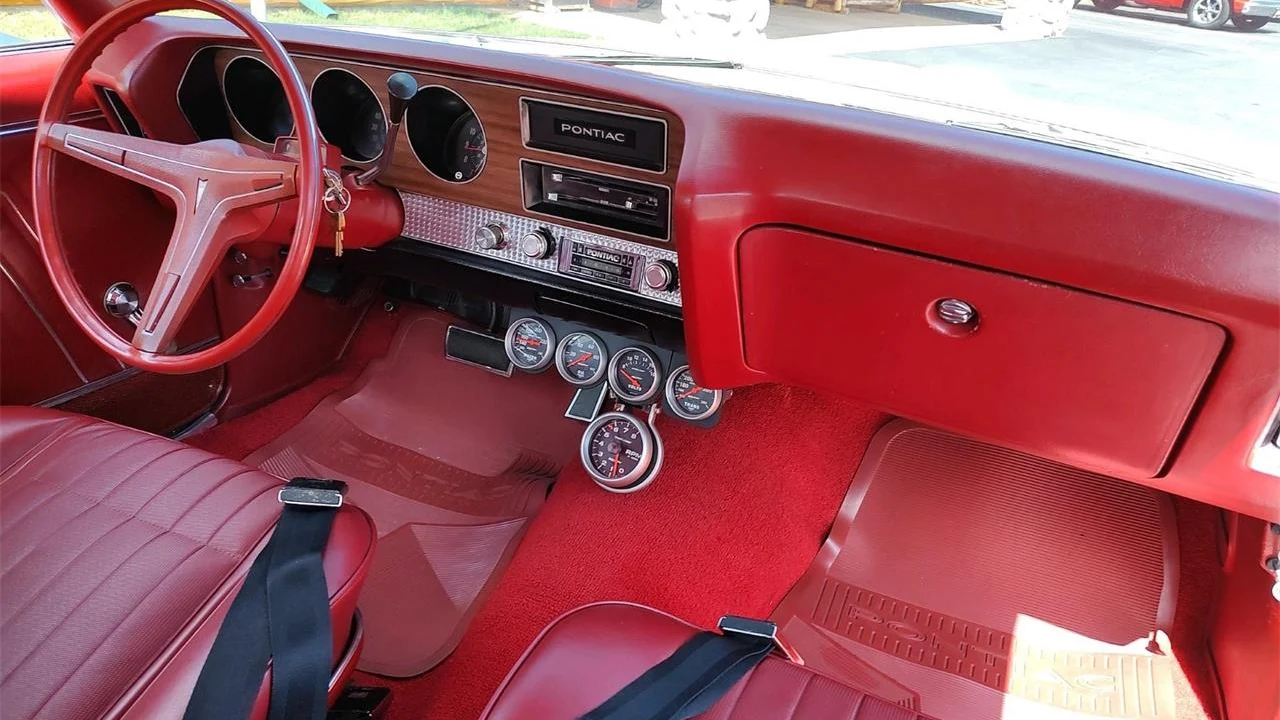
This GTO’s interior is also in extremely good condition, having been completely redone (apart from the original dash) by Legendary Auto Interiors during the restoration. This included the factory-correct red bucket seats, sail panels, deluxe package shelf, headliner, front and rear door panels, armrests and bases. The instrument cluster, which currently shows 72,000 documented miles, is original. The car does feature an upgraded Alpine AM/FM stereo with Bluetooth, happily hidden in the glovebox. A quad set of gauges and tach are mounted under the dash. The car has a deluxe steering wheel (with all three horn buttons working) and deluxe seat belts with shoulder belts front and rear, as well as new carpet, deluxe Pontiac floor mats, and new sill plates.
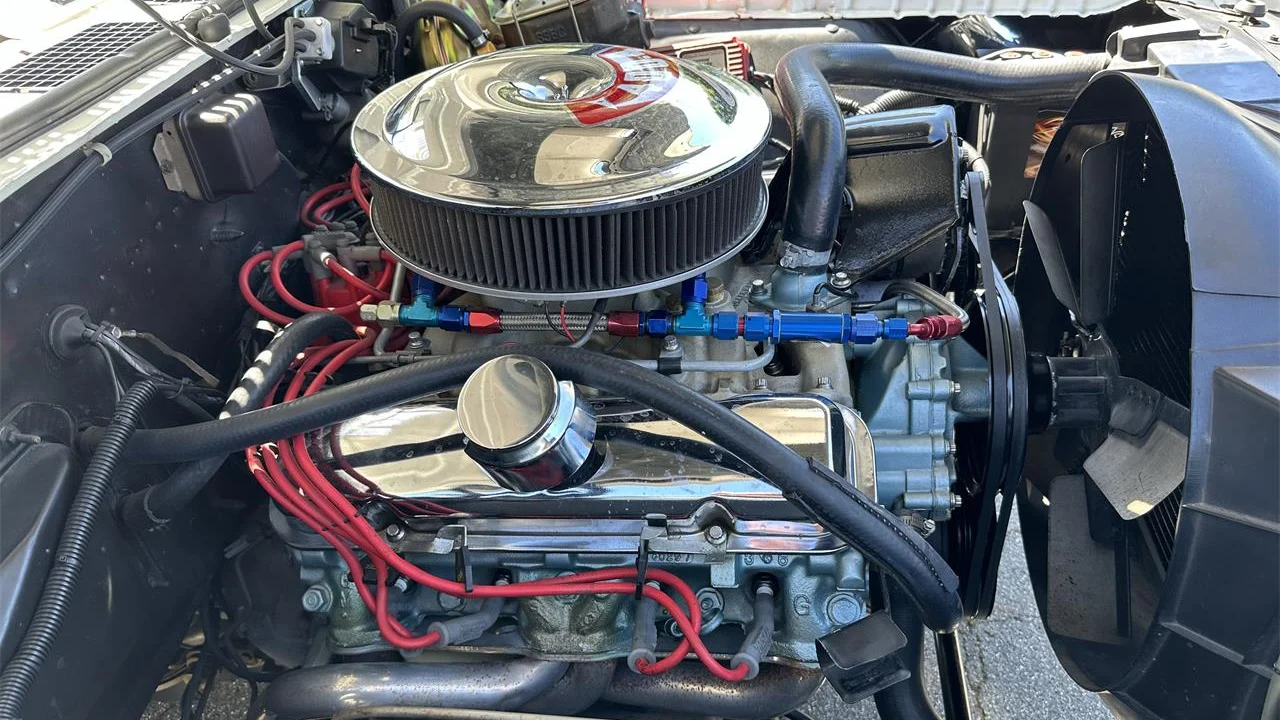
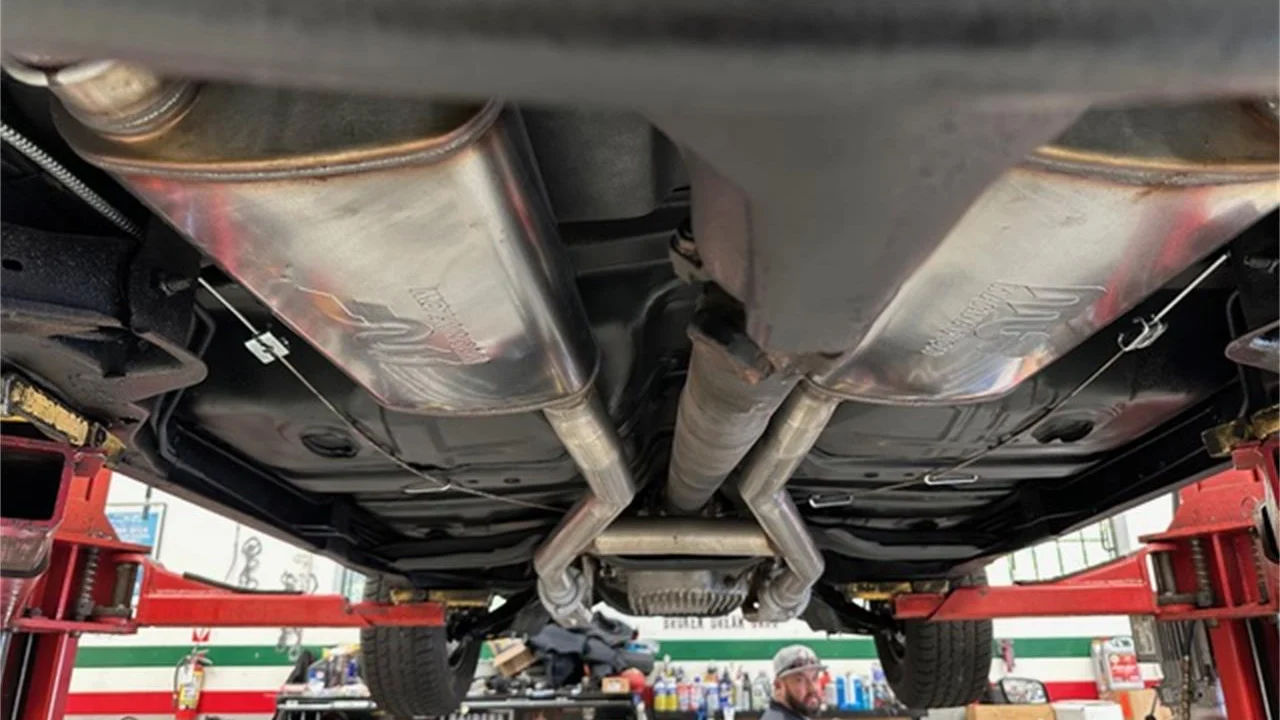
Under the hood of this GTO is a professionally rebuilt and blueprinted, correct Pontiac YS-code 400ci V8 with less than 5,000 actual miles. It has been bored out to 407ci and produces 444 documented horsepower. Other mechanical upgrades include an Edelbrock aluminum four-barrel intake, Demon four-barrel carb, chrome valve covers and breather, K&N filters, full MSD ignition with billet distributor, RPM red line governor chip, heavy-duty radiator with correct shroud and fan, a set of ceramic coated Hooker long-tube headers into a 2.5-inch dual MagnaFlow exhaust that exits out the back with correct tips, and power front disc brakes. What I really like most about the modifications is how understated they look when you peek under the hood.
The awesome power of this engine is carried to the rear wheels by a professionally rebuilt, smooth-shifting 400 transmission with a 2800 converter. The car also features an F41 suspension package with a larger front sway bar, rear sway bar, and boxed control arms. It has brand-new inner fender seals, adjustable shocks, springs, ball joints, and bushings, factory Safe-T-Track rear with 3.55 gears (updated with an Auburn posi unit), and a new fuel tank and sending unit. The car rides on a set of factory Rallye II wheels with correct PMD center caps and black dot lug nuts, 235/60 all around.
This truly looks to be an exceptional example of a 1970 GTO, with all the mods you would want to work well in today’s world. I don’t think I would change a thing on it. For me, this would be an awesome choice for a tour or vintage rally car. I say “tour,” as I would enter this car into something like the Copperstate 1000 and proudly represent the muscle car community at that event, which is primarily comprised of sports cars. I would guess this car is quite a bit quicker than the European sports cars on that rally and, without question, more reliable. Personally, I would gladly take home this GTO and park it in my garage.
You probably want to know what all this awesomeness is going to cost you. Well, the asking price for this 1970 Pontiac GTO is only $54,500. If that seems steep, you are nuts, as this car has way more than that invested into the restoration. In my opinion, it looks like a great value for an iconic muscle car that’s been restored this nicely.
This ’32 Ford roadster was built in 1981 by Dick Brogden, President of L.A. Roadsters and shop manager for Boyd Coddington. It remained in two collections between 2000 and 2020, when it was acquired by the seller. The full-fendered roadster body and frame are both original Ford steel, per the seller, and it rides on a drop axle with a four-bar setup up front and a four-link rear end with adjustable coilovers. A 355ci Chevrolet V8 with 202 heads and headers is linked to a TH400 automatic transmission and a Ford 8″ axle. A 21-louvered hood, a filled grille shell, a 2″ chopped windshield, a banjo-style steering wheel, and retro-look gauges are additional details. The car was used for promotional posters and featured in Street Rodder magazine while owned by Brogden, and it was reportedly the test vehicle for the first set of center-lock wheels built by Coddington. Since that time, steel wheels, rubberized running boards, and chrome bumpers have been added along with electronic ignition. This ’32 roadster is now offered with historical literature featuring the car, the unmounted Boyd center-lock wheels, a car cover, and a clean Illinois title in the seller’s name listing the car as a 1932 Ford Special Construction.
The frame and body are both claimed to be original Ford steel, and the car features a 21-louvered hood, a filled grille shell, wind wings, guide-style headlights, a chrome front spreader bar, and a tan soft top that is removable. Chrome bumpers were added by a previous owner around 2016, and the running boards feature a rubberized top.
The car rides on a drop front axle with a four-bar setup, and out back is a four-link setup with adjustable coilovers. The previous owner added the steel wheels, and staggered Michelin tires were mounted by the seller in 2021. The car has front disc brakes, as well.
Tan upholstery covers the bench seat and rumble seat, and color-coordinated carpeting lines the floors.
The banjo-style billet steering wheel is mounted on a body-color column. The seller has added ~2,200 of the 17k miles indicated on the retro-look gauges.
The seller tells us the engine is a 355ci Chevrolet V8 with 202 heads, and it is topped by an aluminum intake manifold and has tubular headers. Electronic ignition was added a few years ago, at which time the valve covers were also replaced.
The TH400 automatic transmission is linked to a Ford 8″ rear end.
The car has been featured in multiple cover posters for L.A. Roadsters shows and Street Rodder magazine.
The center-lock wheels originally installed and claimed to be the first set built by Boyd Coddington, are included with the car.
The car is titled as a 1932 Ford Special Construction using the Arizona-assigned VIN AZ291469.
This 1955 Ford Courier sedan delivery was refurbished and modified over the course of more than a decade by a prior owner in California with work that included a repaint in red. Power comes from a 350ci Chevrolet V8 linked to a three-speed automatic transmission, and the interior has been re-trimmed with black and red vinyl upholstery, a Bluetooth-capable JVC head unit, and a column-mounted AutoMeter tachometer. An independent front suspension assembly with power steering and disc brakes was added, and other highlights include an Edelbrock carburetor, side exhaust outlets, and 15” wheels. Work performed since the seller’s acquisition in 2023 has involved updating the interior, replacing the tires, and repairing and refinishing portions of the body,. This custom Ford is now offered with trophies, two sets of keys, recent service records, and a clean Texas title in the seller’s name.
The hood ornament and badges were shaved, the fuel door was filled, and the body was smoothed under prior ownership. The car was then repainted in PPG Carrera Red, according to the seller. Details include a wraparound windshield, a side-hinged cargo door, round side mirrors, side exhaust outlets, and chrome bumpers. The right-side fender and rocker panel were repaired and refinished under current ownership, and the seller notes bubbling paint on the left-rear corner of the tailgate as well as peeling chrome on portions of the grille.
Argent Gray epoxy paint was applied to the recesses of the chrome 15” wheels, which are wrapped in 215/65 Falken Sincera SN250 A/S tires showing 2024 production date codes. A General Motors independent front suspension assembly with power-assisted steering and disc brakes has been fitted to the chassis, and they are joined by rear drums.
The bench seat is trimmed in black and red vinyl, and they are joined by black door panels. Work performed under current ownership included installing sound-deadening insulation, replacing the carpets, and adding aluminum control knobs, inertia-reel seatbelts, and dual-tone horns. The dashboard was also refinished in black and silver, and the lower section is covered with marine-grade tweed fabric. A Bluetooth-capable JVC CD head unit is connected to speakers mounted in boxes behind the seats, and an overhead console houses an analog clock and toggle-switch controls for LED cargo ceiling lights, overhead map lights, and blue ambient lighting. The seller notes that the windshield wiper motor is present but not connected.
The four-spoke steering wheel sits ahead of a column-mounted AutoMeter tachometer and a 120-mph speedometer, while a variety of AutoMeter and Summit Racing auxiliary gauges have been mounted below the dash. The five-digit odometer shows 65k miles, approximately 200 of which have been added under current ownership.
Tufted upholstery lines the sides of the cargo area, and a Tanks, Inc. fuel tank is mounted below a hinged floor panel.
The 350ci Chevrolet V8 is equipped with an aftermarket camshaft, an Edelbrock intake manifold and carburetor, and four-into-one headers that flow into a dual exhaust system with a crossover pipe.
Power is sent to the rear wheels through a three-speed automatic transmission and a 10-bolt rear end. Corrosion is visible on underbody components, which can be viewed in the gallery.
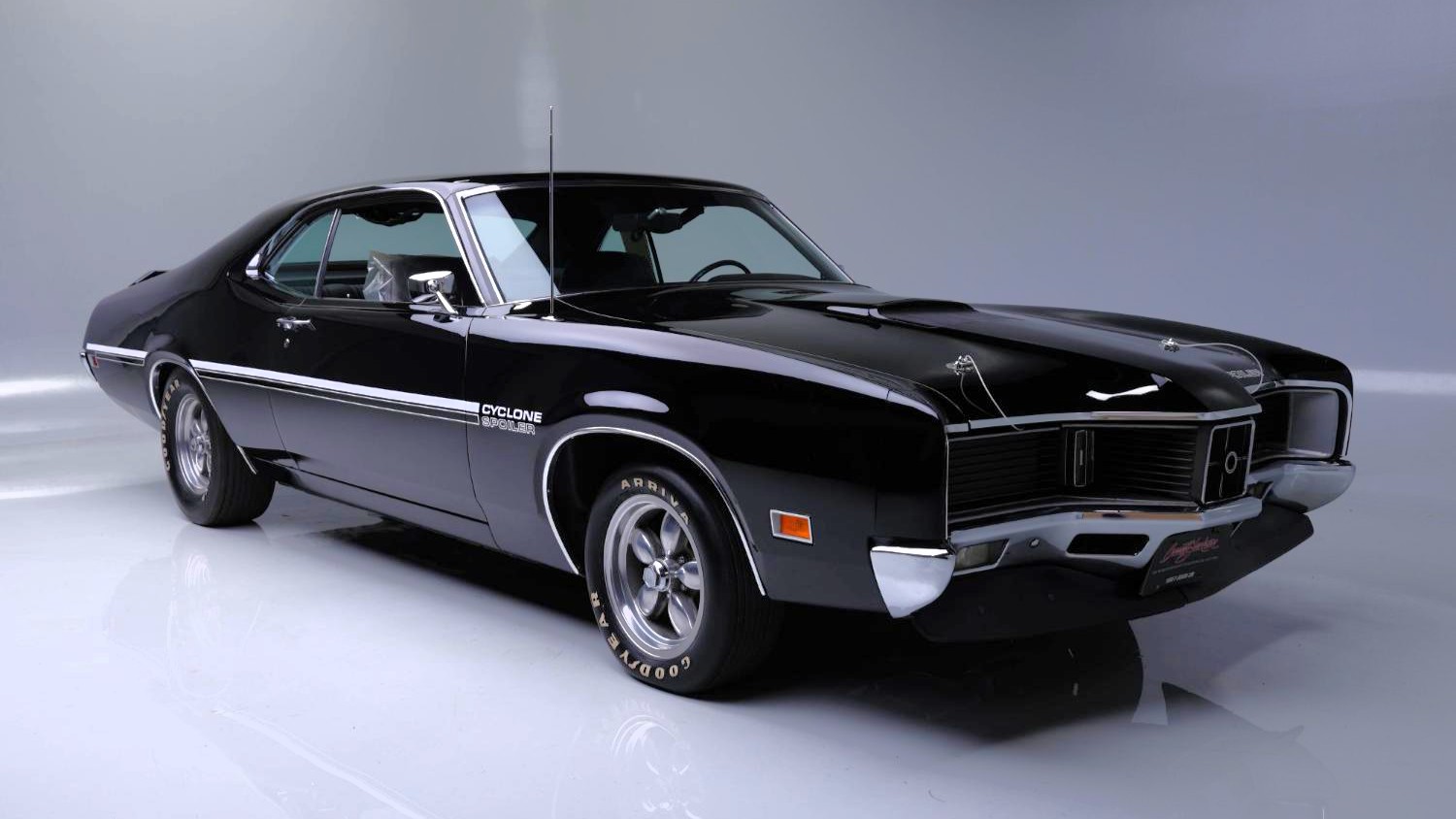
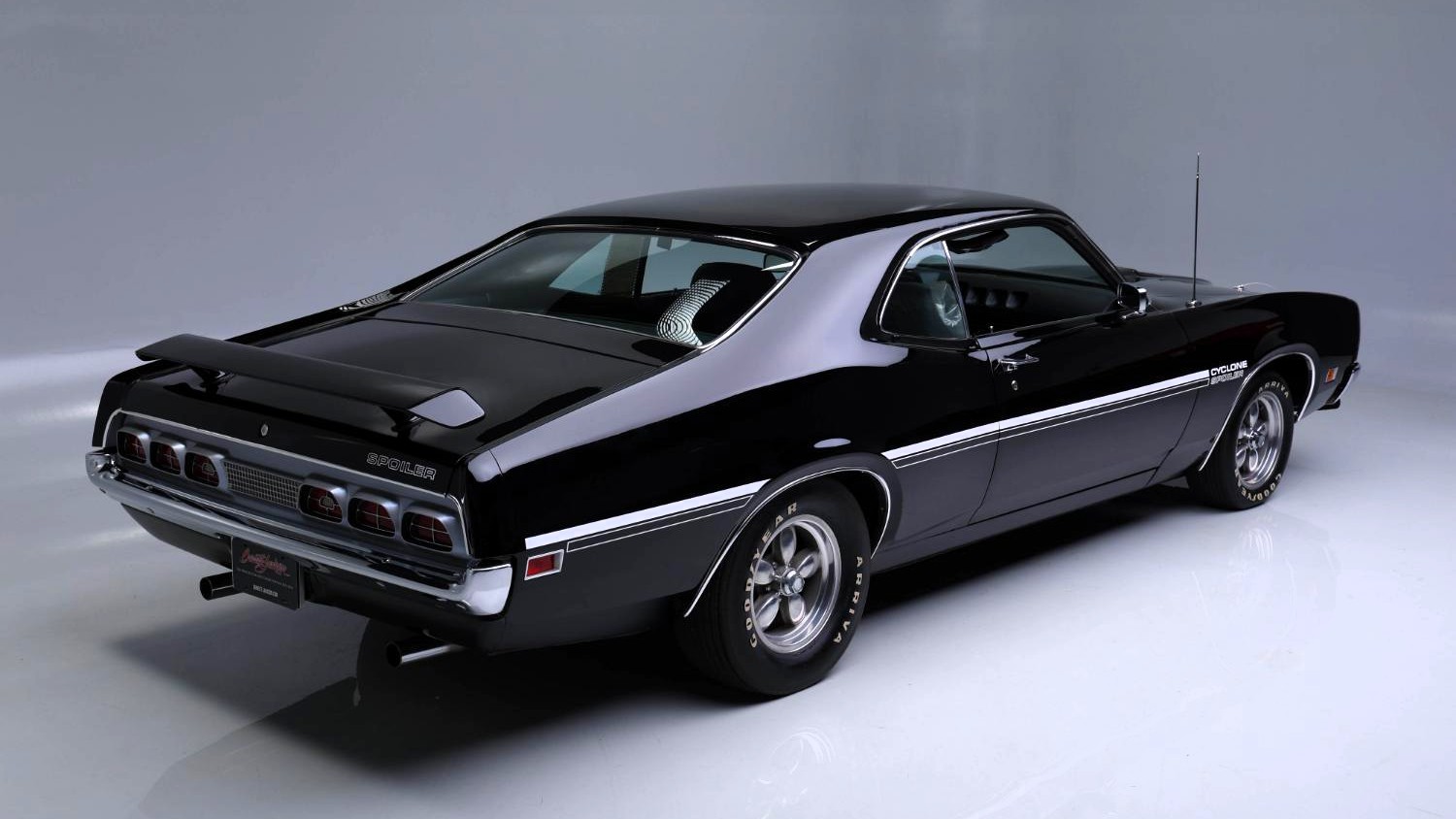
If 1970 is the high-water mark for American muscle, then this 1970 Mercury Cyclone Spoiler must be the ultimate. Arguable? Sure, so pull up a chair and listen as we make a case for this 1970 Mercury Cyclone Spoiler being the most desirable Cyclone ever built. You will be able to purchase this low-mileage vehicle with No Reserve at the Barrett-Jackson 2025 Scottsdale Fall Auction October 15-18 at WestWorld.
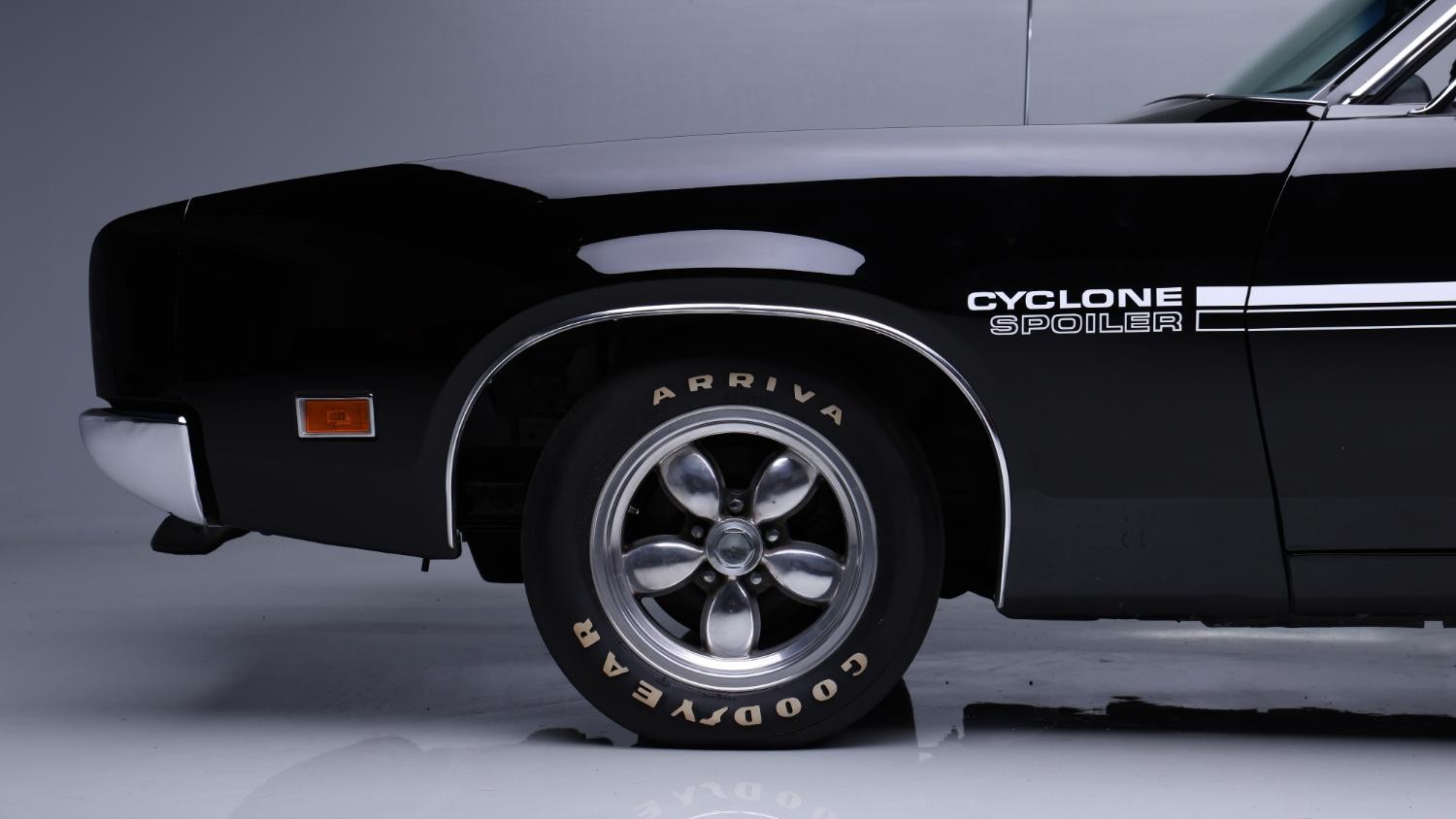
Let’s start with the obvious: this is a 1970 Mercury Cyclone Spoiler SCJ, one of 1,631 built. The Spoiler was the top model among three Cyclones that included the base Cyclone and the upmarket Cyclone GT. All Spoilers were powered by the 429 Cobra Jet with ram air and a choice of four-speed or automatic. Note the unique stripes and spoilers, all of which were not available on other Cyclone models.
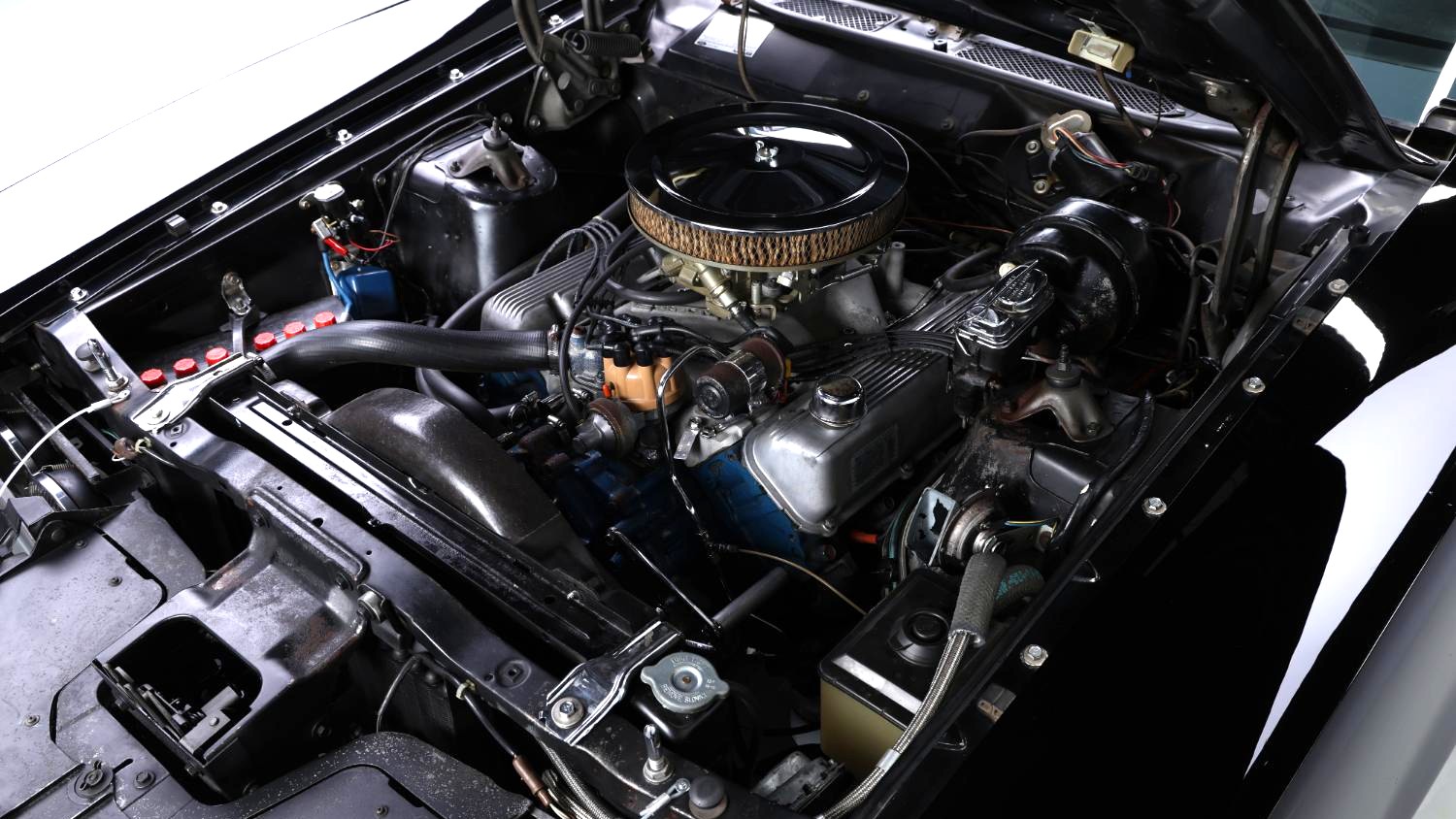
This car has something that sets it apart from most other Cyclone Spoilers: the Drag Pak, making it one of 341. Mathematically, 429 Cobra Jet + Drag Pak = Super Cobra Jet, which means this 429 received several heavy-duty tweaks to protect it from the rigors of racing. The Drag Pak also added 3.91 or 4.30 gears, the latter of which was specified for this particular vehicle.
Then there’s the special-order color. Cyclone Spoilers were available with a limited selection of colors: Competition Blue, Competition Green, Competition Yellow, Competition Orange, Competition Gold, and Pastel Blue. According to Marti Auto Works, only 31 folks decided they didn’t want any of those colors, instead opting for some other hue. How many of the 31 were black, no one knows, but few will disagree black helps this Spoiler become the ultimate Cyclone.
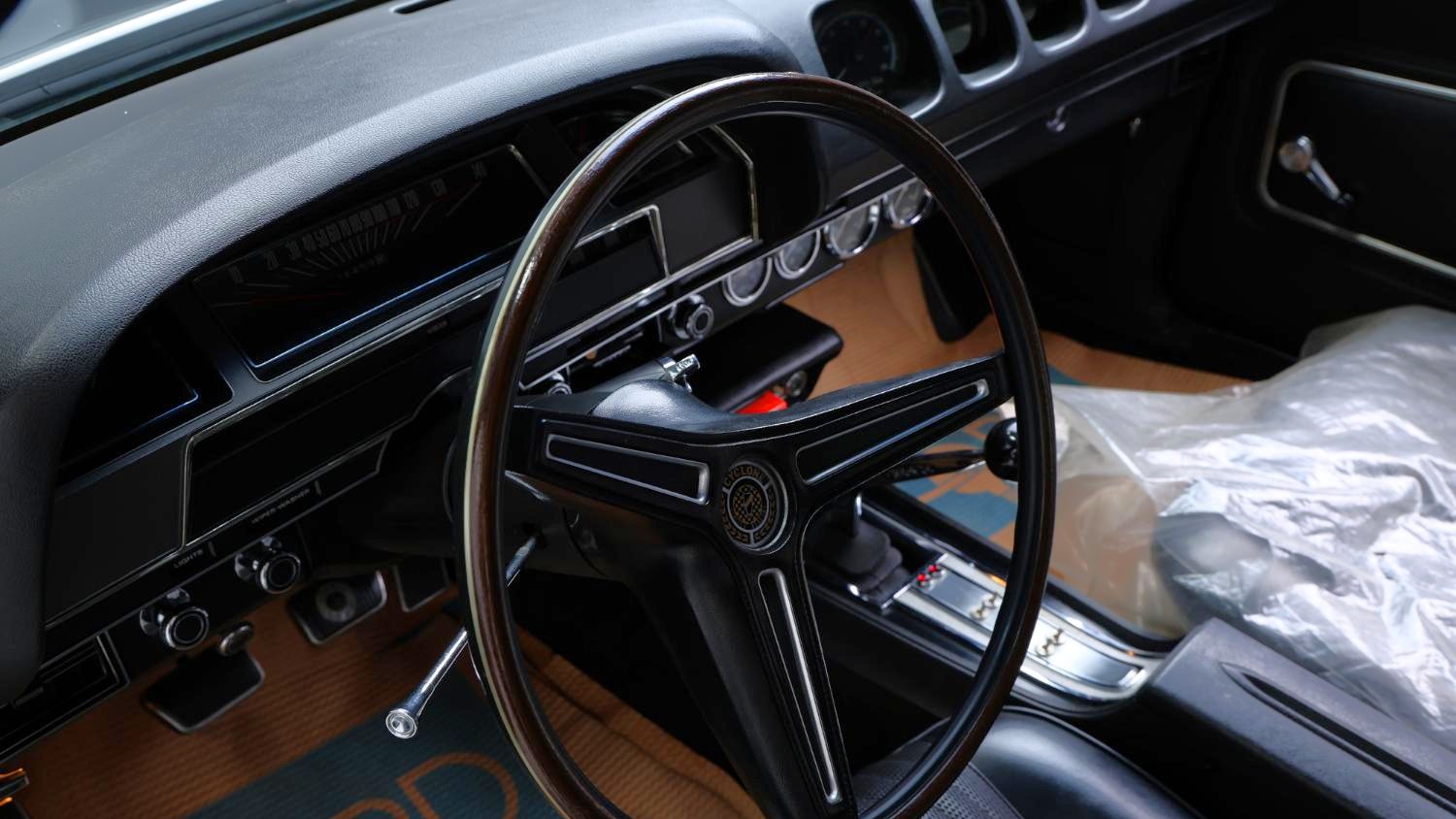
Take a peek inside and you’ll note this Spoiler has a four-speed manual with console. Glance at the odometer and your eyes will open wide at the 4,459 actual miles. It’s like this car can’t get better than it already is, yet it does—check out the “Day 2” equipment that’s been on this vehicle for decades, such as the American Racing 200S wheels mounted on Goodyear Arriva tires, the huge Holley R-4575-AAA 1150-cfm carburetor on a Shelby aluminum intake manifold, the set of eight Sun gauges mounted on the dashboard, and the Craig Powerplay 50-watt stereo amp with 8-track.
There’s even more desirable options to highlight, such as the hidden headlights and AM/FM radio, but those are regular in comparison. Seriously, what more could you want? This car has it all! If you’re a big Cyclone fan or you simply want the best of the best for your muscle car collection, this is a once in a lifetime opportunity. October 15-18, this 1970 Mercury Cyclone Spoiler SCJ will be available for bidding at the Barrett-Jackson 2025 Scottsdale Fall Auction, so you have a little time left to practice raising your arm for bidding and dancing a jig after winning.
Register for the Barrett-Jackson 2025 Scottsdale Fall Auction and bid on location or online.
ClassicCars TV was lucky to spot a 1962 Maserati 3500GTI, one of only 441 fuel-injected 3500GTIs produced between 1961 and 1964, at the Barrett-Jackson 2025 Palm Beach Auction. The 3500GT/GTI series was important to Maserati because it was the first series of road cars that the Italian company built in large numbers.
Clearly, this 3500GTI was also important to a previous owner because it received a variety of updates, including fresh paint, new leather upholstery, an overhaul of the racing-derived 3.5-liter straight-6, and a new fuel injection system. One determined bidder took this restored piece of Italian car history home with the winning bid of $187,000.
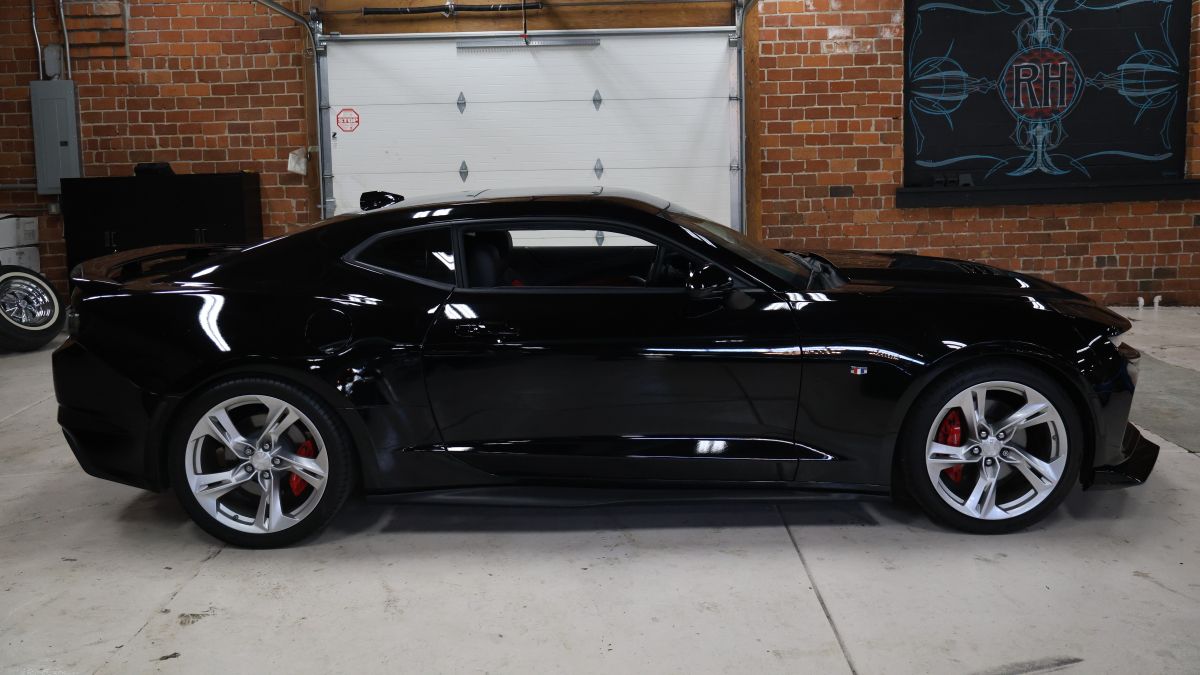
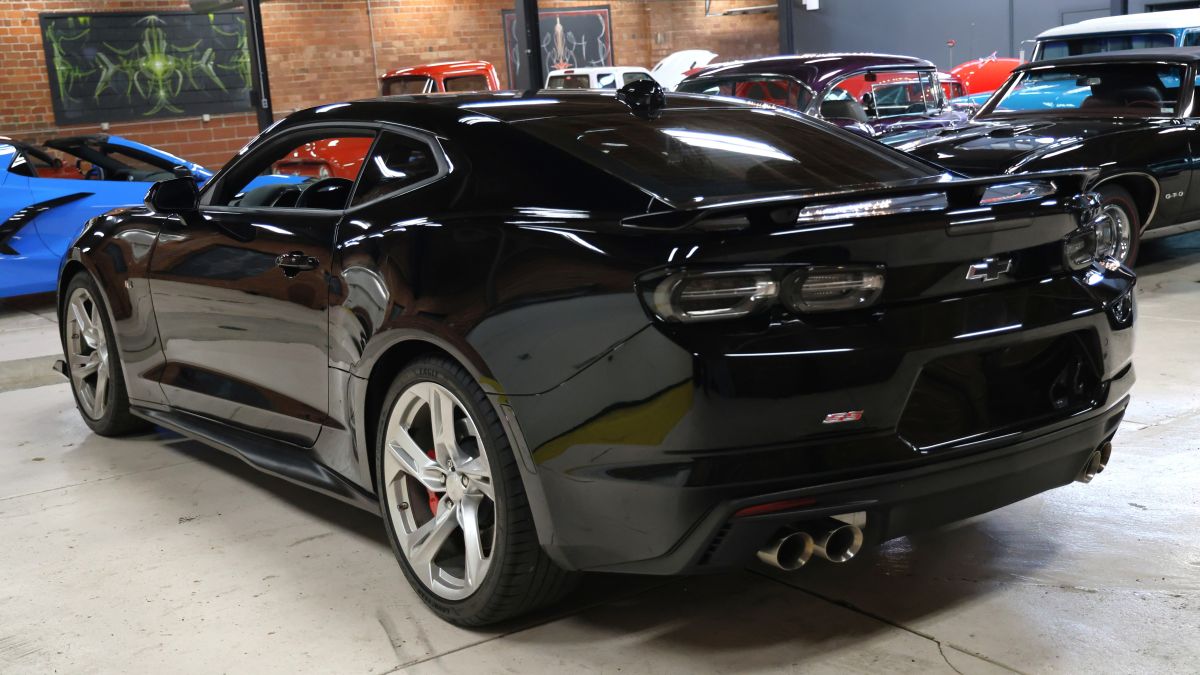
The Chevrolet Camaro has been discontinued, so remaining low-mileage examples are bound to be future collector items. Featured on AutoHunter is this 2023 Chevrolet Camaro 2SS Coupe. It is being sold by a dealer in St. Louis, Missouri, and the auction will end Wednesday, October 8, 2025, at 11:45 a.m. (PDT).
The most recent (sixth-generation) Camaro was introduced at Belle Isle in Detroit in May 2015 for the 2016 model year (here is a YouTube video that documented the in-person reveal). The car was met with acclaim in the automotive press, receiving recognition as a Car and Driver “10 Best” for several subsequent years. About eight years later, the General Motors Newsroom announced that the Camaro nameplate would formally retire at the conclusion of model year 2024. Scott Bell, Vice President of Global Chevrolet, said, “While we are not announcing an immediate successor today, rest assured, this is not the end of Camaro’s story.”
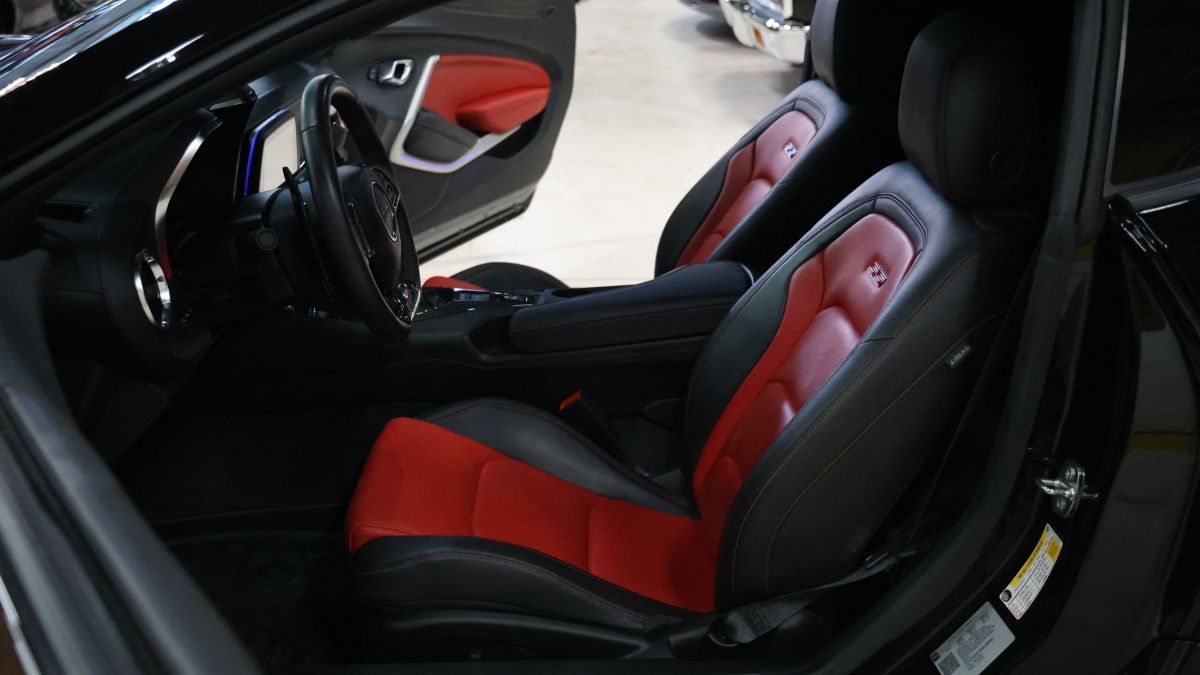
Enthusiasts are eager to hear what Chevrolet’s future plans for the Camaro will be, and there is increased appreciation for low-mileage examples like this one with only 2,728 miles on the odometer. The window sticker indicates that the car was originally delivered to Capitol Chevrolet in Austin, Texas, and had a total retail price of $50,470. That price tag included the options installed by the manufacturer, namely a 10-speed automatic transmission, remote start, power sunroof, dual-mode performance exhaust system, red-finished brake calipers, and the Adrenaline Red interior package.
Speaking of the cockpit, in my opinion that’s where this Camaro really stands out. The two-tone black and red color combinations is elegant and sporty at the same time, and the car came well-equipped for its time. Features include carbon-fiber trim, an “Infotainment 3 Plus” touchscreen, Bose Premium nine-speaker audio system, wireless charging, and dual-zone automatic climate control.
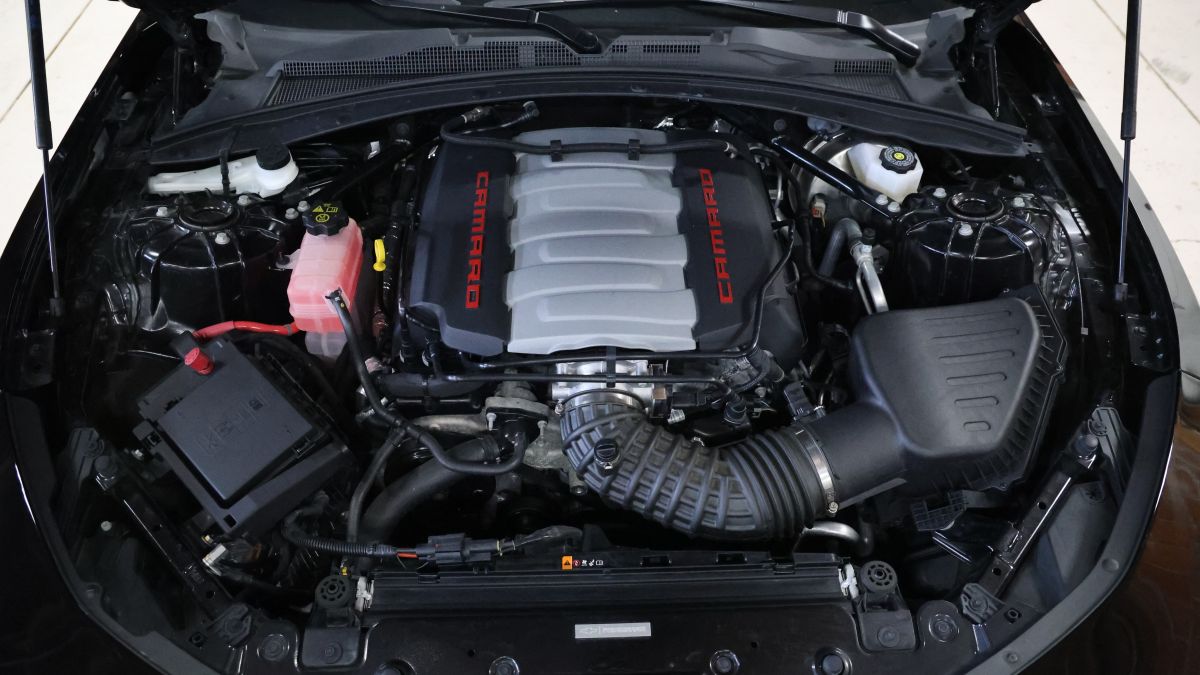
Sports car looks are best accompanied by plentiful power, and the Camaro delivers: momentum comes from an LT1 6.2-liter V8 mated to a 10L80 10-speed automatic transmission and a limited-slip differential. Chevrolet rated the car at 455 horsepower and 455 lb-ft of torque when new. One important note worth taking into consideration: according to the CARFAX report, the car carries a rebuilt/salvage title. While details surrounding the classification are not provided, it does go without saying that interested buyers are encouraged to do their due diligence with respect to the car’s condition. If history holds true, it may sell at a discount compared to its clean-title counterparts. It’s a unique opportunity to own a well-equipped, low-mileage Camaro.
Speaking of which, whenever I see a Camaro pop up in the marketplace, I can’t help but remember my fun Q&A session from almost a year ago with Leonard Stevenson, the man who’s owned 11 Camaros. Maybe he’d be interested in adding another to his collection?