This 1931 Ford Model A is the product of a one-year build that was completed in 2020, and it was acquired by its current owner in 2021. The car is finished in red over a black leather tuck-and-roll interior and is powered by a rebuilt 392ci Chrysler V8 paired with a Tremec five-speed manual transmission. Features include an all-steel body with a 4″ chop, a pinched frame, a Ford 9″ rear end, a limited-slip differential, Halibrand-style alloy wheels, and front disc brakes as well as Hilborn electronic fuel injection, a full-flow oiling system, MSD electronic ignition, and a big-block Chevrolet water pump with an aluminum crossover. This Model A hot rod is now offered on dealer consignment with a clean Oregon title in the owner’s name.

The all-steel 1931 Model A body was purchased in Oregon and is finished in Viper Red. The pinched 32-style frame was sourced from Blackboard Hotrods and powder-coated to match. Four inches have been chopped out of the roof, the rear corners were radiused and smoothed, and hand-laid silver pinstripes were applied to the headlights, taillights, and each of the louvers on the custom hood and trunk lid. Additional features include a 1932 front grille, an external sunshade, a tilt-out windshield, tempered tinted glass, a black cloth roof panel, and a driver-side peep mirror.

Halibrand-style Rocket Racing alloy wheels are finished in gray and wear Firestone Deluxe Champion pie crust tires. The front brakes are SO-CAL Speed Shop discs with Buick-style alloy “drum” covers and polished stainless-steel backing plates. The rears are 12″ “Police Special” drums. A Corvette master cylinder and stainless-steel lines are also installed. The chrome front-end assembly was also sourced from SO-CAL Speed Shop and consists of a drop-axle, a transverse leaf spring, hairpin radius rods, and shrouded shocks. Rear suspension is handled by Peter and Jake’s ladder bars, a Posies Super Slide leaf spring, and shocks.

The cabin is lined with Dynamat heat and sound insulation and features a black leather tuck-and-roll bench seat with a matching leather headliner and door panels as well as a frame-connected roll bar.

The steering wheel is mounted to an Ididit column, and the engine-turned aluminum instrument panel houses a 160-mph Stewart Warner speedometer, 8k-rpm tachometer, and auxiliary gauges. The five-digit odometer shows 1,165 miles, approximately 800 of which were driven under current ownership.

The 392ci Chrysler Hemi V8 was rebuilt at Peckham Precision Engines of Grant’s Pass, Oregon, where work included boring the engine .030″ over and fitting it with Hilborn electronic fuel injection, a Hot Heads full-flow oiling system, a street camshaft, and a big block Chevrolet water pump with an aluminum crossover. Additional equipment includes:

  • Walker Radiator Works radiator
  • Cooling Components fan
  • MSD Street Fire ignition control and distributor
  • Hot Heads polished timing and valley covers
  • O’Brien Truckers polished valve covers
  • AN fuel-system fittings
  • Ceramic-coated headers
  • Ceramic-coated dual exhaust system
  • Hot Heads transmission adapter

Power is sent to the rear wheels through a Hurst-shifted Tremec five-speed manual transmission and a Currie 9″ Ford rear end with PosiTraction, alloy axles, and a 4.11:1 final drive. Additional photos of the underbody, including those showing scrapes on the exhaust system, can be viewed in the gallery below.
This scooter was designed to resemble a hot-rodded Willys Americar coupe, and it was purchased by the seller out of Chicago, Illinois, in 2023. The fiberglass bodywork is finished in metallic red with a flame motif mounted over a tubular steel frame, and power comes from an air-cooled single that drives the rear axle via a chain drive. Additional equipment includes an electric starter, a single-exit exhaust, a rear disc brake, 6″ polished wheels, LED headlights and taillights, a chrome grille, handlebar-mounted throttle and brake controls, dual footrests, and a black vinyl seat. Service performed in preparation for the sale reportedly included the installation of a new spark plug and battery as well as a rebuild of the carburetor and an oil change. This Willys-style scooter is now offered at no reserve in Saint Louis, Missouri, on a bill of sale.

The fiberglass bodywork was designed to resemble a Willys Americar coupe, and it is finished in metallic red with both yellow and ghost flames as well as painted headlights. Features include a chrome grille, LED headlights and taillights, a chrome single-exit exhaust, and foot pegs mounted on either side of the body.

The 6″ polished wheels are mounted with bias-ply tires that feature black dice valve stem caps. The tubular steel frame is finished in silver, and stopping power is provided by a disc mounted on the rear axle.

Steering is controlled via a handlebar mounted over the front axle and routed through the hood. Features include two rubber grips, a twist-grip throttle on the right, and a brake lever on the left. A raised black vinyl seat is fitted over the rear deck. A leather storage bag was added behind the seat in preparation for the sale.

The air-cooled single is said to displace 110cc and sends power to the rear axle via a chain drive. An electric starter is fitted. Service performed in preparation for the sale reportedly included the installation of a new spark plug and battery as well as a rebuild of the carburetor and an oil change.

Today’s vehicle spotlight is proof that you can combine mobster looks with modern features.

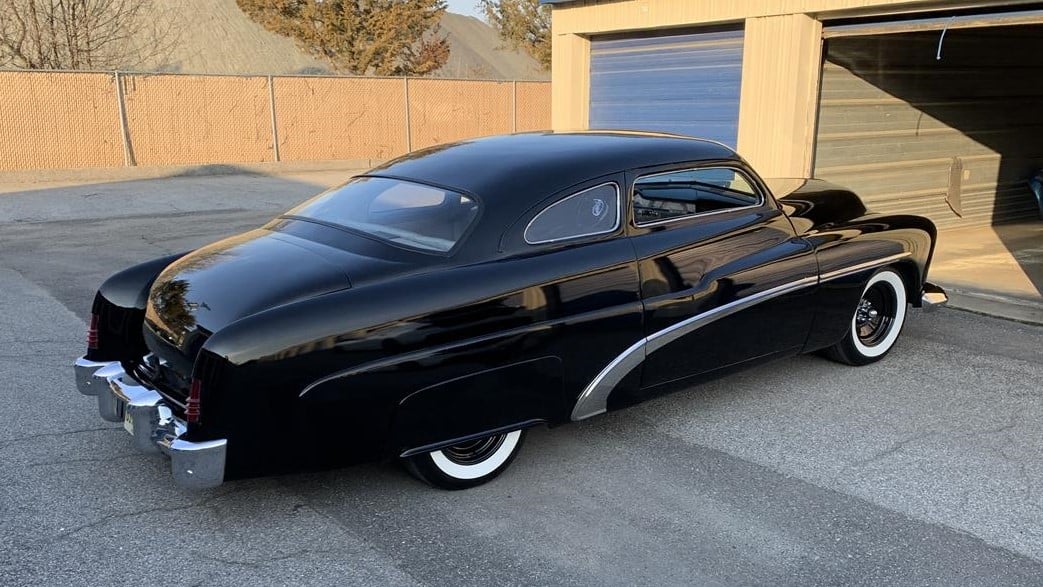
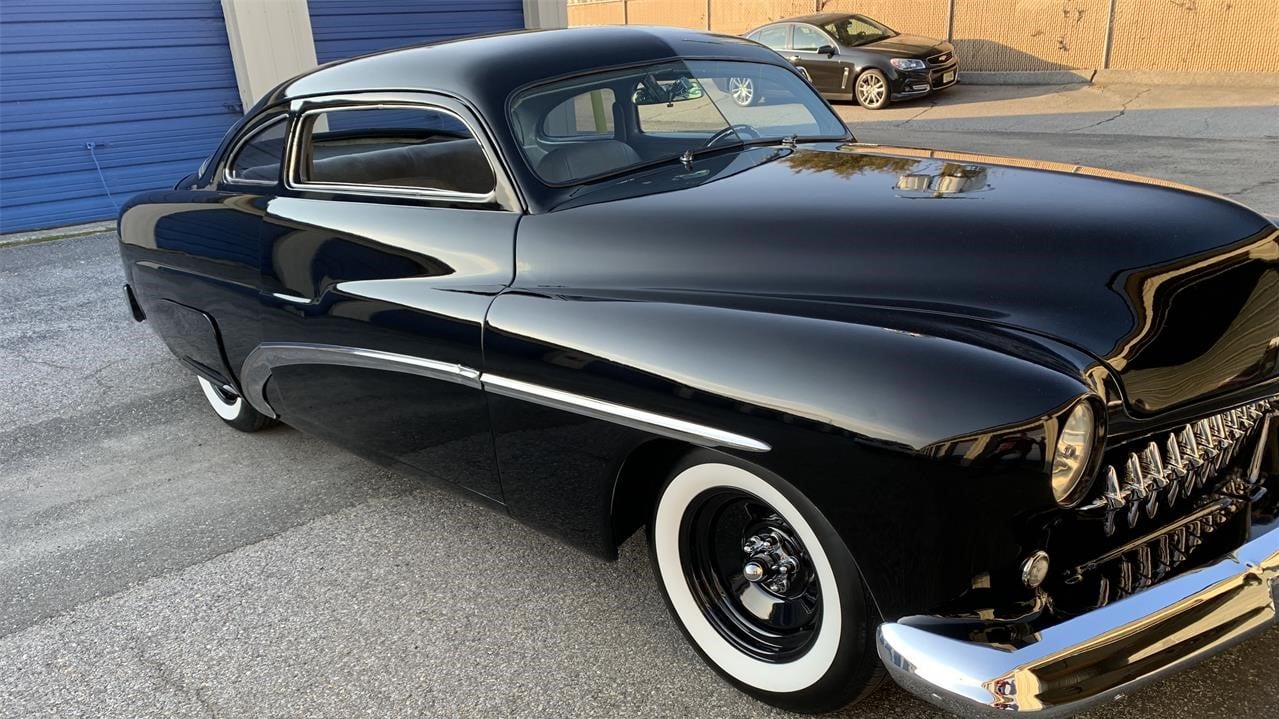
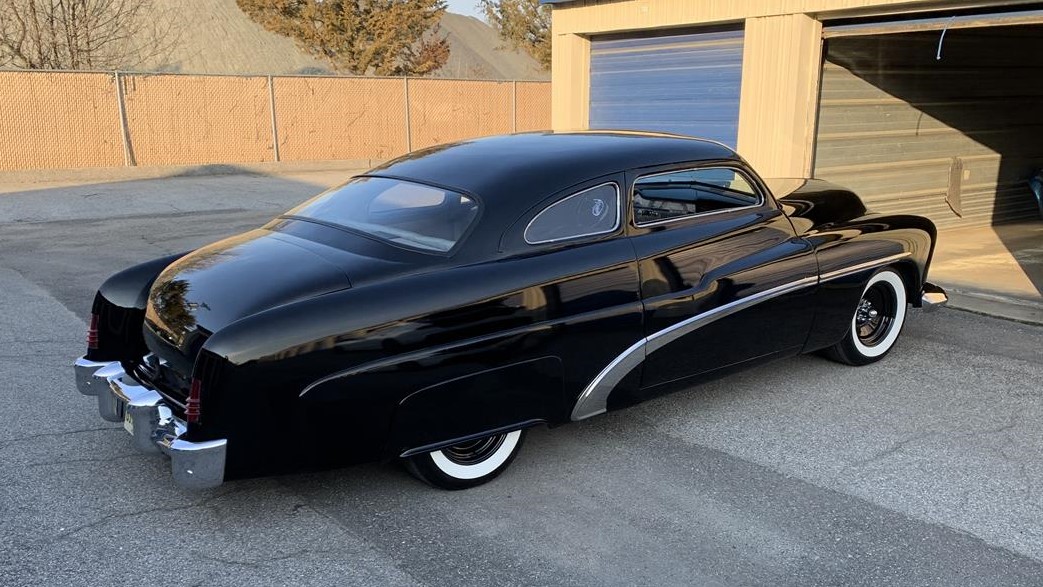
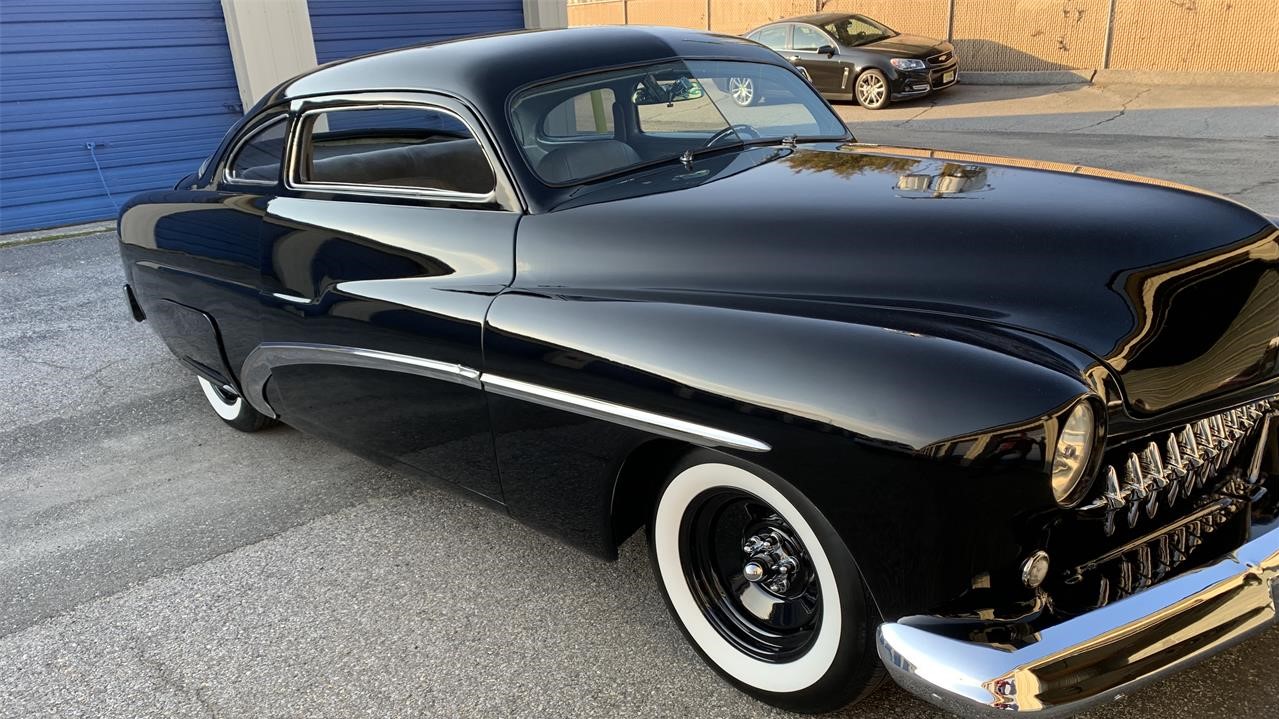
The Pick of the Day is a 1951 Mercury coupe listed for sale on ClassicCars.com by a private seller in Franklinville, New Jersey. (Click the link to view the listing)

The stealthy blacked-out appearance of this lead sled is accentuated by a beveled windshield, curved side moldings, and a dual exhaust system. “Chopped, shaved, nosed, decked,” the listing states. There isn’t much on this old coupe that hasn’t been given some sort of custom treatment.

This car is part of the Mercury “Eight” lineup of vehicles that became the first all-new postwar models from the brand beginning in 1949. The body at the time took on pontoon styling which eliminated the use of running boards and separate fenders. During that era, power for the Eight came from a 255cid flathead V8 paired with a three-speed manual transmission. However, as we would expect, today’s car leaves that dated powerplant behind.

In its place is a much more performance-oriented powerplant: a Chevrolet LS2 V8. This popular 6.0-liter engine was rated at 400 horsepower and 400 lb-ft of torque when it appeared in the C6 Corvette, the Pontiac GTO, and the Cadillac CTS-V. The transmission in the Mercury is similarly upgraded to a 4L65 four-speed automatic unit. This car clearly has the “go” to back up its “show.”

The chassis and braking systems received upgraded content in the form of four-wheel disc brakes and a coilover suspension. On the interior, the cabin features gray vinyl bucket seats and a custom center console, with added content like Vintage Air climate control, Dakota Digital instrumentation, power windows, and a Bluetooth-connected stereo system. The whitewall tires are new, too, so this car is ready to rock and roll.

Mid-century Mercury models continue to be popular with customizers in the modern era, and this car is a perfect example of a clean build that combines a vintage framework, a modified sleek profile, and modern underpinnings. This coupe would be right at home as a Sunday driver or as a dedicated show car. It has enough creature comforts to make gangster Al Capone feel right at home!

The seller is asking for $58,000 or the best offer for this hot rod.

To view this listing on ClassicCars.com, see Pick of the Day.

Today’s vehicle spotlight is proof that you can combine mobster looks with modern features.

The Pick of the Day is a 1951 Mercury coupe listed for sale on ClassicCars.com by a private seller in Franklinville, New Jersey. (Click the link to view the listing)

The stealthy blacked-out appearance of this lead sled is accentuated by a beveled windshield, curved side moldings, and a dual exhaust system. “Chopped, shaved, nosed, decked,” the listing states. There isn’t much on this old coupe that hasn’t been given some sort of custom treatment.

This car is part of the Mercury “Eight” lineup of vehicles that became the first all-new postwar models from the brand beginning in 1949. The body at the time took on pontoon styling which eliminated the use of running boards and separate fenders. During that era, power for the Eight came from a 255cid flathead V8 paired with a three-speed manual transmission. However, as we would expect, today’s car leaves that dated powerplant behind.

In its place is a much more performance-oriented powerplant: a Chevrolet LS2 V8. This popular 6.0-liter engine was rated at 400 horsepower and 400 lb-ft of torque when it appeared in the C6 Corvette, the Pontiac GTO, and the Cadillac CTS-V. The transmission in the Mercury is similarly upgraded to a 4L65 four-speed automatic unit. This car clearly has the “go” to back up its “show.”

The chassis and braking systems received upgraded content in the form of four-wheel disc brakes and a coilover suspension. On the interior, the cabin features gray vinyl bucket seats and a custom center console, with added content like Vintage Air climate control, Dakota Digital instrumentation, power windows, and a Bluetooth-connected stereo system. The whitewall tires are new, too, so this car is ready to rock and roll.

Mid-century Mercury models continue to be popular with customizers in the modern era, and this car is a perfect example of a clean build that combines a vintage framework, a modified sleek profile, and modern underpinnings. This coupe would be right at home as a Sunday driver or as a dedicated show car. It has enough creature comforts to make gangster Al Capone feel right at home!

The seller is asking for $58,000 or the best offer for this hot rod.

To view this listing on ClassicCars.com, see Pick of the Day.

The 500,000th Mercedes-Benz G-Class rolled off the production line on Thursday at the SUV’s plant in Graz, Austria.

The milestone comes 44 years after the civilian version of the G-Class made its debut, and as a sign of the vehicle’s growing popularity, the last 200,000 examples were built in just the previous six years.

To mark the milestone, the 500,000th example is a special one-off design with elements mimicking an early G-Class, specifically a 1986 280 GE. Key retro cues include the agave green exterior paint (one of the earliest colors available on a G-Class), checkered fabric on the seats, and orange lenses for the indicator lamps. The design of the steering wheel and spare wheel cover also feature classic cues, according to Mercedes.

The G-Class, which draws its name from gelandewagen, the German word for “off-road vehicle,” was conceived as a military vehicle. However, Mercedes and the Austrian firm Steyr-Daimler-Puch began discussions about a civilian version of the SUV as early as 1969.

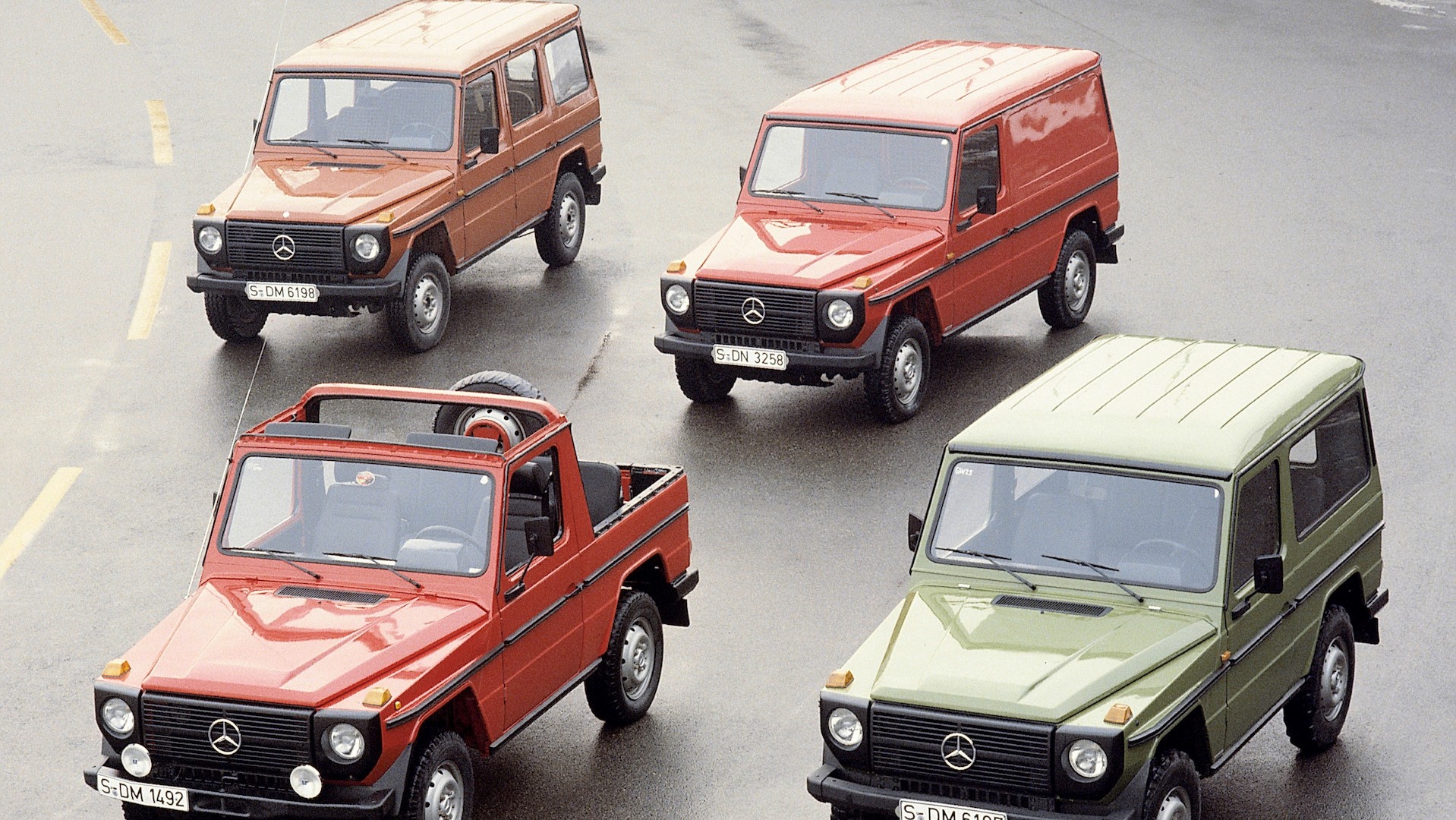
1979 Mercedes-Benz G-Class lineup

By 1972, the decision was made to develop one and in the spring of 1979 the first civilian G-Class was launched. Steyr-Daimler-Puch was responsible for production, right up until 2001 when the company was dissolved. However, its vehicle manufacturing operations were taken over by Canada’s Magna International and turned into the new division Magna Steyr, which today still builds the G-Class for Mercedes.

Over the decades, the G-Class has been updated while keeping its look and feel unchanged—a philosophy that will be tested next year when the first electric G-Class is launched.

HIGH-RES GALLERY: 500,000th Mercedes-Benz G-Class is completed – April, 2023

This article was originally published by Motor Authority, an editorial partner of ClassicCars.com

Today’s feature on AutoHunter Cinema is a twin-turbocharged Ferrari-powered 1968 Ford Mustang nicknamed “Corruptt” – yes, two Ts for twin-turbocharged. This wild mashup of two stallions was built by Tony Arme of American Legends Hot Rods and Musclecars. Power comes from a twin-turbocharged Ferrari F136 V8 (the one used in the F430), though it runs an F149 California intake due to the front engine placement. Power is a robust 700 horsepower on a stand-alone ECU. Aside of the unique powerplant, both the Mustang’s exterior and interior have also been heavily modified starting with a 2.5-inch chop of the roof, flush glass and custom acrylic taillights, plus other custom aluminum and carbon fiber components finished with 3D printing and CNC machining.

Watch more AutoHunter Cinema videos, and get updates on the latest by subscribing to the YouTube channel.

The second trailer for “Fast X,” the 10th installment of the “Fast and Furious” franchise, was released on Wednesday and gave us a better look at some of the cars that are set to appear.

It follows an initial trailer that was released in February.

The new movie is due in theaters on May 19. Many original characters will return to join some new ones, including the new villain, Dante Reyes, played by Jason Momoa. Reyes lost his family during the bridge chase from “Fast Five,” and he’s out to get his revenge. Another new face is Brie Larson, playing one of the good guys.

As for the cars, naturally the 1970 Dodge Charger R/T, the favorite of Vin Diesel’s character, Dominic Toretto, makes an appearance. Other classic muscle that will appear includes a Chevrolet Impala, a Chevrolet El Camino, and a Ford Fairlane. Modern cars will include a Dodge Charger SRT Hellcat Redeye Widebody, a 997-generation Porsche 911 GT3 RS, a Lamborghini Gallardo, and even a McLaren Senna.

There’s expected to be an 11th movie that will share an overarching story with this one and wrap up the main plot of the franchise—which goes all the way back to 2001’s “The Fast and the Furious.” Diesel said in a 2021 interview that the 11th movie—tentatively scheduled for a 2024 release—will be the end of the main storyline. However, that still leaves room for spinoffs like 2019’s “Hobbs and Shaw.”

However, Hobbs and Shaw might be over as Dwayne “The Rock” Johnson, who plays the titular character Luke Hobbs, decided to quit the “Fast” franchise after the ninth movie, despite some attempts by franchise stalwart Diesel to get him back.

This article was originally published by Motor Authority, an editorial partner of ClassicCars.com

On September 8th through the 10th, the Goodwood Revival is celebrating Carroll Shelby’s life on what would be his 100th birth year. The 2023 event is also commemorating 75 years of the Motor Circuit and 25 years of the Revival.

Carroll Shelby began racing cars in 1952, before the days of fire suits, when drivers counted on being thrown from the vehicle to avoid fatal impact. During his racing career he won Le Mans as both a driver and a team owner. Heart problems ultimately forced him to halt racing 1960, which was when he diverted his attention to performance and sports car building, his most famous builds being the Shelby Cobra and the Shelby Mustang. He passed away in 2012 at the age of 89 as an automotive legend with enough accomplishments and unforgettable stories under his belt to fill a museum.

England’s Goodwood Revival will honor the legend, his cars, and even the airplanes he flew while he was an instructor in WWII. It’s not clear which planes will make an appearance, but Shelby flew several, including the B-25 Mitchell bomber, Douglas A-26 Invader, and the long-range, high-capacity B-29 bomber.

In a press release from the Evening Post, Shelby’s grandson Aaron Shelby said, “Goodwood held a very special place in my grandfather’s heart… We’re honored that the Duke of Richmond and his team have chosen to honor the 100th anniversary of Carroll’s birthday this year.”

“It’s such a privilege to be celebrating Carroll Shelby at the Goodwood Revival this year,” said the Duke of Richmond, Goodwood’s host. “He was a good friend and I remember when Carroll first came to the Revival back in 2000—having raced and famously won at Goodwood in the 1959 TT—bringing with him his infectious personality and competitive spirit. It will be wonderful to see those glorious cars that Carroll raced and designed in action at Goodwood once again over the weekend.”

For those needing to plan ahead, tickets for the Goodwood Festival are already available at Goodwood.com.

Every April, the tourist town of Pigeon Forge, Tennessee fills to capacity with all types of cars and trucks. The Pigeon Forge Rod Run happens twice a year (Spring and Fall) and it never fails to draw a huge crowd of enthusiasts. The event has an interesting formula for success, and it has a lot of history in the foothills of the Great Smoky Mountains. Although it is known as the Rod Run, the event went by another name for most of its early years. It was originally held in Gatlinburg, Tennessee, another nearby tourist town. It was first an unofficial gathering that grew into a huge street party that led Gatlinburg city officials to push the event out of town in 1982. The next town over, Pigeon Forge, was a growing tourist town with the Dollywood theme park and many other attractions and welcomed the hot rods to town for the 1983 event.

1.Chris Ryan’s 1966 Corvette coupe features a deep green hue, covering flawless bodywork. Horsepower comes from a stack-injected LS engine.

At the time, the event was known as the Grand Run, as the show was held at the Grand Hotel and Convention Center, but most folks called it the Rod Run even back then. As the event grew, MCS Promotions took over the event and added a spring event to the schedule. In 2014, the event moved to the new LeConte Center, and the name officially changed to the Pigeon Forge Rod Run. The LeConte Center is the perfect home for the Rod Run, as it provides indoor and outdoor space for hundreds of cars and hundreds of vendors. The event is held Thursday through Saturday, and there are lots of great awards for the hot rods, muscle cars and classic cars in attendance. In addition to the awards is the Dirty Dozen, a special invitation-only feature area organized by ScottieDTV. High-end, head-turning builds make up the Dirty Dozen, but that’s just a fraction of the show cars on display at the LeConte Center.

Nova funny car custom

1.The Pigeon Forge Rod Run is known for its wild builds, and this Nova funny car is a prime example. It features a twin-blown big block Chevy engine, and rumor has it this Nova was spotted driving on the street after the show closed.

We enjoyed the weekend of activities at the Spring Pigeon Forge Rod Run and assembled this gallery of photos from the show field. Stay tuned for another coverage of the action that takes place outside of the show. Every available parking place in town is packed with old cars, and people love to get out and cruise when the sun goes down. If you want to see the Pigeon Forge Rod Run for yourself, mark your calendar for the fall event, which takes place September 12-14, 2023 or check out www.rodrun-pigeonforge.com for more information.

Cars from the 2023 Spring Pigeon Forge Rod Run

One of the greatest thrills in the car community is opening the rusty, creaking doors of an old barn or garage and finding a forgotten car that was sitting there for decades. These barn finds were been considered lost by many. There was nothing but legends claiming their existence. They often need restoration projects to be presentable, but they’re well worth the time and money.

The rarest classic car barn finds were someone’s pride and joy at some point. Yet they were forgotten and neglected for years. The internet is full of such stories. Enthusiasts have even scored high-profile barn finds such as Ferraris or Rolls Royces as a result. Some car archeologists even strike gold by finding a multimillion-dollar machine. Other barn finds uncover relatively ordinary cars that were just left to rot. Today, we’ll spin the tales of the most impressive barn finds and the stories behind these fantastic cars rescued from hiding.

Photo Credit: Legendary Motor Cars

Shelby Cobra 289

This barn find deserves a special place since it inspired a book called “Shelby in a Barn” and started a worldwide fascination with uncovering rare cars. The Shelby 289 is the first car by Carroll Shelby and a fantastic piece of automotive history. The small-but-powerful American V8 in a light and nimble European body proved a match made in heaven. Soon, this roadster started dominating domestic championships by beating Corvettes, Ferraris, and Jaguars (via Legendary Motor Cars).

Photo Credit: Auto Week

However, a small number of road-going Cobra 289s were made, and they were expensive and sought after by collectors. This particular car was bought in Indianapolis in 1963. After a few years of use, it was parked in the barn, where it spent a long time amongst the farm animals. Shelby collector Bob Weaver found it and documented the process.

The post Hidden Gems: The Coolest Classic Car Barn Finds Of All Time appeared first on Motor Junkie.