If you’re of a certain age, do you remember “art house movies,” flicks that were rated X due to “adult situations” but were not necessarily pornographic? Our Pick of the Day features a color that’s named as an homage to one of those movies. This 1971 Plymouth ‘Cuda convertible is listed for sale on ClassicCars.com by a dealership in Celeste, Texas.

The movie in question was from Sweden. Swedish movies were a popular way to see something subversive, but subversive is all relative—many things back in the 1960s seem tame today. And that’s quite true about “I Am Curious,” a series of two movies that would have given the Church Lady a conniption. There actually were two versions of this movie: “I Am Curious (Blue)” and “I Am Curious (Yellow)”, with the former featuring a timeline surrounding the latter. The pair of movies was intended to be seen consecutively, but that’s not how things ended up. Though nothing worse than an R by today’s standards, “Yellow” aroused the consternation of authorities and was banned in Massachusetts, leading to a SCOTUS case; the tamer “Blue” is possibly responsible for creating the term “blue movie.”

When the Chrysler Corporation was creating new High Impact colors for 1971, there were several carry-overs and one new hue. Continuing from 1970 was (Plymouth/Dodge) In Violet/Plum Crazy, Tor Red/Hemi Orange, and Sassy Grass Green/Green Go; returning from 1969 was Bahama Yellow/Butterscotch. The only brand-new color was Curious Yellow/Citron Yella. Curious Yellow had a bit of green in it compared to 1970’s Lemon Twist/Top Banana, though the latter would be reintroduced in September 1970, soon after the 1971 model year began. Why the need for two bright yellows? Apparently, the Chrysler Corporation had its reasons.

To these eyes, Curious Yellow was the more interesting yellow of the two, plus it was named after a movie that showed some skin—I bet every teenage boy giggled and teenage girls rolled their eyes. Even better, this was a High Impact color that was not restricted to certain Plymouth and Dodge models—it was available for Furys, Polaras, and Monacos, something that was an exception more than a rule.

You’re welcome to argue with me if you wish, but Curious Yellow never looked better than it did on the Plymouth Barracuda. The Barracuda featured a heavy facelift for 1971 with quad headlights, parking lights that moved to below the bumper, simulated front fender louvers (on ‘Cuda models), and separated brake and reverse lights. Grilles were argent aside from certain ‘Cuda models depending on the paint chosen. The formerly standard road lamps were now optional on the ‘Cuda, and still available for regular Barracudas and Gran Coupes. A new stripe design, today known as the “Billboard,” was more outrageous and clearly outdid anything from Brand X. However, the buff books didn’t like the new styling, and an evolving market ended up demanding much fewer Barracudas than in 1970.

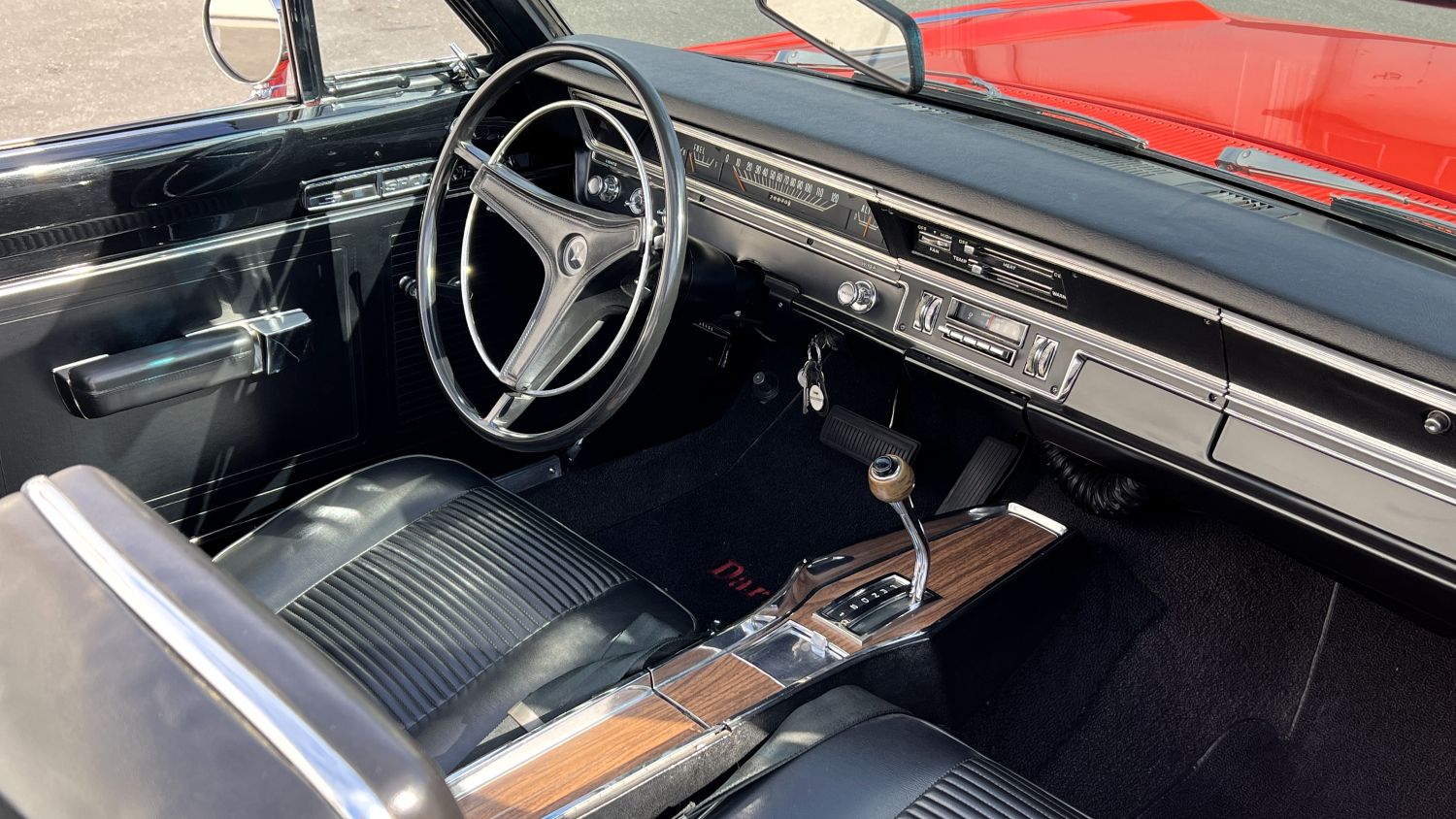
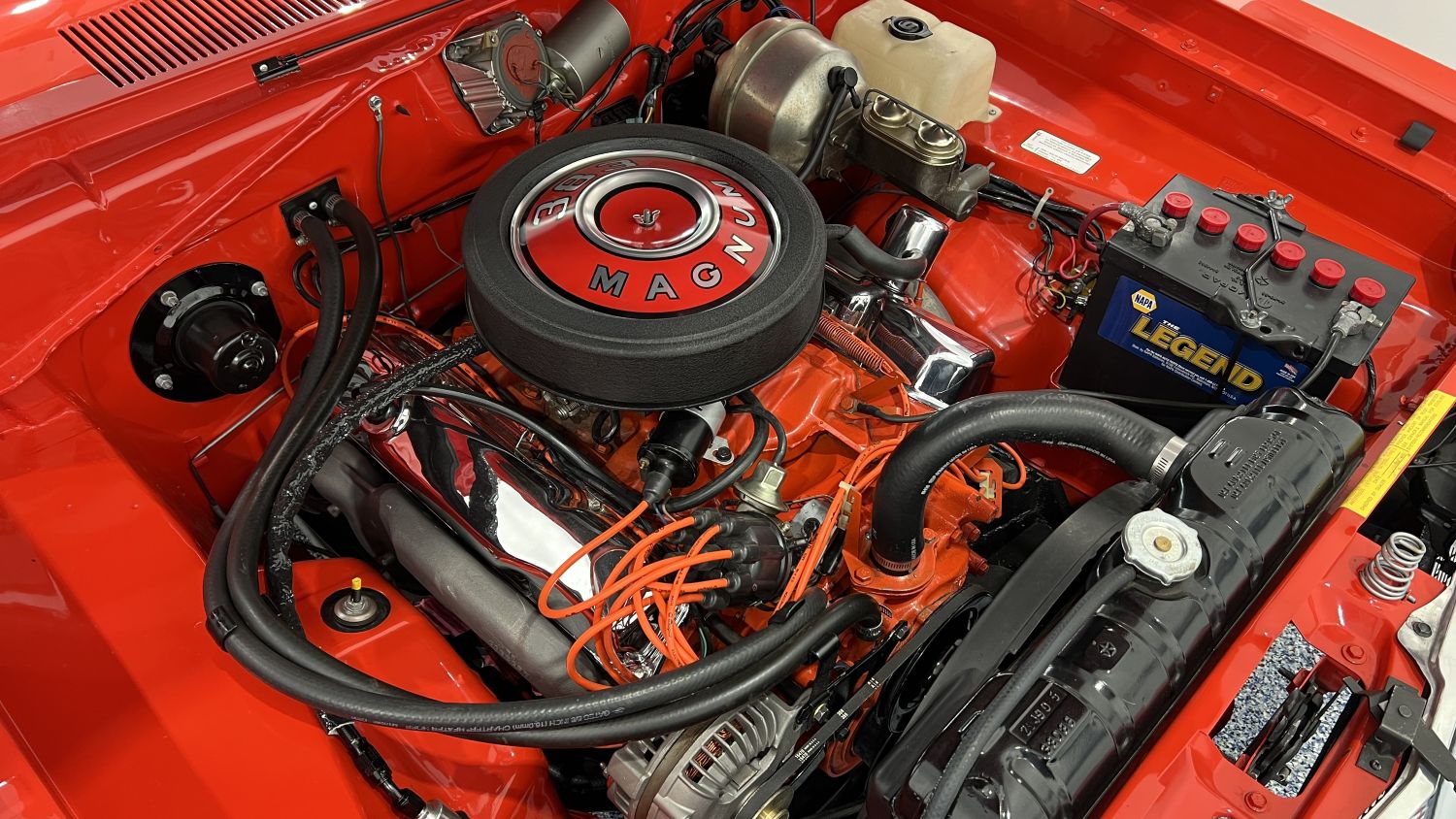
The 1971 Plymouth ‘Cuda convertible is one of the most desirable muscle cars, and one sprayed in Curious Yellow likely would command a premium. Truth be told, this example was originally painted in “GF7” Sherwood Green metallic with a white interior and top. However, check out the other options and you’ll see this car would be hot no matter what color: 340 four-speed, Shaker hood, rear wing, Rallye dashboard, and more. Aside from the color, Billboards and “A21” Elastomeric Front Bumper complete the package to make this car look as hot as a Barracuda could be. “The underside is just as gorgeous as the top, every brake/fuel line is new or redone. All suspension is painted or powder coated,” says the seller. “Everything works! Every light, every gauge, wipers and window washers, radio, horn, etc.”

When the industry was trying to get away from loud, horsepower-laden vehicles, along came the ‘Cuda to challenge the morals of America. If you decide to pay the $198,500 asking price, you can color me jealous.

Click here to view this Pick of the Day on ClassicCars.com

This ’32 Zipper Roadster was built around 2001 using Zipper Motorsports pinched ’32 frame rails, a fiberglass Zipper body with a removable hardtop, and a hand-formed aluminum hood. Painted PPG yellow with a gold pearl coat, the car rides on a fully independent suspension with a Kugel Komponents front end, a polished Dutchman rear end, four-wheel disc brakes, and chrome alloy wheels. The 351ci V8 was built with aluminum heads, Zoomie headers with cutouts, and a polished intake manifold, and it is linked to a built AOD automatic and a 3.56 rear end with a Detroit Locker. The interior features black upholstery, yellow accents, a tilt wheel, a custom sound system, a Lokar pedals. The car was featured in Street Rod Builder in 2004, which included a pull-out poster of the car, and is claimed to have cost over $250k to build. This 1932 roadster is now offered on dealer consignment with service records and a clean Utah title.

The Zipper fiberglass body is mounted on a pinched ’32 Zipper frame and features a removable hardtop, hand-formed aluminum hood, PPG yellow paintwork with a gold pearl coat, LED lighting, and a chrome rear nerf bar.

The independent front end is from Kugel Components and uses inboard pushrod-activated coilovers, polished tubular A-arms, and Borgeson power rack-and-pinion steering. The four-link Dutchman rear end has a Strange Engineering center section, polished axles, and coilovers. Wilwood calipers are paired with discs all around.

The chrome-plated OZ Racing wheels measure 16″ up front and 17″ out back, and they are mounted with staggered Pirelli rubber.

Denny Nish Interiors did the custom black interior and yellow accents. Black wool carpeting lines the floor, and the Custom AutoSound stereo is linked to a Rockford Fosgate amplifier, a Polk Audio subwoofer, and Diamond component speakers. The pedals are from Lokar, and a Snap-On tool kit is concealed in the bulkhead.

The carbon-fiber dashboard was made by “Starvin” Marvin Miller and houses Stewart-Warner instruments. The custom-wrapped wheel is mounted on a modified Cadillac tilt column. The current owner has driven the car ~300 of the 1,100 indicated miles.

The 351ci V8 was built with aluminum heads and a polished intake manifold, and the oil pan was custom-made, as were the Zoomie headers with cutout. The Griffin radiator is cooled by a SPAL fan. The carburetor was rebuilt in preparation for the sale, and the valve covers were replaced.

Art Carr reportedly built the polished-case AOD automatic with a 2,400-RPM stall converter, and it is linked to the 3.56 Detroit Locker in the Strange Engineering center section.

The 2004 Street Rod Builder feature has a pull-out poster and details of the build.

The car is titled as a 1932 Ford Hi-Boy using VIN 181393622, which is consistent with a 1935 sequence.

This 1967 Volkswagen Beetle was modified in 2020 with a custom-fabricated chassis and a front-mounted 431ci Chevrolet V8 with an Air Flow Research intake manifold, a Holley four-barrel carburetor, MSD ignition components, and long-tube headers. Finished in gold, green, and brown metal flake, the steel bodywork features a chopped roof, a split rear window, and flared wheel arches. Inside, a roll cage has been added along with two-tone vinyl upholstery, a TCI Outlaw shifter, power windows, and Classic Instruments gauges. Other highlights include a TH400 three-speed automatic transmission, bespoke bumpers, wheelie bars, American Racing 15” alloy wheels, an independent front suspension, a four-link rear setup with QA1 coilovers, and four-wheel disc brakes. This custom Beetle was acquired by the selling dealer in 2025 and is now offered with a clean Pennsylvania title.

The roof was chopped during the build, and a split rear window panel was added along with a corresponding engine lid. Grille openings were cut out of the hood, which also has an air scoop.  The quarter windows were filled, and the fenders were extended with flared arches.

Gold metal-flake paint is accented by airbrushed green and brown areas with lace, fish-scale, and other patterns. Custom-fabricated bumpers, early-style headlights, and wheelie bars were also installed.

American Racing 15” alloy wheels are wrapped in 26×8.00” front and 30×12.00” rear Mickey Thompson tires. The car rides on a custom-fabricated steel chassis with tubular control arms, rack-and-pinion steering, and coil springs up front as well as a four-link rear setup with a Panhard rod and QA1 adjustable coilovers. Braking is handled by four-wheel discs with Wilwood rear calipers.

A roll cage has been added to the cabin, which houses bucket seats trimmed in green vinyl with diamond-patterned tan inserts. The upholstery scheme carries over to the headliner, rear bulkhead, and door panels. The rear seat has been removed, and power windows have been installed along with a TCI Outlaw shifter, a polished dashboard fascia, billet door handles, and bound carpets.

The four-spoke steering wheel is mounted to a tilt column and sits ahead of Classic instrumentation consisting of a 140-mph speedometer, an 8k-rpm tachometer, and auxiliary gauges. The five-digit odometer shows 57 miles. The selling dealer states the mileage is not accurate, and total mileage is unknown.

The front-mounted 431ci Chevrolet V8 is equipped with aluminum cylinder heads, an Air Flow Research Eliminator intake manifold, a Holley Ultra XP four-barrel carburetor, an MSD Blaster SS ignition coil, a billet serpentine accessory drive, an aluminum radiator, Craiger-branded valve covers, and long-tube exhaust headers. Output is estimated to be greater than 600 horsepower.

A fuel cell is mounted in the former engine compartment.

The TH400 three-speed automatic transmission has a finned oil pan. Corrosion is visible on underbody components, which can be viewed in the gallery.

The car is titled using the VIN 117772237, which appears on the identification plate shown above and is consistent with a Volkswagen Beetle produced for the 1967 model year.

Have you ever heard of the concept of “slow car fast”? As it turns out, the fun-factor associated with driving a car doesn’t have to be dependent on its horsepower statistic. In some cases, pushing a lesser-powered vehicle at or near its limits can feel about as invigorating as dipping into the throttle of an all-out exotic supercar.  

CRX Background

The Honda CRX came at a time when motorists had dealt with ongoing energy/oil crises throughout the 1970s and were adopting small, fuel-efficient cars. The CRX was produced from 1984 to 1991 and was praised for its peppy driving experience combined with class-leading fuel efficiency. At its core, it was a simple, two-seat, front-wheel drive compact with sporting aspirations. But “sporty” could only so far, since the most performance-oriented model (in the United States, anyway) was a 108-horsepower, 1.6-liter “Si.”

There were two distinct generations (1984 through 1987, and a slightly rounded-off 1988 through 1991). Drivetrains and engineering features were largely shared with the more contemporary Civic, but the CRX weighed only about 1,800 to 2,100 pounds, so it had a distinct power-to-weight advantage over other models in the Honda lineup. That meant that it was capable of hybrid-like fuel economy. One trim level in particular, the HF (for “high fuel”), had an eight-valve 1.5-liter, taller gearing, and extensive weight-savings measures. It was rated at over 50 miles per gallon on the highway – and this was back in the 1980s!

Worth adding – although not marketed explicitly as a CRX in the United States, the 1993-through-1997 del Sol (a two-seater with a removable rooftop) did carry the CRX nameplate in some markets around the world. We will revisit that unique model another time.

Greg’s Collectible CRX

In recent years, the CRX has gained strong momentum in the collector community, and well-kept, low-mileage, unmodified examples are sought after. My friend Greg is no stranger to the platform since he’s owned several CRXs – and keeps coming back for more.

Greg’s current pride and joy is a Rio Red 1990 (which he dubbed the “Rex”) showing only 50,556 miles on the odometer. The car’s background is a classic “little old lady” story: It was owned by its original owner in Louisiana from 1990 through 2025 before finally being set free after 35 years. First delivered to Holmes Honda World in Shreveport, the car had a retail price of $11,390. Dealer-added equipment on top of that included air conditioining, an AM/FM cassette, and floor mats. Today, the car retains its original D1616 SOHC 1.6-liter which received a new timing belt, valve cover gaskets, and a battery earlier this year.

Greg brought his low-mileage CRX out for an informal “all-red-car” meet-up where I displayed my 1992 Acura NSX and my friend Eric showcased his Mugen-upgraded 1987 Acura Integra. Even under overcast skies, the trio looked eye-catching – and we couldn’t help but agree that the CRX, Integra, and NSX represent what many consider to be “Golden Era” vehicles for Honda.

For being a relatively slow car (on paper, anyway), the CRX is a total grin-machine, and the car helped put Honda on the map when it came to driving enthusiasts. Are you a current or prior CRX owner, and what has your experience with the model been like?

Dagmar is a Scandinavian name, usually given to females but it has a history of unisex usage. It’s also an artillery-shell-inspired bumper guard with a name taken from a buxom 1950s actress. Dagmars was a styling trend that came and went.

Below we have four images of Dagmars from several cars listed for sale on AutoHunter or ClassicCars.com. Can you tell us the model year and make of each? Cheaters can simply click on an image to find an answer for each.

Click on a photo to reveal each car

It’s Tuesday, which means The ClassicCars.com Journal has a fun automotive game to test your knowledge. Once you’re done with this one, you can play past puzzles.

When it came to sporty, affordable compacts of the 1960s, the Falcon—and its “formula” (parts-wise)—set the stage for the Mustang that followed. Featured on AutoHunter is a 1963 Ford Falcon Sprint Coupe that shares much of the spirit of Ford’s famous pony car, yet it came off the assembly line just a little earlier. The car is being sold by a dealer in Gladstone, Oregon, and the auction will end on Wednesday, December 24, 2025, at 11:45 a.m. (MST).

Finished in Corinthian White over a black vinyl interior, the car was restored to original specs. Exterior features include a hood scoop, an antenna, dual mirrors, side moldings, and dual exhaust outlets. The contrasting black vinyl interior presents well, offering bucket seats, a center console, and an AM radio.

The Falcon was produced from 1960-70, and the model marked Ford’s brave foray into a small-car segment. Still, Ford executive Robert McNamara (who later went on to become the U.S. Defense Secretary) had faith in the concept. And his confidence was warranted—the Falcon sold over half a million cars its first year.

In its early years, each Falcon’s window sticker said, “The dollars you invest in this model will be the hardest-working dollars you’ve ever spent. Enjoy Ford quality craftsmanship today—and for many long years to come.” Thus, the theme of the Falcon’s marketing centered around the car’s value. One of the television advertising campaigns included Charlie Brown from the comic strip “Peanuts,” saying “They’ve got savings, they’ve got beauty, they’ve got comfort, they’ve got low prices. You’ll enjoy more from the car America loves most.”

Power for this Falcon comes from a reportedly numbers-matching 260ci V8 mated to a C4 three-speed automatic transmission. Ford rated the engine at 164 horsepower and 258 lb-ft of torque when new.

Did you know that the Falcon Club of America was founded in 1979 and has grown to thousands of members worldwide? Much like other enthusiast groups (for example, the National Acura Legend Meet, which I’ve attended for 20 years), the FCA was established to bring owners together for an exchange of ideas, technical information, and parts resources. President Billy Pope ends each of his messages with “Happy Falconing.”

What better car to choose for your future “Falconing” than a well-kept Sprint?

The auction for this 1963 Ford Falcon Sprint Coupe ends Wednesday, December 24, 2025, at 11:45 a.m. (MST).

Visit the AutoHunter listing for more information and a photo gallery

If you’re reading this right now, you probably have all your Christmas shopping done and the presents are wrapped and under the tree. But what will you be receiving? Socks? A membership to the Jelly of the Month Club? If you’ve been wanting a project car to start working on next year, take a look at our Pick of the Day. You can find this 1974 Lamborghini Espada listed on ClassicCars.com by a dealer in Philadelphia.

The Espada (Spanish for sword, the weapon the matador uses to kill a bull) made Ferruccio Lamborghini‘s idea of a fast car that was also comfortable and luxurious into a reality. Influenced by the 1967 Marzal gullwing concept car, the Espada debuted at the 1968 Geneva Motor Show with a longer and wider version of the 400 GT’s chassis and distinctive styling by Carrozzeria Bertone‘s Marcello Gandini.

Lamborghini went on to make approximately 1,220-plus Espadas (the automaker’s own production numbers vary) across three series from 1968 until 1978. All of them were powered by a front-mounted 4.0-liter DOHC V12 paired with six Weber carburetors. Output started at 325 horsepower, but increased to 350 two years later. Initially, a Lamborghini-made five-speed manual gearbox was the only transmission available, but the very American TorqueFlite three-speed automatic became an option in 1974.

This 1974 Espada is a Series III, which spanned model years 1973-78 and came standard with the previously optional power steering. According to the selling dealer, it’s “believed to be a one owner example based upon the circumstances of our acquisition and the one owner designation on the NJ title we received.” It adds that this 34,521-mile “example is finished in its factory color scheme of Arancio over beige, a rare and desirable specification.”

Clearly, this Lambo has a patina, and a comprehensive mechanical service or even a total rebuild would be a wise investment. The good news is that this project car is not just a body shell with a gutted interior and an empty engine bay—everything seems to be in place.

Once you buy this 1974 Lamborghini Espada for $62,000 (OBO), you can figure out the rest. Do you have a restoration shop or know of one that can do this car justice? Maybe you have the funds to send it straight to Lamborghini Polo Storico. Or perhaps you and your significant other and/or children can turn this Italian machine into a family experience and rolling legacy.

Click here to view this Pick of the Day on ClassicCars.com

This 1930 Ford Model A is a steel-bodied coupe that was built by the seller into a hot rod. Power comes from a built 302ci V8 topped by aluminum heads and an Inglese intake manifold with four dual-throat Weber carburetors, and it is linked to a T-10 four-speed manual transmission and 12-bolt rear end with an Eaton 3.73 limited-slip differential. The car rides on a drop front end with drilled radius rods, a Speedway drum kit, and Saginaw cowl steering, and the rear uses a triangulated four-link setup with coilovers. The steel body was chopped ~6″, and the interior features custom details, bucket seats, auxiliary gauges, and a quick-release steering wheel. This hot rod is now offered with records and a clean New Jersey title in the seller’s name listing the car as a 1930 Ford.

The seller tells us the Ford steel body’s roof was chopped 6″ and filled, and it is mounted on a custom-fabricated chassis with hand-made floors. The tilt-out windshield uses safety glass, and the front turn signals are integrated into the headlights.

The Super Bell drilled 4″ drop axle is paired with a transverse leaf spring, and the split wishbones are also drilled. A triangulated brace is mounted under the front frame, the front drum kit was sourced from Speedway, and the cowl steering system uses a Saginaw box. The four-link rear end uses triangulated radius rods with Heim joints and QA1 coilovers. Cheater slicks are mounted on the powder-coated black steel wheels.

The custom-made metal bucket seats have black pads and spade-motif accents, and the shifter has a crank-style rod and a skull knob.

The steering wheel is drilled, and netting is fitted over the bare doors. An AutoMeter speedometer was used along with a Quick Car tachometer, auxiliary gauges, and ignition panel. The seller estimates he has driven the car 2,000 miles.

The seller tells us the 302ci was rebuilt with a Howards Cams roller camshaft and lifters, and ProMaxx aluminum heads were fitted along with Ford Racing-logo valve covers and Shoenfeld headers. The Inglese intake manifold is topped by four dual-throat Weber carburetors with velocity stacks.

The seller tells us T-10 four-speed manual is fitted with a Quicktime bellhousing, and the 12-bolt rear uses an Eaton 3.73 limited-slip differential and Moser axles. Both units were rebuilt by the seller. Additional build photos are provided in the gallery.

The car is titled as a 1930 Ford using VIN 20198X.

This 1939 Ford Deluxe Tudor sedan was acquired by the seller in 2024 from the estate of its former owners, who built it into a street rod. The body had been repainted metallic blue and it had been fitted with a 350ci V8 and a three-speed automatic transmission. Following the seller’s acquisition, the Holley carburetor was rebuilt, the disc/drum braking system was overhauled, a banjo-style wheel was installed, and Hankook tires were mounted on the staggered Torq Thrust-style wheels. The car is further equipped with bucket seats, a B&M shifter, a custom sound system, a tilt column, and VDO gauges. This ’39 Tudor street rod is now offered with a Texas title in the seller’s name.

The Tudor sedan body was repainted metallic blue by its former owners around 2016, according to what the seller was told. The seller notes holes from removed trim were filled as part of the work, and recommends that the right door, left hood, and left-front lower fender would benefit from paintwork. LED lights have been fitted.

The seller tells us they overhauled the braking system, which features front discs and rear drums, and they mounted 185/75 and 215/70 Hankook tires on the staggered Torq Thrust-style wheels. The car has a drop front axle, rear lowering blocks, and front and rear sway bars installed.

The interior was redone with insulation, Mustang-sourced powered bucket seats, a chrome B&M shifter, a center console with faux Ostrich upholstery, and a CD stereo mounted in the glovebox.

The banjo-style steering wheel was mounted on a tilt column by the seller. VDO gauges are set in the brushed surround ahead of the driver, with a tachometer mounted below. The seller added ~300 of the 16k miles indicated.

The previous owner installed the 350ci V8, and the seller tells us they rebuilt the Holley carburetor, ignition system, and radiator, and the fuel pump, hoses, and wiring harness were replaced.

The three-speed automatic is linked to a Ford rear end.

The car is titled as a 1939 Ford using VIN 5035635. The title carries a “VIN Certification Waived” remark.

Jeep is going to be busy next year. Ten more special-edition Wranglers are coming in 2026 as part of its Twelve 4 Twelve celebration, which leads up to the brand’s 85th anniversary. Now comes news that the automaker has started its “Convoy” campaign with the 2026 Jeep Gladiator Shadow Ops.

In a press release, Stellantis said, “This initiative kicks off a new chapter for the brand, introducing mission-ready special editions that embody strength, unity and purpose. Leading the charge is Jeep Gladiator Shadow Ops, arriving not by air, but through a ground-led military convoy.”

Based on the Rubicon trim level, the limited-run Shadow Ops model has the cosmetic add-ons you might expect from a special edition. Up front, there’s a Satin Black grille. The hood and fenders have special Shadow Ops decals. At the rear, the tailgate has its own special decal as well as a black taillight-to-taillight stripe. More substantial visual changes include the body-color fenders and Freedom Top three-piece hardtop.

However, Jeep also made sure to equip the Shadow Ops with functional upgrades. Both bumpers are made out of heavy-duty steel. Inside, there are all-weather mats. But the coolest feature is the standard factory-installed front winch, which Stellantis says makes the Gladiator the first midsize truck to offer one.

Adding the Shadow Ops package to a 2026 Jeep Gladiator Rubicon will bump up the price by $4,995 – a $2,605 increase from a Rubicon optioned with the body-color fender flares and Freedom Top. Contrary to the name, Jeep wants you to see the Gladiator Shadow Ops when it rolls into showrooms in February 2026.